
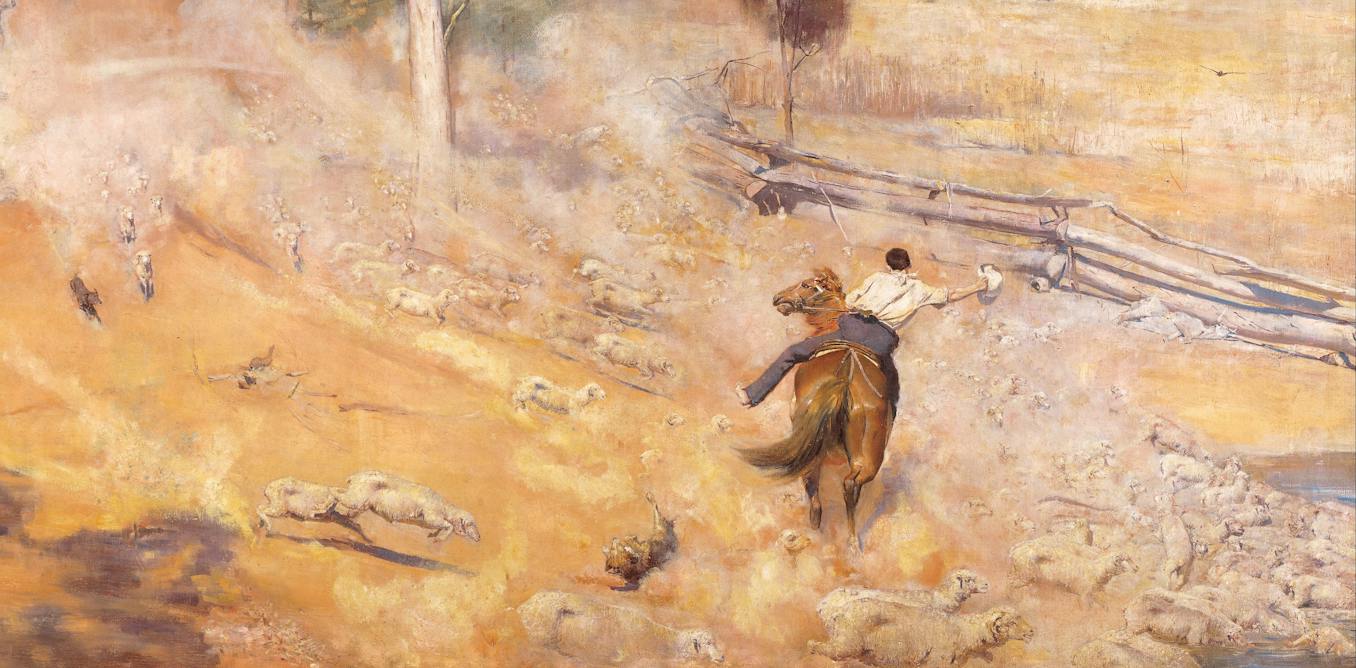
Labelled “Poet of Australia”, a bust of Adam Lindsay Gordon has sat beetle-browed in Poets’ Corner in Westminster Abbey since 1934, about the time his reputation began to slide. This tribute to his significance within the old Empire symbolises why he’s now such a problematic writer in this country. Though he gave bush ballads their name, he appears far too British and far too imperialistic – which is exactly how he would have seen himself. Gordon was born in Cheltenham on October 19 1833. His parents, who were first cousins, had prospered from the Empire. His father served as a captain in the East India Company’s Bengal Cavalry. When he was pensioned off, he returned to England and taught Hindustani to boys hoping to enter company service. From the proceeds of a family plantation in British Guiana, Gordon’s mother brought £20,000 to the marriage. The Gordons were consequently well to do, and Lindsay, as his family called him, always considered himself a cut above. Young Gordon’s school record was nevertheless undistinguished, though he was sporty and excelled at boxing and steeplechase riding. When he failed to curtail these and other more riotous activities, his father was eventually forced to find a character-building post for him in the colonies. In 1853, Gordon sailed off to become a mounted policeman in South Australia. After just two years in the job, however, he returned to what he knew best, earning a casual income breaking horses, with a sideline in trading them, while continuing to ride in steeplechases. As a rider, Gordon was legendary. At Mount Gambier in 1864, he jumped his mount over a fence and onto a narrow rock ledge some 60 metres above the famous Blue Lake – then jumped back over again. In 1887, a commemorative obelisk was erected near the site. In 1861, Gordon’s finances were sufficiently buoyed by the arrival of a £7,000 legacy from his mother’s estate that he could live like a gentleman again, and the next year he married 17-year-old Margaret Park. At “Dingley Dell”, a quaint cottage near Port MacDonell where the couple settled (and which still survives), Gordon began to write poetry seriously for the first time. Bust of Adam Lindsay Gordon in Westminster Abbey. 14GTR, via Wikimedia Commons, CC BY-SA He also entered politics, and became a Latin-quoting, squatter-friendly member of the South Australian parliament. For all his literary talents, he proved an ineffective orator. He resigned after 20 months. Gordon speculated in land, but he wasn’t good with money and his fortune was fast frittering away, not least because of his continued involvement in horse racing. In 1867, an attempt to run sheep in Western Australia ended in failure. His first two books of verse failed to repay his investment in them: the Byronic closet drama, Ashtaroth, barely sold at all, and his first collection, Sea Spray and Smoke Drift, cleared only around a hundred copies. He tried to recover his fortunes by moving to gold-rich Ballarat. There, with a business partner, Gordon rented a livery stable behind the fashionable Craig’s Hotel. This, too, was unsuccessful, as were his efforts to claim the entail of a Scottish estate connected to his family. The death of his toddler daughter and injuries from his steeplechase riding eventually left him depressed, in chronic pain and psychologically adrift. By 1870, Gordon and his wife were living in Brighton, then on the outskirts of Melbourne, where Gordon was well received by other writers, becoming a founding member of the bohemian Yorick Club. Bush Ballads and Galloping Rhymes, his third book, was published on June 23 1870. That same day, he saw an advance copy of a glowing review by his friend Henry Kendall, who was himself poor and miserable at the time. The two may or may not have gone drinking. The next morning, Gordon went to Brighton beach and shot himself dead with a rifle. He was 36 years old. How Australian is he? When introducing a posthumous edition of Sea Spray and Smoke Drift, another friend from the Yorick Club, novelist Marcus Clarke, wrote that the reader would find in it “something very like the beginnings of a national school of Australian poetry”. Marcus Clarke (1866). State Library of Victoria., Public domain, via Wikimedia Commons Yet it’s precisely this question that has dogged Gordon’s reputation: how Australian is he? The fact is that his locally themed poems are mostly restricted to a handful of well known pieces in Bush Ballads and Galloping Rhymes. The rest comprise poems on general subjects or with historical European, notably medieval, settings. These works situate Gordon in the mainstream of 19th-century English poetry, and some are pretty good. The Rhyme of Joyous Garde, for example, is spoken by the guilt-stricken Sir Lancelot, and takes its cue from Alfred, Lord Tennyson’s poetry sequence Idylls of the King (1858–1885). Like Tolkienesque fantasies today, Victorian medievalism often functioned as means of critiquing the modern world, and could draw upon Arthurian legend as an allegory of the course of empire. Gordon’s poetic interest in chivalry gave him a further excuse to write about horses. Gordon’s more conventional works helped sell his exotic bush ballads to the wider English-speaking world, but in this country his Australian poems have naturally commanded most attention. They took off from the 1880s, at a time of rising literacy and growing nationalism, in Australia as elsewhere. Another bush balladist, Barcroft Boake, attested in 1889 that there was “not a bushman or drover who does not know a verse or two” of Gordon’s best loved works. Gordon’s popularity declined after the first world war as literary tastes changed with the rise of modernism. Influenced by the poetry of Algernon Swinburne, Gordon was much given to anapestic meter (dee-dee-DUM, dee-dee-DUM …), a cadence which is excellent for galloping verse involving horses, but whose loping artifice is apt to stale over the long haul. There was also increasing doubt about his skill as a poet. In 1930, extracts from his work were pilloried in The Stuffed Owl: An Anthology of Bad Verse, edited by D.B. Wyndham Lewis and Charles Lee. Rather than Swinburne, Gordon’s more profound debt was to Robert Browning, especially his innovations in the dramatic monologue form. Gordon will sometimes begin a poem in the middle of some kind of quasi-theatrical action. At the beginning of From the Wreck, for example, the reader is instantly grabbed by a confusion of voices signalling something is terribly wrong: “Turn out, boys” — “What’s up with our super tonight? The man’s mad — Two hours to daybreak I’d swear — Stark mad—why, there isn’t a glimmer of light.” “Take Bolingbroke, Alec, give Jack the young mare …” In Wolf and Hound, on the other hand, he ends with a literal bang, when the trooper narrator corners his bushranger foe in a cave, mano a mano: Flash! flash! bang! bang! And we blazed away, And the grey roof reddened and rang; Flash! flash! And I felt his bullet flay The tip of my ear. Flash! bang! Despite the theatrical sound effects (no doubt they sound better in performance), elsewhere the poem depicts the psychology of pursuit with striking realism. For all the emphasis on action in his poetry, Gordon was also good at sturdy maxims of the kind the Victorians loved to assemble in volumes of poetic “beauties” and “gems”. This, from Ye Wearie Wayfarer, was his biggest hit: Life is mostly froth and bubble, Two things stand like stone, KINDNESS in another’s trouble, COURAGE in your own. These lines appear under his bronze statue in Spring Street, Melbourne, unveiled in 1932. In the 1950s, Australian poet A.D. Hope found them carved on the fireplace of the English staff common room of a Canadian university. It’s a mark of how quickly Gordon’s international reputation had waned that no one there had any idea who wrote them. The Sick Stockrider Gordon’s best remembered poem is The Sick Stockrider, in which a dying stockman recalls in vivid images his life in the bush. Once again, he begins by arresting the reader’s attention: “Hold hard, Ned! Lift me down once more, and lay me in the shade. Old man, you’ve had your work cut out to guide Both horses, and to hold me in the saddle when I sway’d All through the hot, slow, sleepy, silent ride.” This surprisingly tender description of physical intimacy between the stockman and his mate invites a queer reading, especially as no female love interest is later mentioned. After all, this is a poem about cowherds, and homoeroticism has been a feature of pastoral verse since Theocritus in the third century BC. Feverish and dying, the stockman has been dozing, but he is still keenly attuned to the landscape through which he and Ned have travelled, and he recognises where they have arrived: Now westward winds the bridle path that leads to Lindisfarm, And yonder looms the double-headed Bluff; From the far side of the first hill, when the skies are clear and calm You can see Sylvester’s woolshed fair enough. These topographical details are characteristic of Gordon’s equestrian poetry. What they tell us is that this is by now a Europeanised landscape. The only two Indigenous place names he mentions – “Moorabinda”, “Katâwa” – are given inverted commas, making them foreign. The speaker then recalls his joy in returning home to the station from a long day in the saddle – “the hardest day was never then too hard!” – and there follows a dramatic account of the “glorious gallop” after the bushranger Starlight, as well as memories of yarning and singing with mates. But the stockman’s mood abruptly shifts to classic ubi sunt (where are…?) mode as he remembers absent friends: There was Hughes, who got in trouble through that business with the cards, It matters little what became of him; But a steer ripp’d up MacPherson in the Cooraminta yards, And Sullivan was drowned at Sink-or-Swim. Other old chums perish from drink or falling from their horse. The daughters of a family he and Ned once knew are now fully grown, with children of their own. This is his only mention of women. For all Gordon’s love of action, there is a powerful melancholy streak running through his work. While this is part of his romantic inheritance, the nihilism that infected his depressive moods is seen in a poem like The Swimmer, where he hopes the sea will take him in like a “weary lover”. Verses from this beautiful poem form the final song in Edward Elgar’s Sea Pictures. In contrast, the dying stockman rallies himself at the end with some sententious last words that include: For good undone and gifts misspent and resolutions vain, ’Tis somewhat late to trouble. This I know – I should live the same life over, if I had to live again; And the chances are I go where most men go. Why should we care about Gordon today? He hasn’t aged well. Unlike even his colonial peers, Charles Harpur and Henry Kendall, he disregarded First Nations people in his verse. And, as Kenneth Slessor pointed out, one could substitute “gorse” for a local word like “tea-tree” in The Sick Stockrider and easily think it was set “in one of the hunting counties of England”. When Gordon’s stockman says “nearly all our comrades of the old colonial school” have passed away, he marks a deeper epochal shift. The days of pioneering, of the unfolding frontier, are coming to an end. In a disenchanted spirit, the restless, itinerant coloniser is at last forced to come to terms with himself and the consequences for what he now calls home. In the US, historian David M. Wrobel has named this phenomenon “frontier anxiety”. But the Americans don’t own the neurosis. It’s behind the sickness Gordon’s stockman experiences. The Bulletin balladeers who followed him also fretted that an heroic age was over once the bush had been conquered. As Banjo Paterson expressed it in 1896: We may not hope to see such men in these degenerate years As those explorers of the bush – the brave old pioneers. Gordon’s poetry still matters, for in The Sick Stockrider he was the first writer to diagnose our own version of frontier anxiety. And since the impact and meaning of colonisation continue to trouble us, it is yet to be wholly eradicated.
Australian poetry classics: Adam Lindsay Gordon’s The Sick Stockrider captured the nation’s frontier anxiety
Full Article
Original Source
Read the full article at Theconversation →KhanList aggregates and links to publicly available news content. We do not host full articles from third-party sources. Always verify important information with original sources.