
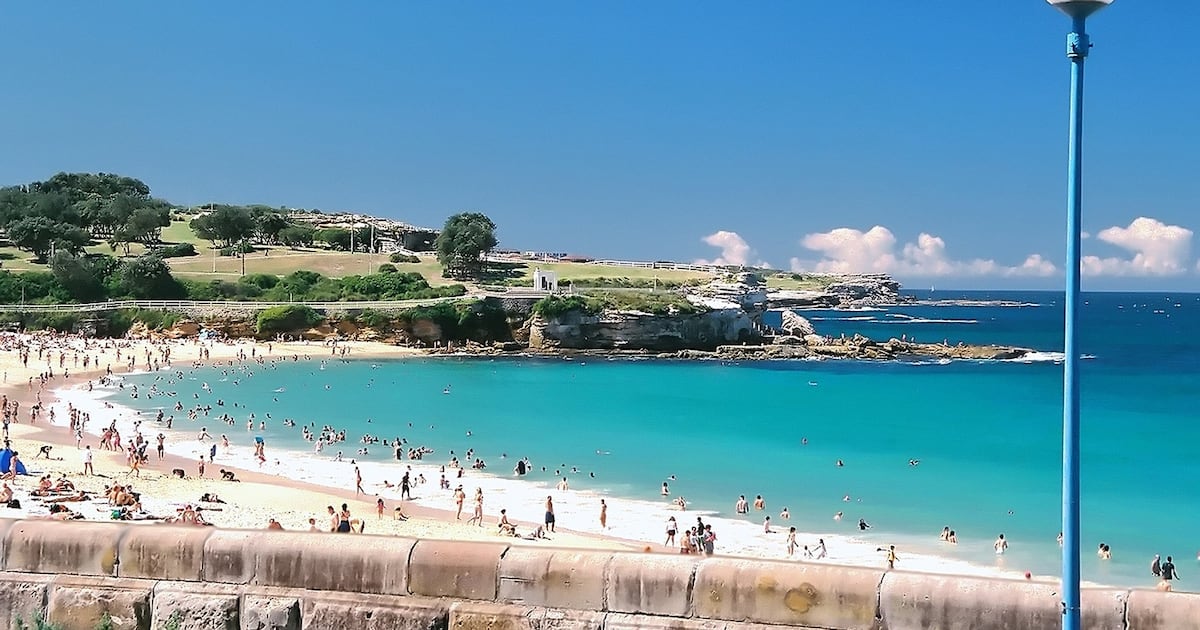
The coastal walk between the beaches of Coogee and Bondi is a must-do for visitors to Sydney. The seafront hike, with its spectacular views out to the Tasman Sea, attracts thousands every day.Last weekend the crowds were particularly large, lured by sunny spring weather and the quirky attractions of the annual Sculpture by the Sea exhibition. As I trekked north from Coogee, past Bronte and Tamarama and on to Bondi, I was struck by something else. Irish accents were almost as conspicuous as Aussie twangs, a reminder of how Australia has become almost a rite of passage for Irish twentysomethings.While some young Irish are drawn to Melbourne, Perth and Brisbane, the eastern suburbs of Sydney have long held a siren call. In the 1990s and early 2000s, “County Bondi” was the epicentre of the Irish enclave. Now it’s “County Coogee” (pronounced cudgy), the slightly more affordable beach suburb just south of Bronte.READ MOREDuring the pandemic, many younger Irish headed home. The vulnerability of being a temporary resident with no access to the public health system (apart from emergencies) or welfare became all too real for many. But post-pandemic, the Irish returned in enormous numbers, eclipsing the scale of earlier influxes.Since Australia’s borders reopened in February 2021, approximately 90,000 young Irish nationals have been granted a Working Holiday (417) visa. This figure does not include those who arrived on permanent residence, skilled sponsorship, spouse or student visas.Just 3,697 of these visas were granted to Irish nationals in 2020-21. In 2021-22 the number increased to 10,491 before doubling to 21,525 in 2022-23. It rose again to 21,997 the following year and then, in 2024-25, 24,165 Irish citizens – equivalent to the total population of Mullingar – were granted their first Working Holiday visas.But changes to the visa rules and pressure on the government to cut arrival numbers have created a new sense of uncertainty, which may mean the mass influx is coming to an end.Irish and other backpackers can apply for a second one-year visa if they complete 88 days of specified regional work. This can include work in agriculture, mining, construction, tourism and hospitality, as well as bushfire and natural disaster recovery. (British citizens are not compelled to undertake regional work to get subsequent visas, a consequence of Australia’s free trade agreement with the UK. Some eligible Irish nationals have taken up British citizenship to avoid the obligation.)[ Broke in Australia, I took a street sales job - but sidelined my better instinctsOpens in new window ]Those on a second Working Holiday visa who complete six months of regional work during their stay become eligible to apply for a third. Both are particularly popular with Irish applicants.According to the Department of Home Affairs, Irish applications for second Working Holiday visas increased from 7,482 in 2023/24 to 9,585 in 2024/25, a 28 per cent hike. Applications for third visas rose even more sharply, from 1,000 to 3,692, an increase of 269 per cent. Irish passport holders account for 15.2 per cent of total applications, second only to UK citizens.[ A Dublin woman in Ottawa: ‘Canadians take time to adapt to our humour and way of doing business’Opens in new window ]But the Australian government is about to change the rules in a way that will directly affect Irish passport holders.Merely completing your regional work obligation will no longer guarantee you a second or third visa. Under changes being rolled out over the next 12 months, backpackers who want to stay on will have to enter a ballot, with second-year visa places capped at 45,000, down from 57,000 issued in this financial year. Third-year places will be capped at just 5,000, down from 31,000.According to Sydney-based registered migration agent Fred Molloy, some young Irish have decided it’s all getting too difficult.“The main issue with the new ballot system is the uncertainty it creates,” the Dubliner tells me. “We’re already seeing Working Holiday visa holders deciding to go home. We are coming into harvest seasons and many Irish Working Holiday visa holders will quite reasonably ask: ‘Why bother doing the regional work if there is no guarantee of getting a second or third Working Holiday visa?’ The whole attraction of doing the regional work was that there was a clear benefit at the end of it.”[ A Belfast designer on making it big in New York: ‘There are still days when I have to pinch myself’Opens in new window ]Another Irish migration agent, Donegal native Andrew McDonagh, predicts the changes “will address the supply but not the demand – people are still going to want to come to Australia”.“[But] what it will do is reduce the numbers of people staying, especially for the third year, and probably push more people towards earlier applications for longer-term visas,” he says.Immigration is a hot-button topic in Australian politics. The Labor government is under pressure from the far-right One Nation party and the conservative Liberal-National Coalition to cut net overseas migration. But the business community has pushed back on cuts to skilled immigration, so the government has focused on students, temporary residents and working holidaymakers.However, the refocused immigration programme may open up more opportunities for Irish nationals to get a permanent visa, according to McDonagh.“The focus on priority sectors – among them construction, healthcare and teaching – plays very much to the core of the Irish diaspora. Opportunities for people with the right skills to stay here and eventually gain permanent residency remain very good.”Billy Cantwell is an Irish journalist based in Sydney.
Australia welcomed tens of thousands of young Irish in recent years. That’s about to change
Full Article
Original Source
Read the full article at Irishtimes →KhanList aggregates and links to publicly available news content. We do not host full articles from third-party sources. Always verify important information with original sources.