
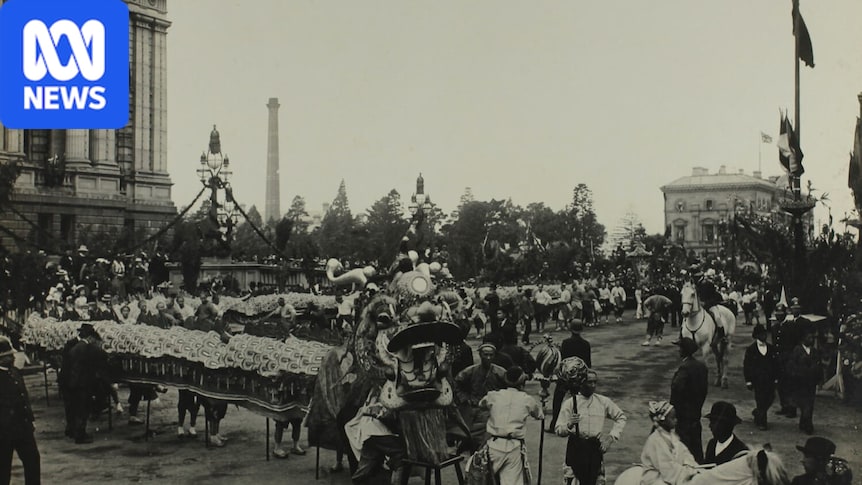
This year's Boyer Lecture series explores the opportunities and challenges of Australia's engagement with Asia in the 21st century. Dr Louisa Lim, Associate Professor at the University of Melbourne, reported from China for a decade for NPR and the BBC. This is an edited extract of her lecture, Tell it Slant.When I was asked to reflect on Australia's role as part of Asia, I sat on a flat, white beach under a grey winter sky and thought about what that meant.I suspected I was meant to address the logic of political realignment; potential economic markets; durable bridges between Australia and Asia. Tidy bullet points, bolstered by neat statistics, tessellating into a clear argument. (Preferably one that would fit on an Instagram tile.) Instead, I'm going to talk about a dancing white lion… but not quite yet.As the sky darkened over that beach, I felt the weight of being the first Asian Boyer lecturer. I'm a new Australian, one of just three years standing. I have a Singapore Chinese father, a white British mother. I've written two books about the Chinese Communist Party's erasure and rewriting of its own history. What do I know of Asia and Australia?Dr Louisa Lim is a journalist, author and University of Melbourne lecturer. (Supplied: Laura Du Vé)The topic needed research. My first stop was Readings in Carlton, in Melbourne's north, with its stock of tens of thousands of books. At the counter, a harried man was punching at the till.When I asked if they had any books on Australia's Asian history, he seemed surprised. He said they used to have one.We went over to the Australian Studies section together. Eighteen shelves, maybe 400 books. He ran his hand over the spines."It's not there, I'm afraid," he said, crestfallen."What was it?" I asked."A biography," he said. "Someone in Bendigo. I can't remember who."After that, I asked the same question at every bookshop I went to. Each time, it was a no. Though my writing explores forgotten and hidden histories, I was surprised to glimpse that invisibility here in Australia.To be fair, these books do exist; more than 40 titles on the history of Chinese in Australia have been published in the past decade, but none were on the shelves of the shops I visited. They're not mainstream. You would only find the canon of work if you know where to look (in work done by scholars like Mei-fen Kuo and Juanita Kwok).But there isn't even a single university course on the subject, let alone an Asian Australian studies centre at an Australian university.History is story is identity. And that continuing invisibility has deep consequences for Australia's Chinese population.The costs we pay"When I was six years old, one of the kids at school called me 'Ching Chong Chinaman, born in a jar, christened in a teapot'. Ha, ha, ha."That's Photographer William Yang. He was born in Dimbulah in Queensland in 1943."I had no idea what he was talking about, although I knew from his expression he was being horrible to me. So I went home to my mother and I said to her, 'Mum, I'm not Chinese, am I?' And she said, 'Yes, you are.' Her tone was hard, and it shocked me. And I knew in that moment, that being Chinese was like a terrible curse." William Yang and his family pictured at their home in Dimbulah in Far North Queensland in the 1950s. (Supplied: Sydney Festival)I heard this story last year at William's show, named Milestone. It took me straight back to 2016. I was sitting in the principal's office of a state primary school. We'd just arrived in Melbourne. My eight-year-old had complained they'd been teased by a boy, backed up by his mates. He'd been taunting them with "ching chang chong", pulling back his eyes. Yes, this was in 2016. The same old story as William's, but almost 70 years later.I wanted to know what action the school would take. But the principal was a busy woman, with a school to run. She looked at me as if I were a naughty child."The boys were only joking," she said wearily. "They've been told not to do it. It won't happen again."That day I discovered there were no teachers of colour at that school. There was no one who even recognised racism. And it's still common. According to the 2023 recent Lowy Institute report on being Chinese in Australia, one in five Chinese Australians reported being called offensive names in the past 12 months. For younger people aged 18 to 29 the reported rates of racism were even higher.After that, I moved my child to another school. One with an excellent Chinese immersion program, diverse students and teachers. Every day for three years, we drove there and back. Half an hour each way, twice a day. Twelve hundred hours over three years. That was just one cost we paid. Five months' worth of workdays.I was at work earlier this year, when the same child rang me. They're 19 years old now. But that day, they were sobbing so hard I couldn't understand what they were trying to say. It turns out, they'd been walking down the street, holding hands with their boyfriend, just round the corner from his house in inner north Melbourne. Suddenly, a complete stranger began screaming at the pair of them; she was shouting "Find yourself an Australian girl!"I dropped everything and I drove to pick them up. When I got there, the pair were sitting by the side of the road, heads bowed into each other, dazed. How can I talk about Australia's role in Asia when I'm crouched in the gutter, hugging my child?Words and names matter"Growing up in Australia, I've always felt very disconnected from my heritage."That's comedian Noah Szto. He's a doctor who also writes very funny stand-up. He has a white Australian mother, and a Chinese Australian father."If you'd asked me when I was a kid how I felt racially, I probably would have told you that as far as I was concerned, I was 100 per cent white but there just happened to be a Chinese man in my house sometimes." I've thought about those words a lot. For Noah, they're personal. But they also sum up the mindset left behind by the White Australia policy. Deep down, I suspect many Australians feel like Noah felt about his family: Australia is a white country that just happens to have Chinese people living in it.That feeling is grounded in history. One reason for Federation, back in 1901, was to pass unified legislation limiting Chinese immigration. The modern Australian nation is rooted in anti-Chinese sentiment and in fear. When MPs debated the Federation bill, they were deciding not just who would be let into Australia, but who would be allowed to become Australian. Being Chinese often precluded becoming Australian. The underlying fear, the anti-Chinese sentiment, they're still visible.One school holidays, I took my family to Bright, in Victoria's High Country. It was bitterly cold. We went sledding, whooping as we skidded down the white hills, our cheeks chapped by snow. The next day I got up early to visit the Chinese bridge at Wandiligong. It marks the contributions of the Chinese miners who transformed a small village into the largest town in the region in the 1850s.Nowadays the Chinese bridge is handsome, painted red, crowned at either end with a corrugated iron pagoda. I was pleased to see Chinese contributions so publicly remembered. Then I read the signboards. They quoted books of the time. This was how they described Chinese miners: "To us they were just chows or chinks to be ridiculed and baited or given a wide berth." Those words felt like a slap in the face.Another year, our holiday trip was to Metung, in East Gippsland. My morning run skirted the beautiful bayside, taking me through a place called Chinaman's Creek. That word stopped me short. Chinaman. According to the Macquarie dictionary, it's "widely considered to be an offensive term". Yet there are still 235 places in Australia with 'Chinaman' or 'Chinamen' in their names. It's just one indication of how normalised anti-Chinese racism still is in Australian life.Names matter. As the author Richard Flanagan said, "We become the words we speak." This repetition and incantation of racism, it replicates and amplifies it.A scattered history After that, I began seeking out Australian Chinese history. I needed other narratives, ones that were more useful to me.That was why I was tramping up a hill in Vaughan, south of the central Victorian town of Castlemaine, with my friend Natasha. Our feet rustled through the copper-coloured gum leaves. We knew we were in the right place when we found stones arrayed in a perfect circle on the ground. This was the Chinese cemetery from the mid-1850s, at the peak of the gold rush, when there were 49,000 Chinese immigrants on the Victorian goldfields. They had to pay entry taxes of 10 pounds a head, about $15,000 today; they also paid residence taxes not imposed on any other group."Daylesford Cemetery: on the Daylesford-Trentham road, 1.5km east of the Farmers Arms Hotel, across the street from the Daylesford Dharma school, one Chinese headstone: severe damage."This is the poetry of Grace Yee, from her collection Joss: A History. Grace spent two years in the State Library of Victoria. She read the archives, then she turned them into poetry. Even the Bulletin's Anti-Chinaman Special Number of 1888.By then, anti-Chinese sentiment had led to organised attacks on Chinese in Buckland, in Lambing Flats, mob violence in Bendigo, Ballarat, Maryborough and elsewhere.Natasha and I used Grace's poetry as our guidebook; we couldn't find any other."Maryborough Cemetery: on the outskirts of town, a 17 minute walk south-east from the Maryborough Wattle Reserve Netball complex, eighteen Chinese headstones: gardeners, labourers, storekeepers: humble lane. From 2.8km west of Ballarat Bird world."The poetry provided unexpected compass points, orienting us differently to landscape and history. Headstones whose Chinese calligraphy was worn smooth by wind and rain. A brick tower for burning paper offerings.The sights we were seeing felt strangely archaeological. Holes in the ground that had once been Chinese baths. A Mad Max moonscape. Once, a Chinese mine, now dotted with burned-out cars."Chiltern cemetery, 1.3km northeast… near the Chiltern bushland reserve. Four Chinese graves, friends meeting)."But this is recent history, just 170 years old. The visible traces of Chinese migrants on the landscape are so clear, yet so much of Australia's Chinese heritage is now lost. Forgotten, abandoned. Victim to the 20th-century racism of white Australia.What remains of our Chinese history lies scattered, but the connective tissue is missing.Poet Grace Yee won the 2024 Victorian Prize for Literature for her verse novel, Chinese Fish. (ABC News: Danielle Bonica)These gaps are being filled by the poets and artists, the photographers and novelists. Maybe the artists are less governed by institutions, less governable. Those institutions have gate-kept the past, deciding what research to fund, what to teach, what Australian students should learn. The Roman empire, oh yes. Australia's Asian history, less so.The poets and artists, the photographers and novelists; they're freer agents. Their work is freighted, weighted, fuelled by white hot anger, burning curiosity, the need to explore the gaps in their own histories.They have family trees that go back a single generation. Grandfathers who changed their names, wiping clean their Asian pasts, internalising that racism into the silence that became a family legacy.Again, I think of a poet's words — Emily Dickinson this time: "Tell all the truth but tell it slant."That word "slant" is so tainted by racism and the taunts of the playground… but it's time to reclaim it.Emily Dickinson writes, "Success in circuit lies", and maybe the circuitous route journeys through photographers' eyes, poets' words, to reach a different set of truths about Australia's past. Both about the extent of Chinese influence in Australia, and the ugliness of the persecution."Let's languish on Little Bourke street; the longest continuous/Chinese settlement in the western world."Back in 1968, in his Boyer lectures, the anthropologist WEH Stanner coined the term The Great Australian Silence. The cult of forgetfulness, as he put it, practised on a national scale towards Indigenous people and history.The lie of the tabula rasa wipes out 65,000 years of First Nations history. That Great Australian Silence has over time swallowed up Australia's Chinese history too; we need to fill it with voices, lives, stories."I am learning to/Prioritise my heritage in this shiny-buckled civilisation, /Where yellow-perilled white men brass the city's walls."History is story is identityWhen I moved here, I felt more Chinese than I ever have. Maybe because that was the way I was treated.It came as a surprise that so many Australians seemed to view the country as part of Europe, just displaced to the other side of the world. As historian David Walker writes, Australia has seen itself as "a nation in the region but not of it".That mental geography needs to change. Our future is here as part of Asia.And so too is our past. History is story is identity.It is an indisputable fact that some of Australia's cities were also Chinese cities. For four decades, Darwin had more Chinese residents than white ones. Broome's population was majority Asian for much of the first half of the 20th century. Bendigo's population was 20 per cent Chinese. Many Indigenous people also have Chinese heritage.Loong during the 1910 Easter procession in Bendigo. (Supplied: Golden Dragon Museum/Vincent Kelly )Australia has never been a monoculture. Its history is not a singular narrative. It is polyphonous, multilingual, plural. Yet the country keeps looping back into the same stale old arguments, driven by domestic politics.That disregard for Australia's Asian history has dire consequences in the present, most urgently a lack of Asia capacity.My child was very lucky to go to a Chinese immersion school. Only seven government schools offer Chinese immersion programmes in the whole of Australia. Just four secondary schools. (Only three per cent of our high school students learn Chinese, Japanese or Indonesian.)Fewer than five students a year graduate from honours programmes in Chinese studies with language skills. We can barely talk to our neighbours, let alone understand them.We need different role models, new points of reference.I found one a few years ago when I was invited to the Bendigo Writers festival. I was speaking at the Golden Dragon Museum. When I walked inside, I was astonished to find myself face to face with a gigantic dragon. His head alone, fringed with blue gills, was bigger than my whole body. This is Dai Gum Loong, the longest processional dragon in the world.He's the highlight of Bendigo's Easter parade. After I saw him, I went back the next year with my family.It was a true community event. Stilt walkers led the parade, followed by BMX bikers, firefighters, religious puppets.And dragons of literally every stripe. From all over Australia. There was a Falun gong dragon carried by members of a sect banned in China. There was a LGBTQIA+ dragon in trans colours.And, of course, there was Dai Gum Loong.Longer than a soccer pitch, carried by more than sixty Bendigonians, of all ethnicities, all genders.The thing is: dragon dances at Easter aren't a Chinese tradition at all. It's one that began in Bendigo in 1892. In the Golden Dragon museum, I saw sepia pictures of the people responsible. Chinese men with white wives and Wasian kids. Families like mine, but a century and a half earlier. They stayed on through the White Australia era, and they used their traditions to raise money for Bendigo's hospital.This dragon, and the museum itself, they were both the brainchild of Russell Goldfield Jack. An Australian born in 1935, he's also known as Louey Yeung Man. He was the subject of the book I couldn't find at Readings, a biography by Dianne Dempsey.Sadly, he has just passed away, aged 91.Jacinta Allan and Russell Jack. (Supplied: Facebook)In September I went to his funeral. He was accompanied on his last journey by a silver-white funeral lion, the Chinese colour of mourning. It shimmered as it danced slowly through Bendigo's streets.In the theatre where his funeral was held, the lion bowed to his coffin, which was covered with an Australian flag. This was the first ever state funeral for a Chinese Australian."He was a great man, a great Australian," said former state premier Jacinta Allan.At the grave side, people bowed with incense. His family burned paper money. The funeral lion went up in flames too, as firecrackers exploded around us.I never met Russell Jack, but I benefited from his legacy. He made visible a different version of Australia's history. One that foregrounds Australia's Asian history, its Asian story, its Asian identity.The white lion is the symbol of a society where citizens do not need to choose between being Australian and being Asian. To truly integrate into the region, Australia first needs to reckon with its own Asian past, and its continuing legacy of racism.Story is history is identity. But this time, let's tell it slant.This lecture and other Boyer Lectures will air on consecutive Sundays from October 18 on ABC Radio National's Sunday Extra program. They can also be found on ABC listen.
Australia has an Asian history, too, you just have to look for it
Full Article
Original Source
Read the full article at Abc →KhanList aggregates and links to publicly available news content. We do not host full articles from third-party sources. Always verify important information with original sources.