
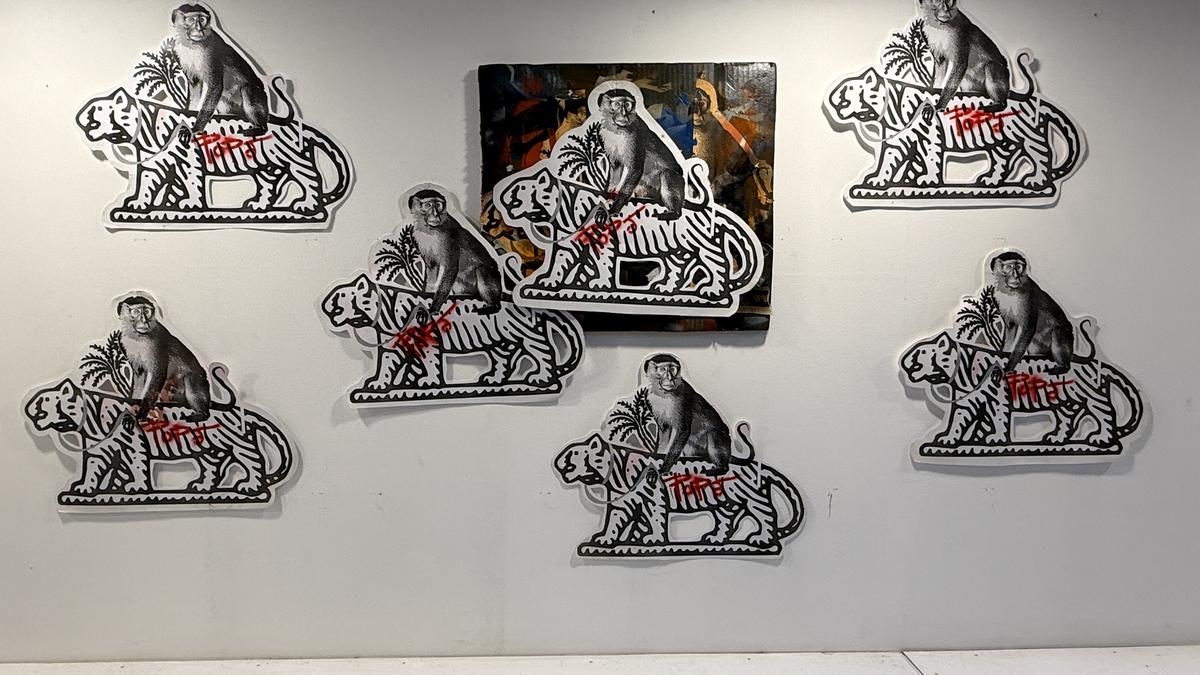
A woman screams in rage, her image titled Virodhi (meaning rebel in Bengali) is reproduced in multiple colours and spread across a wall. A table nearby carries paper rockets depicting the wounds of Gaza, while a few pamphlets highlighting the oppression faced by Dalits are scattered across the floor, inviting the audience to pick them up and read.Parcha: Voicing the political, an ongoing exhibition by SAHMAT (Safdar Hashmi Memorial Trust) at the Asian College of Journalism, opens up conversations surrounding ideas of dissent, solidarity and social justice — all triggered by a humble pamphlet. Inaugurated by artist Trotsky Marudu on November 11, the exhibition displays the works of around 100 artists, each touching upon subjects ranging from dilution of labour codes, and farmers’ protests, to the state of air pollution in Delhi, among others. “There is one artwork of a man carrying another man, wrapped in white, on the back, portraying the COVID-19 pandemic. Despite the media’s coverage of the pandemic, it is evident that COVID-19 in this neo liberal India, engineered a mass exodus of migrant labourers,” says Sagnik, a student of Asian College of Journalism, on his observations of a pamphlet by artist Girish Behera. Parcha titled ‘Women of Shaheen Bagh’ | Photo Credit: Special arrangement Another artwork, titled Women of Shaheen Bagh by artist Ita Mehrotra, also seems to have caught his eye. “The Shaheen Bagh uprising was portrayed as an anti-national conspiracy involving Indian Muslims. But the painting presented it as a democratic uprising, with subaltern Muslim women at its forefront, capturing the intersectional nature of the protest,” he says.For Ita, conversations with the women on the protest site inspired her work. She says the movement opened up space for not just Muslim women but also women from different backgrounds to come together and claim public space. Pamphlets are vital to protest movements, she says, adding that as an artist, it is exciting to be able to create something that can be disseminated quickly to so many people.“It is one of the most exciting ways of integrating literature and visual art into social movements. It works across class and social movements,” she adds.For curator Aban Raza, an artist based in Delhi, the act of distributing a pamphlet is as important as creating one. Conceived as a platform to defend freedom of expression, SAHMET has, over the past 37 years, upheld the right of artists to express themselves through their work and engage with issues concerning the country and the world. | Photo Credit: Special arrangement Similarly, historian Sohail Hashmi, who is famous Indian playwright Safdar Hashmi’s brother (the trust has been constituted in his name) believes that art has always been political, whether it supports the status quo or challenges it. SAHMAT was formed as a response from the creative community to the attack and assassination of Safdar Hashmi in 1989. Conceived as a platform to defend freedom of expression, it has, over the past 37 years, upheld the right of artists to express themselves through their work and engage with issues concerning the country and the world.“Any protest through poetry, music, painting, or prose writing is political, and all of this is art. There is art that supports the oppressor, and that too is political; then there is art that opposes injustice and atrocities. The difference lies in whether you support those who want the existing system to continue or those who seek change for the better,” he says.SAHMAT continues to carry forward the work of Safdar Hashmi and the many creative artists who have stood against injustice, inequality, and the marginalisation of people, he adds. “These were the values Safdar upheld throughout his life and lived and died for,” Sohail says.Back in the exhibition, the parcha continues to echo stories of resistance, solidarity and hope. The exhibition ends with a work by Manini Chatterji, featuring a used stamp paper addressed, “To whomsoever it may concern.” On it are the words: “Do not despair, my friend. Dreams never die, nightmares end.”
At Asian College of Journalism, pamphlets turn into powerful tools of protest
Full Article
Original Source
Read the full article at Thehindu →KhanList aggregates and links to publicly available news content. We do not host full articles from third-party sources. Always verify important information with original sources.