
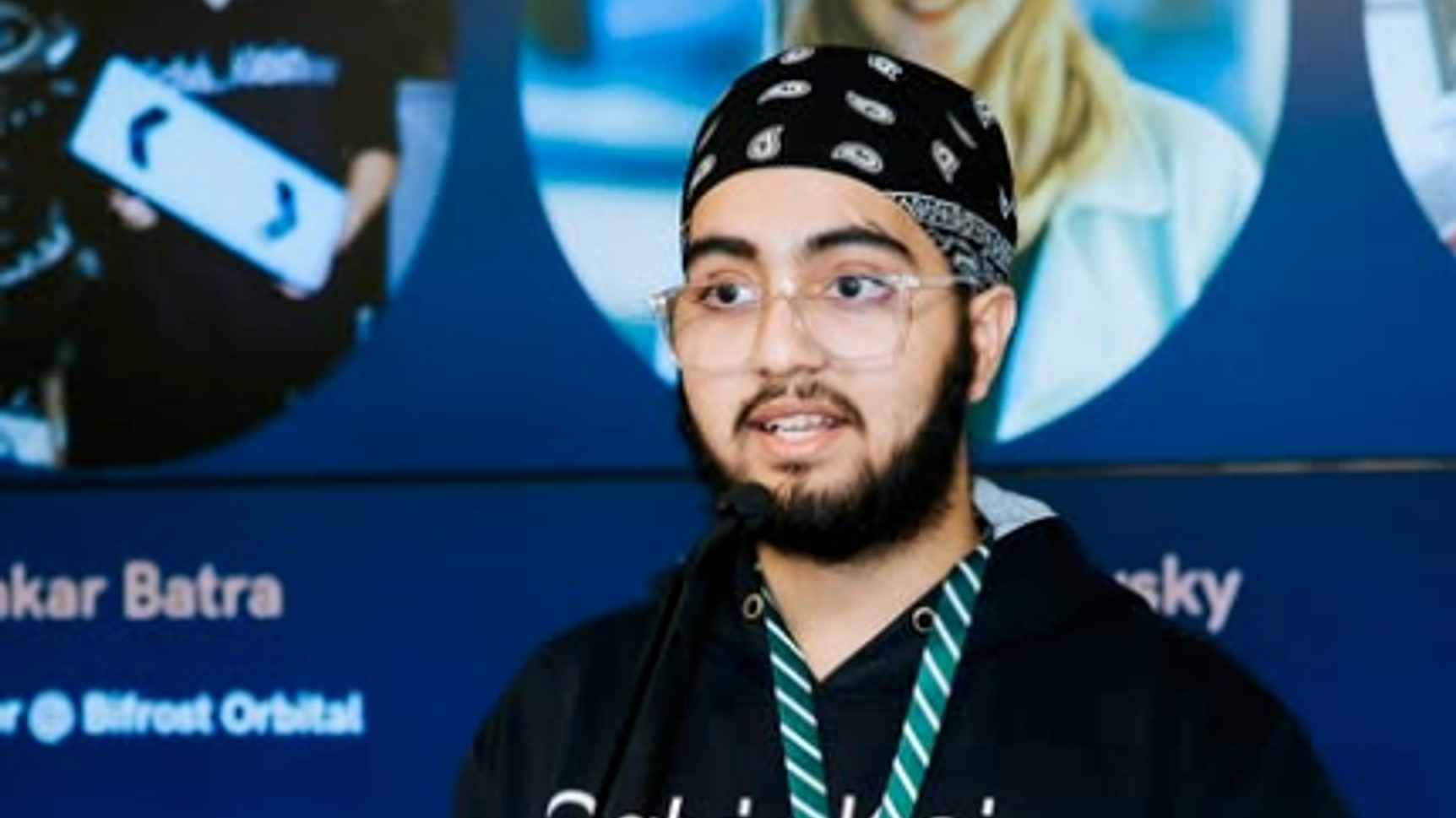
Jammu-born entrepreneur Onkar Singh Batra is building Apolink, a satellite relay company tackling communication gaps in low Earth orbit. An IITian and a Guiness world record holder, Batra is now on the path to becoming an inspiration for many more.When in the age of AI, with each passing day, one or the other challenge is emerging for humanity, the young generation is busy building. It is busy making websites, youngsters as young as 7 are learning to code, AI models are becoming a part of everyday life, robotics is being explored in tiny school labs, and some are even dreaming of building satellites for the country.Amid all these sounds, one name from Jammu stands out, Onkar Singh Batra.At the age of 7, Batra built his first website and was recognised as the world’s youngest male webmaster. A few years later, at 12, he wrote a book. By 13, he had started his own company. At 16, while still a school student in Jammu, he developed InQube, described as India’s first open-source satellite.And by the age of 19, he had moved to Silicon Valley and raised $4.3 million for a space-tech startup attempting to solve one of the persistent problems in satellite communication: keeping satellites connected when they move out of the line of sight of ground stations. Today, at 20, the Jammu-born entrepreneur is building what he describes as a continuous communication layer for satellites in space.You might be reading one or the other news story discussing some young achiever. That is true. But what Onkar has done takes the race to another level.At 20, he is the founder and CEO of Apolink, a Palo Alto-based space-tech company working on satellite relay infrastructure.And if that is not enough for a youngster, his journey also includes a national child award, multiple world-record claims, research work, teaching engineering students, and recognition from the global technology ecosystem.So, how did he manage to do all of this so early?THE JOURNEY STARTED WITH A WEBSITE AT 7Born and raised in Jammu and later took admission to IIT, Batra developed an interest in computers at a very young age. His father worked in information technology, giving him early exposure to computers and technology.At just seven, he built his first website.The feat later earned him an identiy as the World’s Youngest Webmaster. The World Record Certification Authority lists the record at the age of 7 and says he had begun developing multiple websites before going on to run Batra Technologies.But the website was only the beginning.AT 12, HE WROTE A BOOK3 years after his first website, Batra turned his energy towards something very different, theoretical physics.At the age of 12, he wrote “When The Time Stops,” a 49-page work that, according to his LinkedIn profile, challenged Albert Einstein’s argument on time dilation.He was subsequently recognised as the World’s Youngest Theoretical Author.By then, technology was no longer simply an interest for him. It had become something he was trying to build around.In 2018, he founded Batra Technologies, followed by United India Publishing in 2019.COVID landed as an opportunity for Onkar, he helped create an interactive web-based platform that allowed people to connect with doctors and seek information related to COVID-19. The platform was developed with support from doctors at Government Medical College Jammu.For this work, he received the Pradhan Mantri Rashtriya Bal Puraskar, one of India’s highest civilian honours for children, from the President of India.THE JOURNEY IN SPACE FIELDWhilst the most not so usual chapter of Batra’s story began when he turned towards space technology.While still in school in Jammu, he began working on InQube, a small satellite system developed under the banner of Paradox Sonic Space Research Agency.The project was described as India’s first open-source satellite. The satellite was designed around a 1U CubeSat platform and weighed around one kilogram. Its proposed missions included testing whether a lightweight satellite could function in space and collecting temperature-related data.What makes InQube particularly important to Batra’s later story is that it did more than put a teenager closer to space. It exposed him to a problem.A satellite in low Earth orbit cannot always see a ground station. As it moves around Earth, there are periods when it passes beyond the station’s line of sight. During these periods, communication can be interrupted.For an Earth-observation satellite tracking a flood, wildfire or another event, such a communication gap can mean that valuable data has to wait before it can reach the ground.This was the problem Batra encountered while working on InQube.Before finishing school in 2023, he was already teaching engineering studentsBatra’s school years did not follow a conventional path.While working on his space projects, he was also associated with IIT Jammu, where his LinkedIn profile shows him serving as a Guest Project Facilitator and Coordinator for IIT Jammu’s Satellite Development Program.His profile also lists an earlier research internship at IIT Jammu’s I2EDC Laboratory, where he worked on embedded systems, software-defined radio and real-time tracking applications.His profile further shows a stint as a Visiting Researcher at the CSIR–Indian Institute of Integrative Medicine, where he worked on image-processing methods for deep-sea nematode specimens.At the same time, he founded onXr Labs, describing it as a hybrid development lab exploring ideas across AI, space and biology.The list looks almost difficult to fit into a conventional rsum.But there is a pattern running through it, Batra kept moving towards problems that required him to learn something new.FROM JAMMU TO SILICON VALLEYThe next move was perhaps the biggest one.Batra moved to the United States, completed high school in New York and later briefly attended Penn State University before leaving college to pursue entrepreneurship in the Bay Area.In 2024, he founded Apolink, a Palo Alto-based space-tech startup.The company’s mission was built around the problem he had encountered while working on satellites: how can spacecraft in low Earth orbit remain connected even when they are not directly visible to a ground station?Apolink’s answer is a satellite relay network designed to provide continuous connectivity to spacecraft in low Earth orbit.The company is developing a hybrid architecture combining radio-frequency and optical communications, with the goal of making the system compatible with existing satellite systems without requiring every customer spacecraft to install specialized relay hardware.At 19, he raised $4.3 million in an oversubscribed seed round at a reported $45 million post-money valuation.The round included Y Combinator, 468 Capital, Unshackled Ventures, Rebel Fund, Maiora Ventures and other investors.AND THEN CAME THE SATELLITEApolink’s first technology demonstration satellite, IPoS-TDsM, was manifested on SpaceX’s Transporter-17 rideshare mission.On July 7, 2026, the Falcon 9 mission launched from Vandenberg Space Force Base, carrying dozens of customer spacecraft. Apolink’s IPoS satellite was among them.The satellite was subsequently deployed, and Apolink announced that it had made contact with its first satellite in orbit.The mission is designed to demonstrate a backward-compatible RF relay approach, allowing existing satellites to communicate through the relay without requiring hardware modifications.In other words, the journey that began with a young boy in Jammu building websites had now reached orbit.- EndsPublished By: Rishab ChauhanPublished On: Aug 23, 2026 14:31 IST
At 7, he built a website. At 16, a satellite. Then came $4.3M: Meet Onkar Singh Batra
Full Article
Original Source
Read the full article at Indiatoday →KhanList aggregates and links to publicly available news content. We do not host full articles from third-party sources. Always verify important information with original sources.