
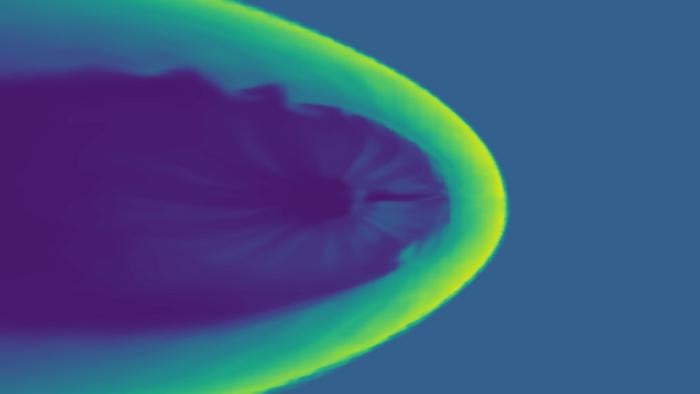
The Earth’s magnetic field is responsible for shielding us from harmful space weather, including solar radiation from the Sun but also cosmic rays originating from outside our solar system. Cosmic rays can include deep space supernovas, so the magnetic field takes the majority of the brunt from solar radiation. Without our magnetic field, the solar wind would slowly strip away our atmosphere, making life on our small, blue world impossible to exist. But where is the magnetic field doing the heaviest lifting regarding how it filters out incoming space radiation? Now, a team of researchers from the United States and Finland might be one step closer to solving this conundrum, as they discuss new evidence that certain regions of the Earth’s magnetic field experiences greater levels of stress from space weather compared to other regions. These findings were revealed in a recent study published in Geophysical Research Letters and holds the potential to help scientists not only better understand the interaction between space weather and Earth’s magnetic field, but magnetic fields on other worlds, too. For the study, the researchers used a series of computer models to simulate how the interaction between the Earth’s magnetic field and solar wind produces a longstanding phenomenon called the Kelvin-Helmholtz instability (KHI), which are wave-like patterns produced at the boundary of the magnetic field when the solar wind strikes it. The solar wind consists of high-energy particles from the Sun and comprises the brunt of the energy impact our magnetic field shields us from. The primary motivation of this study comes from a continuing drive to understand space weather and specifically develop better space weather prediction models. Abundant Asymmetry In the end, the researchers found that the KHI waves exhibit asymmetric, or non-mirror-like behavior, at certain regions of the Earth’s magnetic field. Essentially, the wave activity doesn’t match along the northern and southern hemispheres, indicating the magnetic field experiences different levels of impact and interaction from the incoming solar wind. The researchers note this stems from several reasons, including whether it’s the dawn or dusk side of the planet, winter and summer hemispheres, and the magnetic field’s orientation. For example, the researchers found that the winter hemisphere experienced the strongest wave activity, with the solar wind’s magnetic field determining if the dawn or dusk side experiences stronger activity. “This finding grew out of a long process of thinking through what I was seeing,” said Dr. Lauri Holappa, who is an Academy Research Fellow at the University of Oulu and lead author of the study. “In 2020, when I was visiting NASA as a postdoctoral researcher, I noticed unusual simulation images of the magnetosphere. I later realized that they showed Kelvin–Helmholtz waves at the edge of the magnetosphere, and that the different behavior of the waves on different sides was part of the same phenomenon.” Why Space Weather Matters Studying space weather, and specifically the solar wind, has become essential in recent decades to safeguard satellites and electronic ground stations. However, scientists have actually been studying space weather since the 1600s with Galileo Galilei using his new telescope to observe sunspots. However, it wasn’t until 1843 that the German astronomer Heinrich Schwabe discovered the now-well-known 11-year cycle of the Sun’s activity. This theoretical research continued until the Space Age kicked off in the mid-20th century with satellites being used to obtain direct measurements of the solar wind, with the term “space weather” being coined sometime in the 1990s. What new insights into Earth’s magnetic field interacting with the solar wind will researchers make in the coming years and decades? Only time will tell, and this is why we science! As always, keep doing science & keep looking up!
Asymmetric space waves map pressure on Earth's magnetic shield
Full Article
Original Source
Read the full article at Universetoday →KhanList aggregates and links to publicly available news content. We do not host full articles from third-party sources. Always verify important information with original sources.