
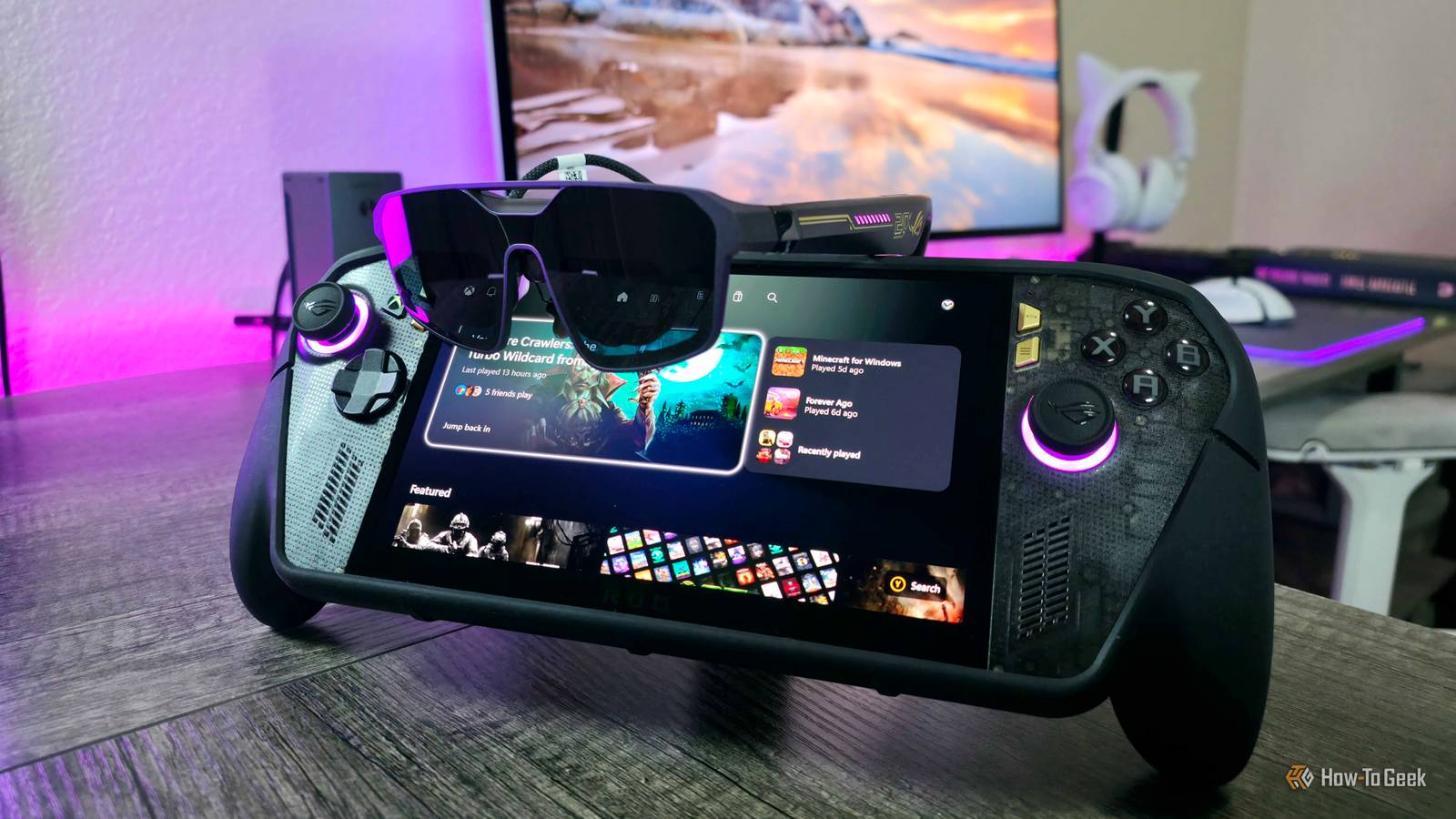
Being the best AR gaming glasses isn't the same as being the smartest purchase Published Nov 9, 2026, 9:00 AM EST Zachary Boddy is a seasoned journalist with over six years of experience covering technology and video games, and is now contributing to How-To Geek. Zachary's career began at Windows Central, where their long-running, deep-rooted passion as a tech and gaming nerd fueled thousands of published articles, including reviews, guides, interviews, editorials, and so much more. When Zachary isn't writing, they're playing video games, reading books, listening to music, and spending time with their family, a very food-motivated cat and an exceptionally creative daughter. Sign in to your How-To Geek account There's a lot of movement in the smart glasses space, from simple tools for capturing your lifestyle to next-generation, fully immersive mixed reality experiences. When it comes to augmented reality glasses that aim to be the ultimate, private, all-in-one external display for your devices, the ASUS ROG XREAL R1 sits at the pinnacle — as it should, when it costs $800 or more. I've been using these glasses alongside the Xbox Ally X20 I reviewed, and it's not a stretch to call them the best at what they do... but I can also confidently say most people should buy something else, like the excellent (and much cheaper) XREAL One Pro. Asus ROG Xreal R1 7/10 Functions Native 3DoF tracking, 3-tier electrochromic lens, 3D Mode Speakers 2x stereo, tuned by Bose Weight 91g Display Dual 0.55-inch Micro-OLED ASUS and XREAL have come together to create the ultimate AR glasses for gaming, and the XREAL R1 really does impress with its excellent hardware and Xbox Ally handheld integration. At $800 or more, though, the vast majority of people interested in AR glasses like these are better off with something like the XREAL One Pro—especially when the headlining feature, the 240Hz refresh rate, compromises image quality without adding much value. Pros & Cons Beautiful, punchy, and responsive dual Micro-OLED displays Premium design with tasteful ROG embellishments Xbox Ally integration is a nice touch The same features and support as the XREAL One Pro 240Hz is overkill and affects image quality $800+ is so much to spend on simple AR glasses Still tethered to your device, always Price and availability The ASUS ROG XREAL R1 comes in two flavors: the regular version that retails for $850 and the Special Edition 20 variant that retails for $800, and is entirely identical apart from its gold-accented aesthetic. For comparison, the XREAL R1 retails for $150-200 more than the XREAL One Pro (disregarding it being regularly on sale), but is ultimately built on the same platform with a handful of additions and improvements. As for why the limited edition XREAL R1 is cheaper, that's because it oddly omits the included ASUS ROG Control Dock, which lets you connect the R1 to a wider range of devices (including consoles like the Nintendo Switch or Xbox Series X) and control your display settings with a built-in joystick. Transparently, I reviewed the Edition 20 model, so I don't have any hands-on experience with the ROG Control Dock Specifications Resolution 1920 x 1080 (per eye) Field of view 57-degrees Refresh rate 240Hz, 0.01ms response time Max brightness 700 nits Functions Native 3DoF tracking, 3-tier electrochromic lens, 3D Mode Dimensions 166.5 x 153 x 50.2mm Weight 91g Connectivity USB-C (DP Alt) Speakers 2x stereo, tuned by Bose Microphone 4x microphones Included accessory ASUS ROG Control Dock Camera Optional 12MP XREAL Eye Image Resolution 2016 x 1512 Video Resolution 1600 x 1200 Storage space 2GB A familiar (but fantastic) AR glasses experience In so many ways, the XREAL R1 is the XREAL One Pro reimagined I have a lot of experience with this category of AR glasses, especially with the XREAL One Pro I reviewed for Windows Central. I praised those glasses for leading the segment, but more than a year has passed since — and that's a long time for technology, with XREAL moving forward with its ambitious AURA mixed reality glasses (stay tuned for my review of that). Unboxing the XREAL R1, it became immediately clear that the core of these glasses is the XREAL One Pro. The dual Micro-OLED displays are practically identical, with their 57-degree field-of-view and reliably excellent image quality; the stereo speakers are still tuned by Bose, the button placement and control scheme are instantly familiar (and still a little awkward), and you still benefit from an easy-to-use frame for prescription lenses and flexible stems to adjust your viewing angle. None of the R1's marketing materials explicitly mention XREAL's custom X1 chip, but it's absolutely here to enable native 3DoF spatial tracking, allowing you to anchor your display in 2D space; this has improved immensely since I first reviewed the XREAL One Pro, with no signs of sliding or stuttering, but those improvements aren't unique to the R1. The XREAL R1 makes use of the same flat, optically transparent lens design, which makes it entirely seamless to stay engaged with the real world while wearing the glasses. The same three-tier electrochromic lens dimming is here, too, which automatically disables when you look away from an anchored display, merging all the features I just mentioned. You even get the same accessory support, including the XREAL Beam companion device and the XREAL Eye camera, which enables 6DoF tracking to anchor screens in full 3D space, and allows you to capture photos and videos with the press of a button. The differences between the XREAL R1 and One Pro are almost entirely in what ASUS contributed. ASUS brings its own magic, with mixed results The ASUS brand isn't just slapped on these glasses, but it's not all worth it If the core of the XREAL R1 is the One Pro, why should you pay an additional $200? ASUS would tell you that this decidedly isn't a one-to-one re-release for four reasons: the design, the interface, the integration, and the performance. To summarize the first two quickly, the XREAL R1 features a more angular and aggressive design reminiscent of the "gamer" aesthetic, and its On-Screen Display interface mirrors that design. ASUS' approach was subtle enough that I actually love this design, though, and I appreciate that the Edition 20's gold accents are reflected in the hardware and software. As for the integration, ASUS has built native support for the XREAL R1 into the Command Center for Xbox Game Bar on all ROG Ally handhelds, including the latest Xbox Ally family. Being able to tweak your R1's settings (including brightness, volume, screen size, refresh rate, and more) directly on my Xbox Ally X20 has been great, but Armoury Crate — which powers Command Center—doesn't give you any deeper control over the XREAL R1... or even mention it at all, for that matter. At the end of the day, this integration is also a benefit for a small subset of potential customers. Finally, there's performance, and this is where the XREAL R1 declares itself the ultimate AR glasses for gamers. A maximum 240Hz refresh rate is insane for AR glasses, but there's a major catch: to achieve this level of performance, the R1 utilizes aggressive resolution upscaling, and the effect dramatically harms overall image quality. Text clarity and texture detail are crushed to achieve a refresh rate that is honestly not practical for the way people (even hardcore gamers) will use the R1, and that's the real killer for these impressive spectacles. Should you buy the ASUS ROG XREAL R1? You should buy the XREAL R1 if: You demand the absolute best in AR glasses. You want AR glasses specifically for your Ally handheld. You'll actually make use of the 240Hz refresh rate. You should not buy the XREAL R1 if: The One Pro gives you what you need for $200 less. You're not a hardcore gamer. You're looking for companion smart glasses. Is the ASUS ROG XREAL R1 technically superior to the XREAL One Pro? Certainly, that's indisputable. Would I buy the R1 over the One Pro? Absolutely not; the upsides aren't worth an added $200. The XREAL R1 falls into a peculiar area, in that I love this product, but I also can't recommend it to most people. ASUS wants the impressive 240Hz refresh rate to sell the R1, but that level of performance makes little sense for AR glasses, and the major hit to image quality simply isn't worth the trade-off. Asus ROG Xreal R1 7/10 Functions Native 3DoF tracking, 3-tier electrochromic lens, 3D Mode Speakers 2x stereo, tuned by Bose Weight 91g Display Dual 0.55-inch Micro-OLED ASUS and XREAL have come together to create the ultimate AR glasses for gaming, and the XREAL R1 really does impress with its excellent hardware and Xbox Ally handheld integration. At $800 or more, though, the vast majority of people interested in AR glasses like these are better off with something like the XREAL One Pro—especially when the headlining feature, the 240Hz refresh rate, compromises image quality without adding much value.
ASUS ROG XREAL R1 review: The best gaming glasses, not the best purchase
Full Article
Original Source
Read the full article at Howtogeek →KhanList aggregates and links to publicly available news content. We do not host full articles from third-party sources. Always verify important information with original sources.