
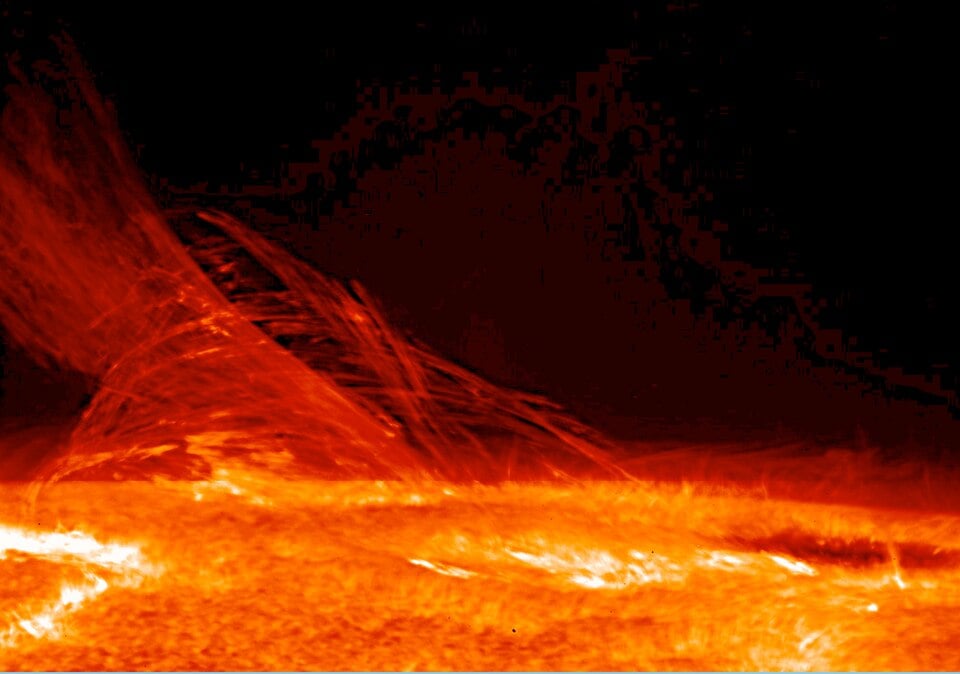
The torrent of corona related discoveries keeps coming. Lately we’ve covered a variety of potential solutions to the “coronal heating problem” - why the Sun’s corona is so much hotter than its surface. Now, a paper led by a team of researchers from the University of Newcastle, Indian Institute for Astrophysics, and University of Sheffield, offers another answer - that we’ve been viewing the “spicules” that form in the lower solar atmosphere all wrong. Spicules are spike-like geysers of plasma that shoot up into the solar atmosphere at tens of kilometers per second, eventually collapsing back down towards the surface after a few minutes. There are thought to be tens of thousands of these along the solar edge, and potentially millions of them at any given time across the entire surface of the Sun. Scientists have always treated them like miniature plasma tornados, with each individual “spike” acting as an individual. The paper calls that into question. Instead of two dimensional spikes, it provides evidence that spicules might actually be an optical illusion created by complex three dimension “curtains” of plasma. They don’t operate as individual cylinders - they are in fact part of a rippling and folded magnetic sheet that acts like a vast atmospheric drape. From our perspective - which is essentially a two dimensional one only at the edge of the Sun, the overlapping folds create the illusion of a series of discrete, spinning jets. Fraser talks about the highest ever resolution image taken of the Sun. Unlike many of the other spicule-related discoveries we’ve reported on recently, this one didn’t come from new data from a new spacecraft, like Solar Orbiter or the Parker Solar Probe - it came from a simulation. The researchers used a computer simulation tool called Pencil Code to model the magnetohydrodynamics of the convection zone beneath the solar surface all the way up through the lower corona. One of the most notable features of that environment was the acoustic pounding, almost like a drum, that the churning granules of plasma beneath the Sun’s surface delivers to its atmosphere. That pounding launches the equivalent of sound waves up into the atmosphere itself - though in this case, they are magnetohydrodynamic waves that directly follow magnetic field lines. As they travel higher, the gas surrounding them gets thinner, and they grow into huge bow shocks. When they eventually break, those shock waves blast part of the atmosphere upward, creating giant “curtains” of plasma thousands of kilometers into the Sun’s atmosphere. Which all sounds very similar to what other research has already said about this process. This obviously wasn’t the first time someone has tried to model the connection between the Sun’s surface and atmosphere. One of the paper’s key findings was modeling what space observatories would actually see. From a top-down perspective, the plasma that was blasted up by these waves looks like a sheet arranged into accordion-like folds. But, if a telescope was looking at the edge of the Sun, the integration of those folds made it appear like a single line - a spicule. The spicules “movements” could even be understood as the curtains swaying and curling over time. Video showing solar spicules, as seen by Hinode in 2007. Credit - WebMaster Hinode YouTube Channel Luckily, there was some real data that could back up these modeled findings. Instead of one of the newer spacecraft, the researchers turned to the Interface Region Imaging Spectrograph (IRIS) and the Hinode satellite, originally launched in 2013 and 2006 respectively. Data from both had shown spicules undergoing some bizarre motions. But when the data was lined up with simulated data from the model, those bizarre motions matched well with a curving, twisting curtain. It appeared that the vertical straws of the spicules could instead be a projection of a rumpled curtain. But perhaps the more interesting discovery was of something that sounds very like spicules, but are actually a different phenomenon altogether. The researchers used automated vortex-detection algorithms on their model and found giant columns of rotating plasma that could stretch all the way out to the corona. However, unlike spicules, these are huge whirlpools hundreds of kilometers across, rotating at up to twenty kilometers per second. The scientists named them Coronal Swirling Conduits, or CoSCos. CoSCos appear to come in two different types. One is created when magnetic field lines snap and break in the solar atmosphere. That snapping and breaking is a primary suspect in the coronal heating mystery, but obviously has a major impact on the surrounding Sun’s environment too. A second creation path is tied to the edges of the spicule curtains - they are much denser than the “void” that makes up most of the rest of the corona, causing huge pressure and density differences along their edges. That mismatch generates something called baroclinic vorticity - on Earth it’s equivalent to how ocean breezes colliding with warm air from farther inland can stir up coastal weather systems. But in fact, as the spicule curtains themselves begin to lose energy and float back down to the surface, the massive tornadoes they kicked up will actually pull them back up into the corona. That is the pathway by which these spicule sheets contribute to the coronal heating problem. CoSCos pull spicular sheet plasma back up from the surface into the corona, powering the solar wind and providing energy that heats the area. Or at least that’s how it works in theory. Observations of rotating bunches of spicules from instruments like Hinode and IRIS affirm where CoSCos exist, showing that rotating spicules mark regions where these theoretical giant plasma tornadoes transport energy into the solar atmosphere. But there’s still a lot we don’t know about this process - maybe we’ll get some more insight from all of the fancy new solar observation equipment that is currently looking at our beloved star. Learn More: University of Sheffield - Britain-sized rotating magnetic plasma curtains drive millions of jets in the solar atmosphere S. Dey, P. Chatterjee, & R. Erdélyi - Solar Spicule Rotation Driven by Plasma Curtain–Vortex Interactions UT - How Flare Ribbons Reveal Hidden Solar Explosions on the Sun UT - Previously Unseen Super-Hot Plasma Jets Heat the Sun's Corona
Astronomers Solve the Mystery of the Sun’s Spinning Plasma Jets
Full Article
Original Source
Read the full article at Universetoday →KhanList aggregates and links to publicly available news content. We do not host full articles from third-party sources. Always verify important information with original sources.