
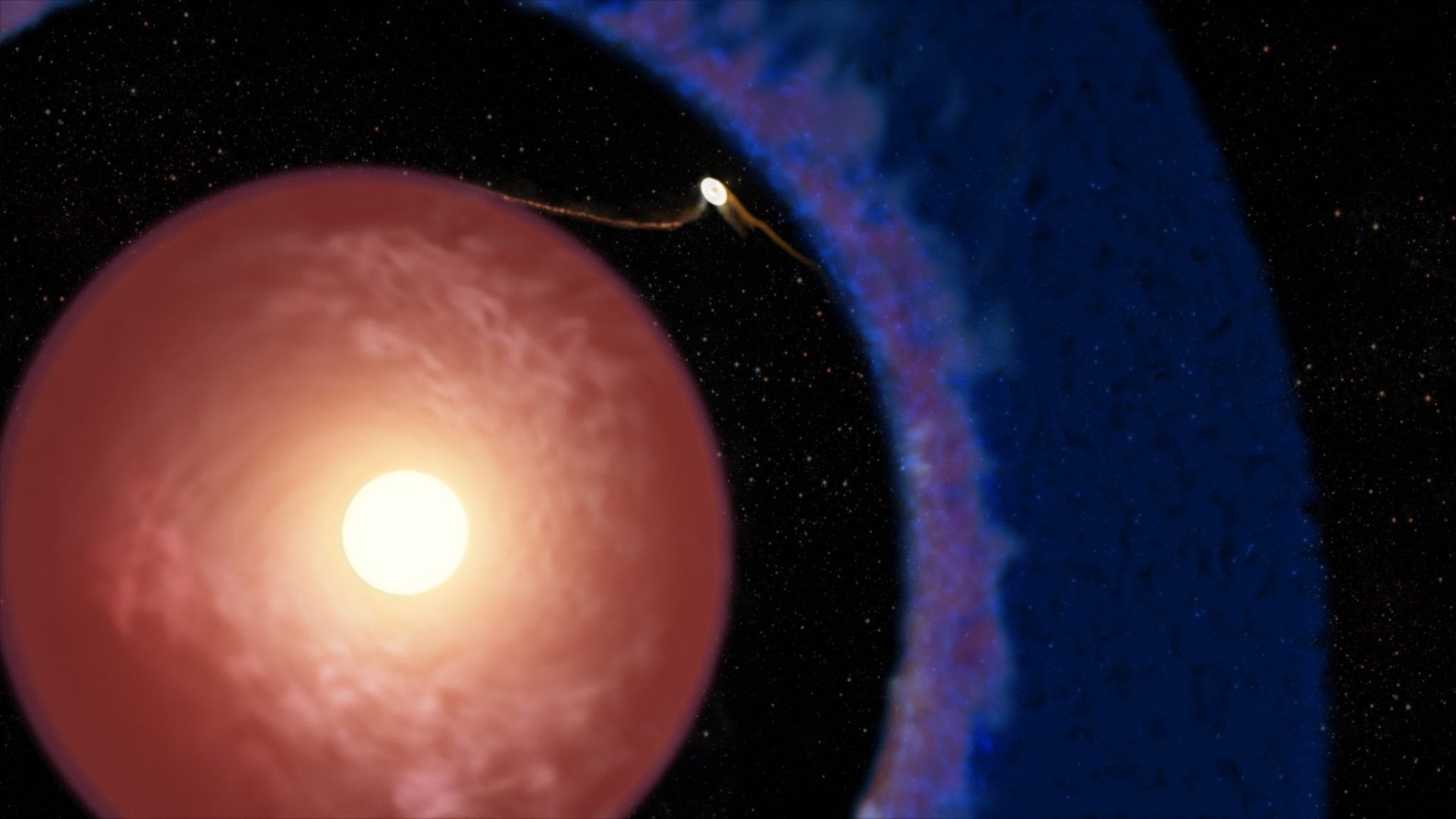
Most exoplanets we find have been around a long time. They’ve cleared out their orbital path (one of the requirements of planethood, as fans of Pluto well know), have their own gravitational pull, and in many cases shine with their own infrared light. But it takes a long time to get to that point - finding “young” planets is much harder. But a new paper available in The Astrophysical Journal Letters by a research team led by Andrea Bernardi of Diego Portales University in Chile describes a new paper that definitely takes the prize as the youngest exoplanet we’ve yet found. That discovery was completed in part thanks to the Atacama Large Millimeter/submillimeter Array (ALMA), located in the Atacama desert in Chile. When this powerful telescope turns its eyes towards systems that are still early in the process of star formation, it regularly sees rings of gas and dust surrounding those stars known as protoplanetary disks. Typically, these disks have very distinct gaps in them, and textbook astronomical theory is that those gaps are plowed out by infant planets collecting material. But trying to see one of those infant planets is difficult. The disks themselves obscure much of what goes on in them, and the host star is absurdly bright compared to whatever light the infant planet is giving off. The best we’ve been able to do so far is to find a planet that had successfully carved out a space in a relatively mature disk, such as the 5.4 million year old exoplanet(s) PDS 70 b/c. Animation of the formation model of the newly discovered exoplanet. Credit - W. M. Keck Observatory YouTube Channel To find an even younger planet, the researchers turned to archival data from the Keck Observatory. Back in 2018, a different group of researchers observed the star known as Elias 2-24, along with six others, with the Near Infrared Cam 2 (NIRC2) instrument onboard the Keck telescope in Hawai’i. Elias 2-24 is around 454 light years away in the Ophiuchus star-forming region, and it had a very distinct gap in its protoplanetary disk about 30 AU wide. This isn’t the first time astronomers had looked at that specific disk gap either - observations from the Very Large Telescope had flagged a bright spot in that gap that could have been a planet, but they were unable to confirm it. The trick was to take all of the observations - from Keck, ALMA, and the VLT - into account. With all the additional context, it became clear that there was indeed an exoplanet orbiting Elias 2-24 at around 54.9 AU - well beyond Pluto’s orbit in our own solar system, but precisely in the middle of the 30-AU-wide gap ALMA had found. And by their calculations, the planet was less than a million years old. For further confirmation, the researchers needed to prove this speck of light wasn’t simply a background star that happened to be perfectly aligned to look like an exoplanet. To do this, they analyzed the relative motion of the spot between data sets collected in 2018 and 2020, and found that the likelihood that another star was causing this signal was just 0.015%. Fraser talks about finding exoplanets Next up in an exoplanet discovery process would be trying to figure out how large and how hot the planet is. Using standard planetary evolution models, the researchers calculated the planet would be between 1.0 and 4.0 Jupiter masses. They also calculated the temperature to be between 1,300 and 1,600 Kelvin - surprisingly hot given how far away from its star the planet is forming. However, there is one large outstanding question - what is the planet’s orbital path. Since it is so far out from its star, the planet only moved approximately 1.5° of its 360° orbital path between 2018 and 2020. That’s not big enough for current telescopes to be able to measure accurately. However, the authors also calculated that, between 2018 and now, the planet will have traveled 6° of its orbit - well within the detection limits of both modern and upcoming observatories. Measuring its orbit will allow astronomers to directly weigh the planet as well as its companion star, adding crucial insight to this early stage of the planetary formation process. There are undoubtedly even younger planets hiding somewhere in the galaxy, but finding them will likely be even more difficult. For now, this planet, known formally as Elias 2-24 b, will have to serve as our earliest example of planet formation, and will undoubtedly be watched closely by as many instruments as we can spare for decades to come. Learn More: W.M. Keck Observatory - Youngest Exoplanet Yet Discovered Found Hiding in Keck Observatory Data A. Bernardi et al - Searching for Embedded Protoplanets with the Keck/NIRC2 Vortex Coronagraph: Confirmation of a Core-accretion Planet in the Narrow Gap of the Elias 2-24 Disk UT - The Youngest Exoplanet Ever Seen? UT - Longest-period young transiting exoplanets discovered
Astronomers Directly Image the Youngest Exoplanet Ever
Full Article
Original Source
Read the full article at Universetoday →KhanList aggregates and links to publicly available news content. We do not host full articles from third-party sources. Always verify important information with original sources.