
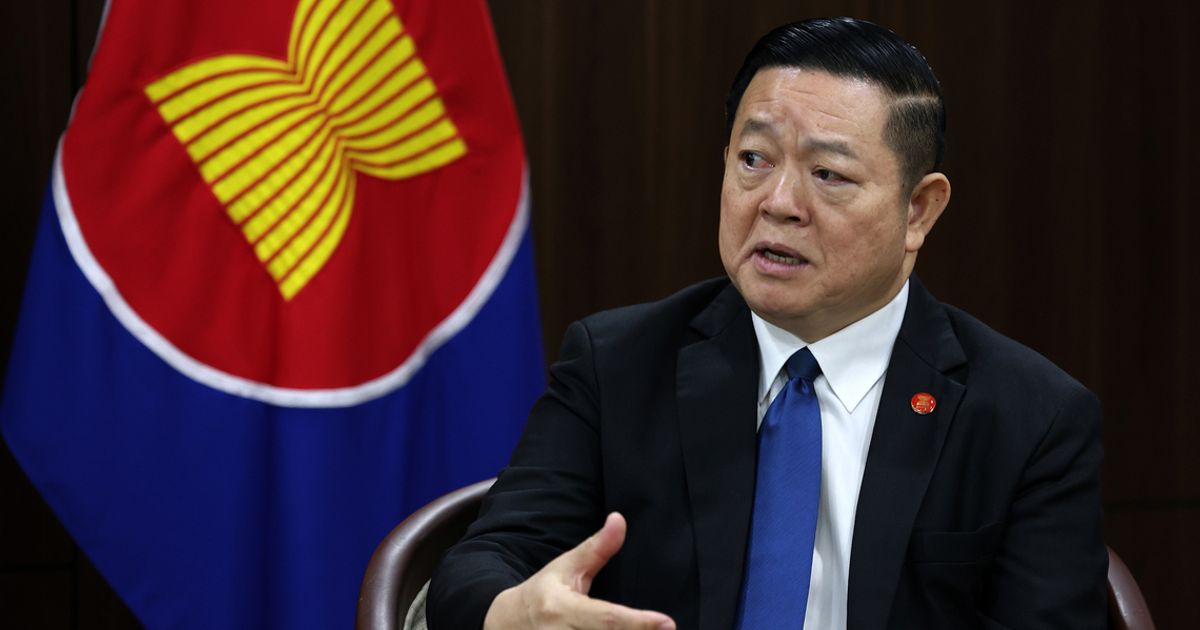
JAKARTA - The fragile ceasefire between Thailand and Cambodia could collapse into renewed fighting unless both countries intensify negotiations, ASEAN Secretary-General Kao Kim Hourn has warned, as Singapore prepares to assume the regional grouping’s chairmanship in 2027.In an exclusive interview with The Straits Times, Kao said little progress has been made in talks between the two neighbours despite efforts by successive ASEAN chairs to end the conflict, leaving the border situation vulnerable to fresh hostilities.He expressed confidence that Singapore could help bring both sides back to the negotiating table, describing the Republic as a “small country, but big diplomacy”.“We should not allow the third round to take place. I think we must prevent another possible eruption of fighting,” he said, referring to two rounds of border clashes in 2025.Kao expressed strong optimism that Singapore could help conclude long-running negotiations between ASEAN and China on a South China Sea Code of Conduct (COC), despite difficult questions over its legal nature and implementation.His remarks come after the Philippines formally handed over the ASEAN chairmanship to Singapore at the grouping’s summit in Manila on Nov 17. Singapore will assume the role on Jan 1, 2027, the year ASEAN marks its 60th anniversary.Singapore has announced “Deeper Integration, Wider Partnerships” as the theme of its chairmanship, which will also focus on strengthening economic cooperation and implementing major regional initiatives.Preventing more fightingThailand and Cambodia’s longstanding territorial dispute along their 800km border erupted into fighting in July and December 2025, killing at least 150 people and displacing roughly one million, according to the Brussels-based International Crisis Group.A ceasefire reached on Dec 27 that year has largely held, though both sides have accused each other of violations.Malaysia helped broker peace efforts as ASEAN chair in 2025, and the Philippines continued those efforts in 2026. In 2027, Singapore will take over leadership of the ASEAN Observer Team, which monitors the ceasefire.Kao said bilateral mechanisms involving the two countries’ foreign and defence ministries, armed forces and border authorities should be put to work, but “until now… not much is happening”.“We have a ceasefire, but the ceasefire remains, I’ll be very frank, fragile, because since the ceasefire was in place, we have not seen a lot of negotiations yet between the two conflicting parties,” he said.He urged both countries to use the breathing space provided by the ceasefire to intensify negotiations rather than risk another outbreak of fighting.While ASEAN had helped contain the conflict, Kao noted that the grouping already has dispute-settlement mechanisms under its charter and the Treaty of Amity and Cooperation in South-east Asia. These include provisions for mediation and arbitration, as well as the treaty’s High Council, which is intended to help resolve disputes but has never been activated.Kao acknowledged diplomatic support from the United States and China, but stressed that a lasting settlement depended on ASEAN and the two countries themselves.“Peace must be from within,” he said.Singapore could help advance talks through its leadership of the observer team and diplomatic engagement with both sides, he added.Kao also expressed confidence in Singapore’s Foreign Minister Vivian Balakrishnan, describing him as “very strategic, very smart”, and said he would have a role to play in advancing peace efforts.South China Sea optimismKao was similarly optimistic about Singapore’s ability to conclude long-running negotiations on the South China Sea COC.“I have every reason to believe that Singapore will lead ASEAN to finalise the COC negotiations,” he said.Kao, who represented Cambodia in negotiations on the Asean Charter in 2007, recalled how Singapore took over the talks from the Philippines and brought them to a conclusion. He said the the Republic could similarly narrow the remaining differences over the COC as ASEAN chair.The COC, which builds on a 2002 declaration between ASEAN and China, seeks to manage disputes and prevent conflict in the contested waters.On Nov 15, Philippine Foreign Secretary Theresa Lazaro said provisional agreement had been reached on about 80% of the paragraphs in the draft COC.Kao said outstanding issues included the agreement’s legal nature and how its provisions would be implemented, but stressed that both sides were committed to concluding negotiations.“We need to have a code of conduct that is agreeable, workable and acceptable by both sides,” he said.Unresolved issues could be referred to senior officials and, if necessary, foreign ministers, he said, adding that a breakthrough would ultimately require compromise from both ASEAN and China.The Myanmar challengeOn Myanmar, Kao acknowledged that ASEAN’s efforts to resolve the conflict had fallen short of expectations, but said the grouping’s approach had evolved towards what he described as “calibrated engagement”.“We cannot disengage from Myanmar,” he said, pointing to visits by Myanmar’s leader Min Aung Hlaing to five ASEAN countries in 2026 as evidence of continued engagement. Since assuming the presidency in April, Min Aung Hlaing has visited Laos in July, Thailand in August, Vietnam and Cambodia in September, and Malaysia in October.Kao called ASEAN leaders’ decision to stay engaged a “wise decision”, saying Myanmar had to be engaged “regularly, consistently and constructively”.But he also stressed that Myanmar must demonstrate its willingness to work with ASEAN, and that the grouping had yet to reach the stage of resuming normal political engagement.Nearly six years after the February 2021 military coup, more than 100,000 people have been killed in the conflict between the military and armed opposition groups, with millions displaced, according to the United Nations.Fighting continues despite ASEAN’s Five-Point Consensus, agreed in April 2021, which calls for an immediate end to violence, dialogue among all parties, humanitarian assistance, mediation by a special envoy and a visit by the envoy to meet all parties concerned.ASEAN has also maintained restrictions on Myanmar’s political representation at its highest-level meetings.Kao said the grouping remained focused on three priorities: reducing violence and restoring stability, delivering humanitarian aid without discrimination, and pursuing an inclusive political process led and owned by Myanmar.Delivering economic integrationBeyond security challenges, Kao identified the ASEAN Digital Economy Framework Agreement (DEFA) as a major priority for Singapore’s chairmanship.Signed at the November summit in Manila, the agreement aims to deepen digital trade and economic integration across the 11-member grouping, including by bringing together countries with differing regulations and levels of digital readiness.Kao said the next priority would be ratification and implementation, with member states working towards a 180-day ratification timeframe.He acknowledged that some countries would need more time to develop digital infrastructure and align their regulations, but said these differences should not hold back regional progress.“Those who are ready to move forward can move forward fast. Those who need more time, they can come on board later on,” he said.The agreement could particularly benefit micro, small and medium-sized enterprises by creating more opportunities to participate in the regional digital economy, he added.Kao also identified energy security and the ASEAN Power Grid, which seeks to strengthen cross-border electricity trade and connectivity, as priorities requiring sustained regional cooperation.Singapore’s chairmanship will coincide with the second year of implementation of ASEAN 2045: Our Shared Future, the grouping’s 20-year vision for a more integrated, resilient and prosperous regional community.Kao said he expected Singapore to build on the momentum of 2026 and accelerate the implementation of the vision.Describing Singapore’s chairmanship theme of “Deeper Integration, Wider Partnerships” as “very bold, very succinct, and very clear”, he said it reflected the need to strengthen integration within ASEAN while deepening engagement with its external partners.With unresolved regional conflicts and major economic initiatives on Singapore’s agenda, Kao expressed hope that ASEAN’s 60th anniversary would be an opportunity to advance peace and cooperation.He said 2027 should be “a year of peace, stability, cooperation, and a year of a lot of hope for ASEAN and for ASEAN people”.
ASEAN sec-gen warns of renewed Thai-Cambodian fighting, backs S’pore to conclude South China Sea pact
Full Article
Original Source
Read the full article at Straitstimes →KhanList aggregates and links to publicly available news content. We do not host full articles from third-party sources. Always verify important information with original sources.