
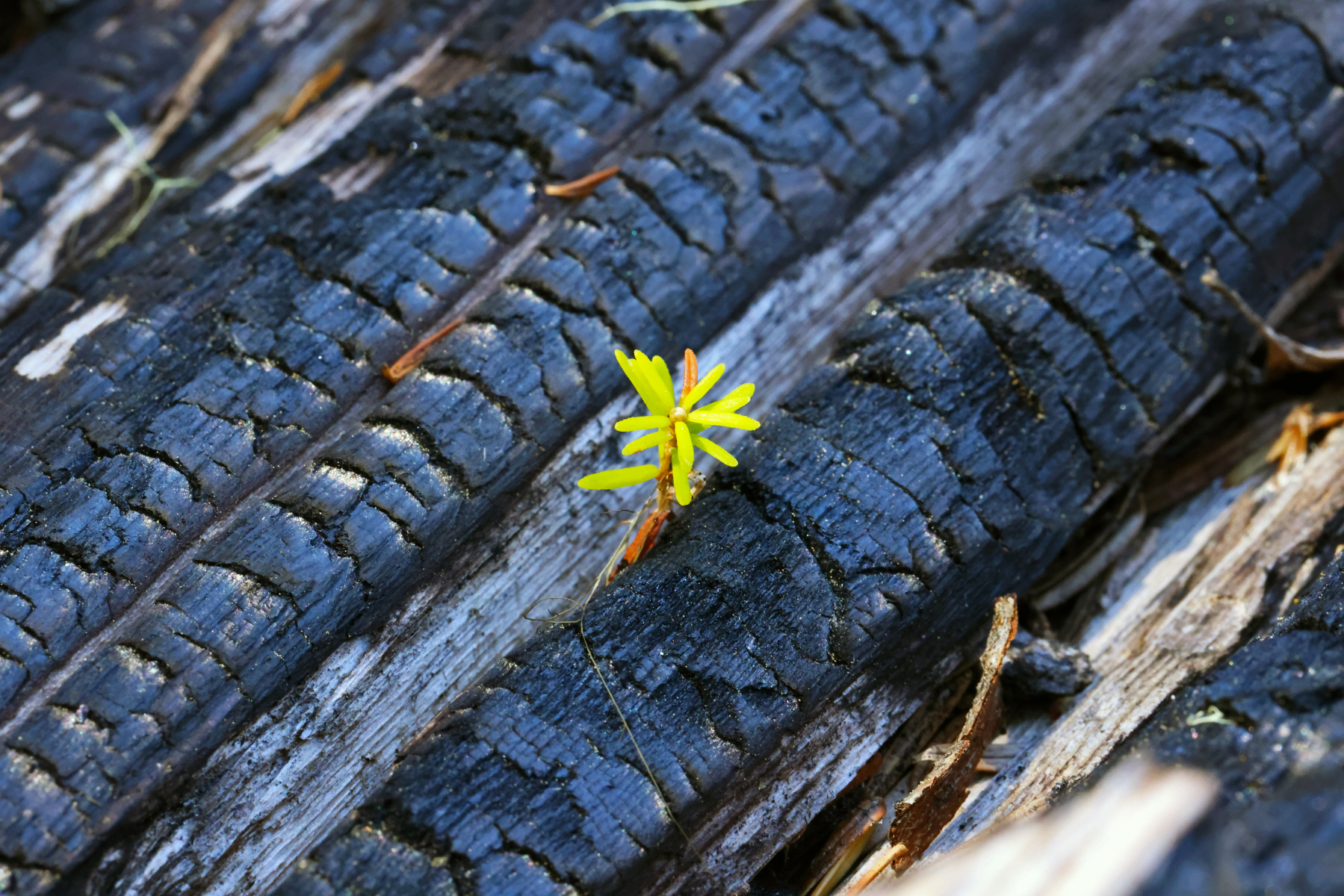
As climate change intensifies, bringing record drought and historic wildfires, scientific studies of fire-adapted organisms in British Columbia, Canada’s Interior, are shedding new light on how important fires are for renewing forest biodiversity.Fungi are pioneers in recovery from fire. Pyrophilous (Fire-loving) fungi, for example, can digest charcoal, help bind soil, and support nutrient cycling in the months after a blaze.Insects and birds also play a critical role. Heat-sensing beetles reproduce more successfully in freshly burned environments, while three-quarters of native B.C. land bird species respond positively, neutrally, or a combination of both ways to wildfire.Research shows mammals, including at-risk Canada lynx, can return to burned landscapes sooner than expected if sufficient forest structure remains. Today’s rapid increase in wildfire frequency and intensity can be devastating, but forests are resilient and can recover, especially when aided by fire-informed research. The reporting and photography for this story was fully supported by a 2025-2026 grant from the Sitka Foundation and the Science Media Centre of Canada. Four of the five worst years recorded for global forest fires occurred since 2021. And 2026 is no exception, with hundreds of thousands in North America, Europe and Africa forced to flee life threatening blazes. Now, as the Northern Hemisphere’s wildfire season subsides and forest recovery begins, tropical countries including Indonesia, Brazil and Tanzania are grappling with widespread fires. Wildfires — now intensified by climate change — can be devastating, life-altering, even deadly. But for many ecosystems and organisms, fire is an essential primeval force of nature that supports ecosystem health and biodiversity. “All terrestrial animals evolved in landscapes that had fire,” Canadian conservation biologist Karen Hodges said. “It goes all the way back to the beginning.” But we still have much to learn about post-fire recovery: Canadian researchers are studying charcoal-munching fungi, heat-sensing beetles, birds and at-risk carnivores in British Columbia’s fire-affected Interior to find out who thrives after the flames die, and why those responses matter for biodiversity and for us. Lieutenant Dan, Canada’s largest known living ponderosa pine (Pinus ponderosa), stands tall in British Columbia’s Montane Cordillera, the nation’s most biodiverse region. Many organisms like this one have evolved alongside fire for millennia. The surrounding forest is slated for logging. Image by Jakob Dulisse for Mongabay. A landscape shaped by fire Tell someone you’re from British Columbia (B.C.) and they’ll likely think “Vancouver,” the province’s large coastal metropolis, or imagine the Pacific coast’s wet temperate forests. But the province is vast and also home to fire-adapted ecosystems and species. Six ecozones spread across B.C., including the country’s most biodiverse: the Montane Cordillera. At 473,000 square kilometers (183,000 square miles), this interior area is slightly larger than Sweden. It extends from the Pacific east into the Rocky Mountains; and from the U.S./Canada border north to the subarctic, and encompasses immense diversity including threatened native grasslands, jagged alpine peaks, fertile valleys and forests, both young and mature, dry and wet. The headwaters of the Columbia and Fraser rivers are here too. After glaciers melted up to 14,000 years ago, wind, rain and earth sculpted this heterogeneous landscape and its wild and human inhabitants, as did fire. “Conifers have all sorts of adaptations to be able to withstand fire,” Hodges, a conservation biology professor and researcher at the University of British Columbia Okanagan, told Mongabay. Other B.C. Interior species became “fire-adapted deep in their evolutionary pasts,” she said. Green fireweed shoots burst up from the site of the 2024 Argenta Creek wildfire where nearly 20,000 hectares (49,000 acres) went up in flames. Image by Jakob Dulisse for Mongabay. After the fire: ‘Wimpy’ plants make a comeback A few hundred kilometers east of Vancouver, thousands of charred, limbless trees cover the hillsides surrounding the community of Rock Creek. In 2015, a fast-moving wildfire burned 4,417 hectares (10, 915 acres) of tinder-dry forest there. “I thought we were going to die. I thought we were going to burn. The wind was blowing, and it was coming for us,” a woman told a local reporter. “There was no time to get anything.” Residents grabbed what few possessions they could and fled by car, as did 200 tourists escaping from a provincial campground on foot. Dozens of homes and businesses were damaged or destroyed. For those caught in the path of such wildfires, the devastation and trauma can linger for years. But walk into the forest burnt by the Rock Creek Fire 11 years later, and you see something else: New life. Native bees and flies visit purple silky lupine (Lupinus sericeus) and the white bells of snowberry (Symphoricarpos albus). Butter-yellow western stoneseed (Lithospermum ruderale) and red scarlet gilia (Ipomopsis aggregata) color the ground. Grasses, fireweed and bright yellow heartleaf arnica crowd around the remains of a western larch two years after a large wildfire near Argenta, B.C., Canada. Image by Jakob Dulisse for Mongabay. Terpenes — scented plant oils released by mature ponderosa trees (Pinus ponderosa) — fill the air with the scent of freshly baked chocolate chip cookies, and verdant tree saplings stand among pastel-toned, pillowy tufts of smooth meadow-grass (Poa pratensis) and Idaho fescue (Festuca idahoensis). This scorched place is rich with greenery. But according to Vancouver-based mycologist Monika Fischer, much of the credit for the comeback belongs to goings on underground. “Plants are total wimps and just an expression of the microbial community in the soil,” Fischer said. Two years after a lightning-sparked wildfire burned 5,980 hectares (14,777 acres) in Valhalla Provincial Park in B.C.’s Interior, mosses and saplings grow across the forest floor. Image by Jakob Dulisse for Mongabay. Fungi: Here for the heat and the feast Fischer runs the Fischer Fire Fungi Lab at the University of British Columbia (UBC) in Vancouver. Her lab closely tracks after-fire fungi, asking fundamental questions, like “what does it mean to exist in this place” and “who is really here?” Her interest in fire-loving organisms began years ago while working as a chef; she simply wanted to learn what makes food taste good. “I got this amazing internship at a farm-to-table restaurant in Washington state [U.S.] where I got to work with the farmers,” Fischer told Mongabay. “They were the ones who taught me about the soil microbiome and mycorrhizal fungi,” and it was those insights that redirected her culinary career toward academia instead. Then in August 2020, while she was working in the U.S. state of California, a freak dry lightning storm ignited hundreds of fires. As the COVID-19 pandemic raged, she and her graduate assistant rushed into the field wearing N95 masks, not to dodge the virus, but to guard against smoke. “At the time the fires were happening, it was really scary,” Fischer recalled. But there was an upside: “Multiple fires happened within an hour’s drive of where I was living. That meant I had a front row seat to the recovery.” Fischer was especially looking for a pyrophilous (fire-loving) fungus (Neurospora sp.), whose lifecycle in the wild is largely unknown. “The fungus that I did my Ph.D. on is fire-adapted. [But] It’s long just been this lab rat model organism; nobody really knows much about its ecology,” she explained. Pyrophilous (fire-loving) fungi can tolerate heat, improve soil structure and help forests recover after fire. Image by Jakob Dulisse for Mongabay. When fire is recent and moisture present, Fischer noted, the “same cast of characters tends to show up.” Plum-purple fireplace cups (Peziza praetervisa) emerge from scorched earth. Yellow-brown, charcoal-loving elf cups (Geopyxis carbonaria) blister up from the black. And Anthracobia sp. deliver dense packages of tiny orange cups which, to Fischer, look like a “shag carpet coating the landscape.” “It’s this barren moonscape and all of these fungi are just thriving,” she said. For millions of years, pyrophilous fungi have depended on wildfire heat, smoke or ash. After a fire, they send threads called mycelium into charred soils and digest what remains, including burned plant matter. “One of the fungi that I study, we know [now] they’re totally able to eat charcoal as a carbon source, which was really surprising to us,” Fischer said, referring to Geopyxis carbonaria, or charcoal-loving elf cups. Fischer thinks these fungi may help kick-start post-fire recovery. “As these fungi are knitting the soil together, they’re also creating this spongy structure that allows water to infiltrate back in,” Fischer explained. “They’re really good at scavenging … nutrients in the soil and liberating carbon out of the charcoal and kickstarting nutrient cycling back into these ecosystems.” Geopyxis carbonaria (charcoal-loving fairy cup) is among the familiar cast of fungi characters that appear soon after a fire in interior B.C., feeding on charcoal and helping rebuild the soil. Image by Jakob Dulisse for Mongabay. Other researchers are also exploring how fungi fare after fire, and how they help shape what comes next. A 2024 study partially supported by Ohio State University found heat-resistant traits in some species. A 2021 study supported by Montana State University observed a 30% increase in post-fire soil aggregation if pyrophilous fungi were there. A 2025 study in India explored pyrophilous fungi’s ability to break down contaminated soil. Like many living in British Columbia, where six of the province’s worst wildfire seasons have occurred in the past decade, Fischer experiences real anxiety with each fire season. But she hopes learning more about fire-loving fungi will offer some comfort to others. “The trauma part of fire is very real,” Fischer said. “But then the winter rains come, and the fungi start fruiting, and it’s this beautiful burst of rainbow rebirth just months after. I find so much hope and beauty [in that moment]. We never would have gotten to this point had we not gone through the burn.” Burned ponderosa pines provide habitat for insects whose larvae are an important food source for woodpeckers and other birds. Image by Jakob Dulisse for Mongabay. Fire-chasing beetles Aaron Bell, an entomologist at UBC Vancouver, has encountered and studied fire-dependent insects both on purpose and by accident throughout his career. In June 2021, during a deadly continental heat dome, Bell was working while staying with his parents in La Ronge, Saskatchewan. More than a dozen large forest fires burned nearby. And suddenly, pyrophilic beetles were everywhere: “They crawled up through the siding area of the house, and they were in the [kitchen] sink,” Bell recalled. “Then I found two in my bed. One came through the ceiling fan in the washroom.” The beetles were Sericoda obsoleta, or campfire ground beetles. Each is equipped with antennae that detect fire, infrared receptors to sense heat (or avoid flames), and an appetite for pyrophilous fungi — early detection tools that allow these coleopterans to rapidly chase down fires. But why the hurry? “If you colonize that [new] burn really quickly and lay your eggs, you’re going to avoid a lot of predators and tiny little parasites,” Bell told Mongabay. Scientists are aware of 60 species of pyrophilic insects worldwide, including metallic wood-boring beetles (Melanophila acuminata), flat-footed smoke flies (Microsania stigmaticalis) and incense-cedar wood wasps (Syntexis libocedrii). Sixty species of pyrophilic (fire-loving) insects have been identified worldwide, including metallic wood-boring beetles, flat-footed smoke flies and incense-cedar wood wasps. Image by Jakob Dulisse for Mongabay. To be considered a true pyrophile, both physiological and behavioral adaptations to fire are required. These can include antennae that detect chemicals released by burning trees and fire-synchronized reproductive cycles. In Bell’s lab, Sericoda obsoleta beetles given the chance to mate on freshly heat-sterilized soil benefited significantly compared to beetle pairs raised in unburnt soils., Those fire-attracted beetles “had an 80% higher reproductive output,” Bell said. Not surprisingly, researchers make their best observations of pyrophilic insects immediately after a fire. This summer, Bell worked cooperatively with the B.C. Wildfire Service setting up insect traps near logging roads across the Interior. “Our goal was definitely to get in there as soon as it’s safe to capture these interactions while they’re happening,” Bell said, to increase understanding of “what insects do in that fire environment.” While support for insect ecology research in Canada remains limited, some intriguing fire-related work has been done. A 2022 paper suggested that wood-boring beetles prefer the largest surviving trees in burned areas of dry Interior Douglas-fir forests. An earlier Alberta study found several species of native spiders present in post-wildfire affected boreal forests. Eleven years after an intense wildfire burned through and around Rock Creek, B.C., dozens of native plant species have returned, attracting pollinators such as the Boisduval’s blue butterfly. Image by Jakob Dulisse for Mongabay. Rob Higgins, a retired entomologist and professor at Thompson Rivers University in Kamloops, B.C., once oversaw a post-fire ant diversity project in B.C.’s endangered Interior grasslands. “In areas that were unburned, you had two to three species of ants,” Higgins told Mongabay. “Post-burn, within a couple of years, you had 12, 13 species. [Fire] really opened up the habitat for new [ant] species to come in.” As a northern Indigenous person, Bell worries about what the soaring number of fires brought by climate change will mean for people who have close relationships to the land. In 2015 those fears became personal, as a wildfire threatened Bell’s hometown of La Ronge, Saskatchewan, destroying a historic store which displayed the work of Indigenous artists. “I used to go into that store as a kid. It’s gone, which is absolutely devastating,” he recalled. But despite such losses, Bell said his growing understanding of fire-adapted ecosystems and the new life they support gives him hope. “By no means are these burn sites … ecological wastelands … Many of them are adapted to bounce back. Many specialist organisms have niches that are very much suited to fire.” Lewis’s Woodpecker (Melanerpes lewis), a species at risk in B.C., benefits from burned forests. Image by Jakob Dulisse for Mongabay. Fire? It’s for the birds; at least 77% of them Pyrophilic fungi and insects aren’t the only organisms to have co-evolved with forests and fires. Birds too play a vital role in post-fire comebacks. The Pacific Birds Joint Venture’s Canadian team recently explored how birds respond to B.C. wildfires. Of the 243 bird species they focused on, 23% responded negatively to wildfires. But 77% had positive, neutral or mixed responses. “When most people think about a burned forest, they think everything’s gone; it’s a dead zone. Or they think of that burned koala in Australia looking for a sip of water from the firemen,” said Andrew Huang, a biologist with Environment and Climate Change Canada and the Canadian coordinator for the Pacific Birds Joint Venture. “Yes, it’s devastating, but at the same time, fire creates habitat for an entire suite of bird species,” he told Mongabay. The Venture team used 25 North American studies to build a database of multiple bird species’ overall, immediate and moderate responses to wildfire and then analyzed a range of life-history traits rather than a single trait to forecast their potential survival. Jenny Munoz, the Venture’s science coordinator and a biologist with Birds Canada, said this approach sets the study apart from existing research on birds and fire. “It allows you to see an organism as this multidimensional, multi-characteristic organism,” Munoz said. A recent review found that 77% of 243 B.C. bird species studied responded positively and/or neutrally to wildfire. Mountain bluebirds (Sialia currucoides) benefit from the open habitat fire creates. Image by Jakob Dulisse for Mongabay. Some birds did well after open habitat fires, including the olive-sided flycatcher (Contopus cooperi), Savannah sparrow (Passerculus sandwichensis), mountain bluebird (Sialia currucoides), and even at-risk species like the Lewis’s woodpecker (Melanerpes lewis) and common nighthawk (Chordeiles minor). Others struggled, and NO:which may require more conservation attention as fires become more frequent across British Columbia. These include species that rely on dense, mature forests (requiring closed canopies for nesting), such as the pileated woodpecker (Dryocopus pileatus) and sharp-shinned hawk (Accipiter striatus), or bird species that need foliage to glean, like the ruby-crowned kinglet (Corthylio calendula). Researchers emphasize that B.C. bird response to fire overall is mixed. Some birds win, some lose; it all depends on who they are, what they do and what they eat. “There are so many species. They don’t just behave like one single unit,” Huang said. Knowing a species’ particular behaviors can greatly aid conservationists in its recovery. While bird research funding is limited at the best of times, Munoz believes such research needs to be a provincial and federal priority as fires increase in number and ferocity. “Everybody in B.C. loves biodiversity. Everybody wants to go to the park, see a tree, see the fish, see the birds. But … what is required for everybody to have [and experience] that biodiversity?” she asked. “I don’t think people are aware of that.” Nature shows that fire can also be a fundamental rejuvenating force for many organisms, and informed research can support that recovery. Knowing this could make a fiery future a little more tolerable. Pacific Marten image by Jillian Cooper via Istock. Leaving a biological legacy During the record-breaking wildfire summer of 2023, Hodges sat in her smoke-filled Kelowna, B.C., office working on the prospectus for her academic book Wildfire and Wildlife; it was published this summer by Springer. As she wrote, she considered the dearth of knowledge on her topic: “There just wasn’t a ‘Dear wildlife biologist, if you’re thinking about designing a fire-related study, what do you need to know about fire [and] … about how animals respond to it?’” Hodges recalled. “It didn’t exist.” Hodges has co-authored many studies investigating what wild birds and mammals do after wildfires. But ask her how animals typically respond to fire in B.C., and she’ll tell you: “There is no typical.” It largely depends on what food and habitat remain post-fire. “Suddenly there’s this bonanza for insectivores and carnivores,” Hodges said. “Play that forward over weeks to months to years as vegetation regrows; you’ve got different species thriving, managing, can’t tolerate, attracted to … [Recovery is] this really dynamic mix of every species doing something a bit different.” For example, her research team found that Pacific marten (Martes americana and M. caurina), a forest specialist and indicator species, will use burned Interior forests as long as they are regenerating and structurally complex. Post-wildfire salvage logging is common in B.C. and can affect how plants and animals recover after a fire. Standing snags (left) provide food, cover and habitat. Clearcut areas (right) leave less organic material for wildlife and can lead to erosion. Images by Jakob Dulisse for Mongabay. “If you’ve got a lot of standing snags, especially if the snags still have holes in them, that’s a much more attractive landscape to a marten than if you had a lot more of the fuel burned or almost everything fell over,” Hodges said. Another of her studies found that southern red-backed voles (Myodes gapperi) and deer mice (Peromyscus maniculatus), important prey for many birds and mammals, recovered between two and 10 years after wildfire. They also help regenerate forests. “A lot of small mammals are pollinators or seed dispersers,” Hodges noted. “So, if you do stuff after a fire that makes it harder for those animals to be present, [such as salvage clearcut logging] that will affect what plants can recolonize.” A 2017 study found that at-risk Canada lynx (Lynx canadensis) used new burns within one to two years after a fire, decades earlier than previously thought, as long as some forest structure (shrubs, snags, live trees) remains. A 2017 study found that at-risk Canada lynx (Lynx canadensis) used burned interior forests within one to two years after a fire, decades earlier than previously thought, provided some forest structure (shrubs, snags, plants) remained. Image by Scalia Media via Istock. “Predator presence really depends on whether their favorite prey can persist after fire and as regeneration occurs,” Hodges explained. “The Canada lynx, a specialist predator of snowshoe hares: They’re not really using the burns until there are snowshoe hares present.” Living in B.C.’s Okanagan region through record-breaking wildfire seasons, Hodges has seen how strong and resilient people can be, and how they recover after the flames leave. Her research has now shown wildlife can do the same; if biological legacies remain. “It could be underground roots that re-sprout. It could be a tree that was only partially burned, isn’t dead … It could be a population of subterranean rodents that tunnel; then after the fire burns across, they pop back up. That means a predator can come in and have a meal,” Hodges explained. Nature shows that fire can be a fundamental rejuvenating force for many organisms, and informed research can support that recovery. Knowing this could make a fiery future a little more tolerable. Image by Jakob Dulisse for Mongabay. Fire takes a toll, offers transition and rebirth 2026 will likely be remembered as another record-breaking wildfire year in B.C. and globally. But as climate change intensifies, it won’t be the last. Increasingly, people across the world are threatened by fire, battling new blazes, or recovering after flames are extinguished. Likewise, scientists are increasingly concerned about how supercharged weather systems like El Niño, massive heat domes and record droughts will impact next year’s fire season. There’s no question: Wildfires are terrifying and destructive, and fire preparedness along with drastic cuts in carbon pollution are desperately needed. But nature shows that fire can also be a fundamental rejuvenating force for many organisms, and informed research can support that recovery. Knowing this could make a fiery future a little more tolerable. “Fire is here to stay,” Munoz said. “We need to think of fire as a transition … it’s so important.” Eleven years after the Rock Creek Fire, new life is emerging among the charred trees and hillsides of B.C.’s Interior. The 2015 wildfire burned 4,417 hectares (10,915 acres) of tinder-dry forest. Image by Jakob Dulisse for Mongabay. Banner image: Wildfires are devastating, but fire can also be a rejuvenating force for many organisms and landscapes. Image by Jakob Dulisse for Mongabay. Citations: Filialuna, O., and Cripps, C. (2021). Evidence that pyrophilous fungi aggregate soil after forest fire. Forest Ecology and Management, 498, 119579. doi:10.1016/j.foreco.2021.11957 Hopkins, J. R., and Bennett, A. E. (2024). Leveraging traits for insight into the fungal ecology of burned ecosystems. Ecosphere, 15(11), e70008. doi:10.1002/ecs2.70008 Rani, R., Srivastava, N., Pandey, M., and Parcha, V. (2025). Pyrophilous fungi: A new frontier in hydrocarbon biodegradation. The PLANTA Research Book Series, 6(1), 1820–1823. Retrieved from: https://planticapub.wordpress.com/wp-content/uploads/2025/05/203-ritu-dav-p.g.-college.pdf Bell, A. J., Calladine, K. S., Wardle, D. A., and Phillips, I. D. (2022). Rapid colonization of the post-burn environment improves egg survival in pyrophilic ground beetles. Ecosphere, 13(8), e4213. doi:10.1002/ecs2.4213 Kitchens, K. A., Peng, L., Daniels, L. D., and Carroll, A. L. (2022). Patterns of infestation by subcortical insects (Coleoptera: Buprestidae, Cerambycidae) after widespread wildfires in mature Douglas-fir (Pseudotsuga menziesii) forests. Forest Ecology and Management, 513, 120203. doi:10.1016/j.foreco.2022.120203 Buddle, C. M., Spence, J. R., and Langor, D. W. (2000). Succession of boreal forest spider assemblages following wildfire and harvesting. Ecography, 23(4), 424–436. doi:10.1111/j.1600-0587.2000.tb00299.x Volkmann, L. A., and Hodges, K. E. (2022). Residual forest structure influences behaviour of Pacific marten (Martes caurina) on post-fire landscapes. International Journal of Wildland Fire, 31(4), 329–349. doi:10.1071/WF21075 Kelly, A. J., and Hodges, K. E. (2022). Postfire salvage logging alters impacts of recent wildfire on small mammal communities in summer. Journal of Mammalogy, 103(5), 1168–1181. doi:10.1093/jmammal/gyac054 Vanbianchi, C. M., Murphy, M. A., and Hodges, K. E. (2017). Canada lynx use of burned areas: Conservation implications of changing fire regimes. Ecology and Evolution, 7(7), 2382–2394. doi:10.1002/ece3.2824 FEEDBACK: Use this form to send a message to the author of this post. If you want to post a public comment, you can do that at the bottom of the page. Credits Topics
As wildfires rage, Canadian researchers study the life that comes after
Full Article
Original Source
Read the full article at News →KhanList aggregates and links to publicly available news content. We do not host full articles from third-party sources. Always verify important information with original sources.