
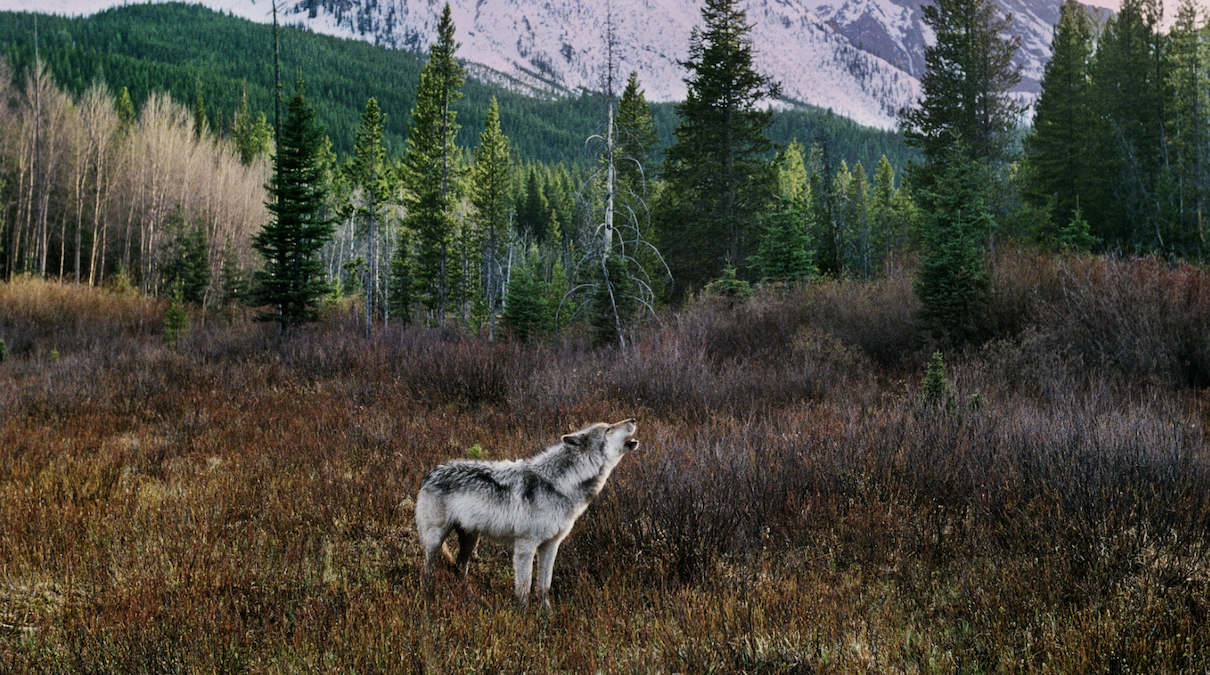
After decades of effort to restore gray wolves to portions of their former range, some U.S. states are once again pursuing aggressive policies to radically reduce their numbers.Two Emmy Award-winning filmmakers who’ve lived among wolves argue in a new commentary that these actions are misguided.“Coexistence begins with the understanding that wolves have a rightful place in the wild. It asks us to prevent conflict where we can, adapt where we must, and resist the idea that killing should be the first response when wolves and people share the same space,” they write.This article is a commentary. The views expressed are those of the authors, not necessarily of Mongabay. For centuries, wolves have been cast as vicious, bloodthirsty creatures of nightmares and fairy tales, rather than as deeply social animals with an important place in nature. We wanted to understand the animal behind those stories. So, in the 1990s, we spent six years living alongside a pack of gray wolves (Canis lupus) on the edge of Idaho’s Sawtooth Wilderness. In a remote mountain setting, we camped among wolves, listened to them, filmed them, and slowly became part of their world. What we came to know was an animal very different from the one humans have been taught to fear. We witnessed wolves raise their pups, care for their injured, and mourn their dead. When a mountain lion killed a member of the pack, we saw how the loss affected the wolves for more than six weeks. Above all, we learned that a wolf pack is an extended family devoted to one another by relationships, experience, and knowledge passed from one generation to the next. The Dutchers’ camp was surrounded by chain-link fence, not to protect them from the wolves, but to protect their gear from the animals’ insatiable curiosity. Image © Jim and Jamie Dutcher. That understanding shapes how we see what is happening to wolves across the American West today. After decades of effort and revenue spent to restore gray wolves to a fraction of their former range, U.S. states are now pursuing aggressive policies to radically reduce their numbers once again. In Idaho, legislation enacted in 2021 expanded trapping and snaring seasons, removed limits on the number of wolf-kill-tags an individual can purchase, and broadened the methods and technology that can be used to decimate wolf populations. Two years later, the Idaho Department of Fish and Game approved a six-year management plan calling for the state’s estimated population of 1,337 wolves to be reduced by 62%, ultimately bringing the population down to approximately 500 statewide. In Wyoming, the situation is even starker: across roughly 85% of the state, wolves are classified as predatory animals and can be killed year-round without a hunting license. In this vast “predator zone,” wolves can be shot, trapped, snared, and even pursued with snowmobiles, creating what amounts to an unrestricted killing zone across most of the state. Meanwhile, in Montana, the state acknowledged in July 2026 that it had overestimated its wolf population for years, revising its most recent estimate from 1,094 wolves to just 725. Yet one month later, the state authorized 300 to be killed during the 2026–2027 season — more than 40% of its newly estimated population and enough to push numbers close to the state’s minimum threshold. Despite the odds, the black wolf at the center of the pack rose to a leading position as alpha female. Image © Jim and Jamie Dutcher. For a species that only recently returned to the Northern Rockies after being nearly exterminated from the lower 48 states, that should give us serious pause. But numbers and policies alone do not tell the full story. A population estimate cannot tell us whether a litter of pups has lost its mother, a lifelong breeding pair has been broken apart, or an experienced wolf carrying years of knowledge is suddenly gone. Those losses matter because wolves depend on one another. We saw this firsthand with the Sawtooth Pack. The alpha male was the first to respond when something unfamiliar entered their territory. He would move immediately toward the disturbance while the rest of the pack remained behind, putting himself in harm’s way to protect his family. That same instinct can make experienced wolves especially vulnerable to hunters. When older experienced wolves are killed, the rest of the pack loses skilled teachers who know how to locate and hunt prey, navigate territory, and recognize danger. And when hunting or trapping reduces a family to only a few adults, bringing down large native prey becomes even more difficult. As a result, smaller, disrupted packs may be forced to turn to easier sources of food, including livestock. In other words, destabilizing wolf families can contribute to the very problems wildlife managers and ranchers are trying to prevent. The Dutchers often observed two wolves lying curled up with one’s head draped over the neck of the other, in a gesture that could be both assertive and affectionate. Image © Jim and Jamie Dutcher. Yet in Idaho, wolves can be killed during times of the year when other species receive protections while raising their young. While female black bears and mountain lions accompanied by dependent young are protected, wolves raising pups receive no comparable safeguards. In 2024, three young pups were killed at an Idaho wolf den, and the hunter received reimbursement through a taxpayer-funded program that covers expenses for successful wolf kills. Policies like these do more than create incentives to kill wolves. They create a system in which killing becomes financially rewarding and culturally normalized. The old bounty system may sound like a relic of the past, but the financial rewards of today can perpetuate the same dangerous logic: that wolves are a nuisance to be legally controlled. Historically, we have seen where that thinking can lead. Wolves were once poisoned, trapped, and shot until they had been eradicated from nearly all of the lower 48 states. Their return required decades of scientific study, conservation efforts, public education, and a willingness to reconsider what we thought we knew about predators. We should never repeat that history. None of this means conflicts involving wolves should be ignored. Livestock producers deserve meaningful support when losses occur, and wildlife managers must be able to respond to genuine problems. But there is a profound difference between targeted, science-based conflict management, and policies that disrupt pack structure simply to drive wolf numbers downward. A mid-ranking adult member of the pack plays with two pups. Image © Jim and Jamie Dutcher. Proven nonlethal approaches can help livestock producers prevent and reduce conflict, especially when they are backed by the resources, training and support needed to put them into practice. Coexistence begins with the understanding that wolves have a rightful place in the wild. It asks us to prevent conflict where we can, adapt where we must, and resist the idea that killing should be the first response when wolves and people share the same space. For six years, wolves allowed us into their world. What we saw was not the villain of folklore. We witnessed loyalty and cooperation, parents caring for young, older wolves teaching the next generation, and family members depending upon one another for survival. We witnessed friendship, empathy, and grief. Should we be surprised that the wolf — the mother of all dogs — shares these same traits with our beloved pets? Most people will never have the opportunity we had to know wolves so closely. What we learned was simple: wolves are more than a population number. Wolves are incredibly social, sentient beings living in complex families. They play an essential role in maintaining the health and balance of the ecosystems they inhabit, and how we manage them should reflect that reality. We already know what happens when fear and intolerance determine their future. We nearly lost wolves once before. Their return was one of America’s great conservation successes, but that progress is not guaranteed to last. There is a choice before us: repeat the mistakes of the past or prove that we have learned from them. Jim and Jamie Dutcher are the filmmakers behind Wolves at Our Door and Living with Wolves, and their television specials on wolves have won three Primetime Emmy Awards. They are the founders of the nonprofit organization Living with Wolves. Banner image: A wolf howls with the Sawtooth Mountains in the background. Image © Jim and Jamie Dutcher. See related coverage: ‘Don’t shoot. Listen’: The AI-aided quest to understand Yellowstone’s wolves Choosing coexistence over conflict: How some California ranchers are adapting to wolves Isle Royale wolves inbred but likely to survive, study says Credits Topics
As US states cull recently restored wolf populations, here’s what we stand to lose (commentary)
Full Article
Original Source
Read the full article at News →KhanList aggregates and links to publicly available news content. We do not host full articles from third-party sources. Always verify important information with original sources.