
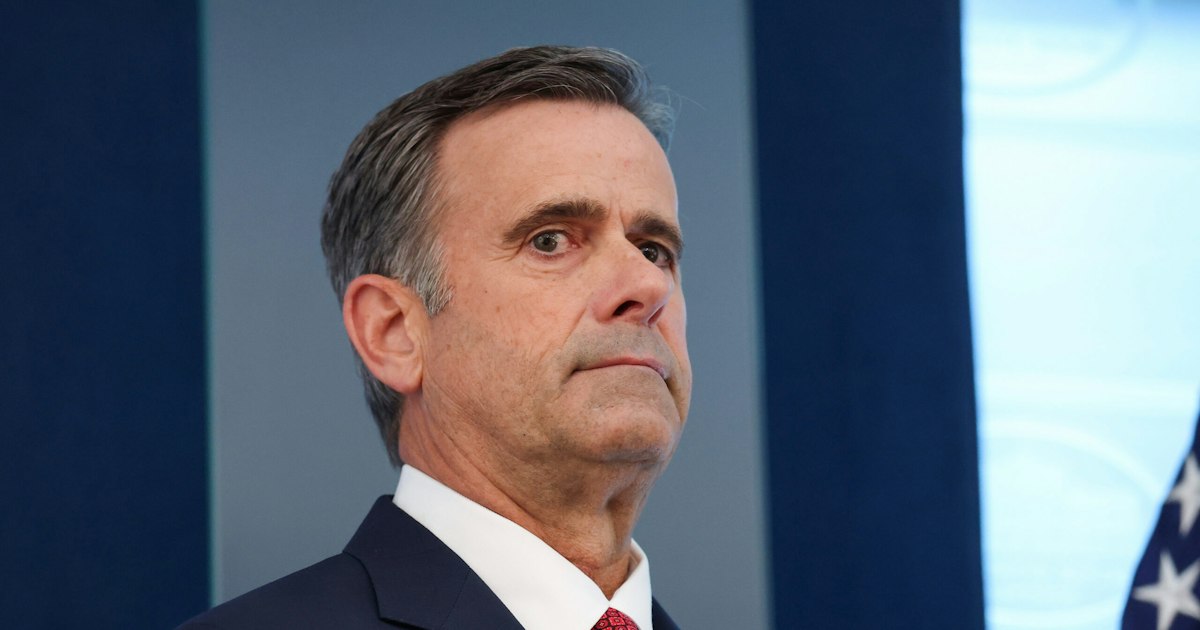
Ukraine Why is U.S. policy on Russia–Ukraine so self-contradictory? (Photo by Anna Moneymaker/Getty Images) The Atlantic on October 23 published a profile of CIA chief John Ratcliffe. Its subheadline contains the most significant “tell” from the piece—“CIA Director John Ratcliffe leads an agency that’s at war with Russia, even as Trump makes nice with Putin.” The Atlantic article makes no bones about its ulterior purpose. It is to present Ratcliffe as an even-handed professional who has mastered the intricacies of the Ukraine War and tells it “like it is” to the president, leaving the latter to decide his options. This panegyric to Ratcliffe, however, hides substantive issues about the probity of CIA intelligence analyses, their impact on policy, and the extent to which the pure excitement of militarized covert action inevitably hobbles intelligence agencies and analytic reporting. Intelligence is never wholly objective. And its professionalism largely hangs on service culture, which can—and does—change. As one example, a former head of the IDF’s Military Intelligence research and analysis division, General Itai Brun, warned that Israel’s inability to recognize what Hamas was planning for October 7 resulted, not from a lack of information, but from a failure of culture and approach. Per the Times of Israel’s report of his comments: Even after the massacre, intelligence didn’t internalize that Hamas believed it could succeed…. The whole military intelligence network “was not listening, because it was convinced it knew…. It could not accept the possibility that it was wrong. So, when it comes to “culture,” in this sense, two points in the Atlantic piece stand out: First, the article hints that Ratcliffe is seen by his staff to be “clear-eyed about the threat Russia poses not just to Ukraine—but to the United States and its allies.” This suggests that Radcliffe sees Russia as an eternal enemy of the West, or at least a current enemy with nefarious intentions. Secondly, the article emphasises that the CIA is in “the lead” on Ukraine and that its paramilitary wing—Covert Action—is thrilled at being so busy. As Larry Johnson, a former CIA official, outlines: The CIA helps Ukraine knock out Russian refining capacity. Diesel prices soar. Then… in the middle of peace talks in Miami… President [Trump] announces a deal for Russia to sell its diesel on the world market…. So the United States is simultaneously paying to destroy Russian diesel production and begging Russia to sell it more diesel. You could not design a more incoherent policy if you tried. The Atlantic piece lends credence to what has long been supposed—that Trump’s attempts to secure a “deal” with Russia (most recently by importing Russian diesel into America to bring the price down for the midterm elections) is a deceit intended to coax Moscow towards making a deal (unfavorable, in the Kremlin optic) with Trump. It would be a deceit because the CIA pursues its own (militarised) covert action war on Russia. The Atlantic, citing a CIA officer, reports: Armed with information that the U.S. provides, Ukraine’s military has launched strikes deep inside Russia. And U.S. spy satellites provide early warning about incoming missiles and drones. Among U.S. personnel on the ground, “the CIA is in the lead,” a retired senior officer who travels frequently to Ukraine told me. The recent Starlink fracas—was its military communications network deactivated, was it go-slowed, did it glitch?—only highlights ever more clearly the dysfunction inherent to the U.S. institutional contradiction underlined by the Atlantic’s subheadline. Plainly—for whatever the behind-the-scenes reason—Trump does not choose (or cannot choose) to exert control over the CIA. (Although, he could cancel all previous “Presidential Findings” that legally frame what the CIA can and cannot do and could substitute them with his own Finding). Evidently, all that Trump was able to do in this instance to advance his putative “peace deal” was to withhold Starlink communications and intelligence sharing, ad interim, until Zelensky agreed to stop hitting Russian fuel refineries. The storm was over in days; Starlink was reactivated. How should we read these events? Plainly, the deep state isn’t on board with Trump’s “making nice” with Russia, and Trump isn’t bringing them along. Does the Russian leadership understand what is afoot with Trump’s apparent soft deceit that is intended to appease the MAGA constituency at home, whilst the CIA, as the Atlantic piece says, continues to “have gotten too good at hurting Russia, for Trump’s taste”? President Vladimir Putin, of course, understands completely. That is why Russian policy has pivoted to an operational-level strategy to destroy the militarily useful infrastructure of Ukraine, thus banishing the specter of a potential attack from the “space” to the west of Russia for at least a generation, maybe more. As Dmitri Trenin outlines: The Russian army has launched its own [campaign]… dropp[ing] some of its self-imposed restraint... hitting the targets that heretofore it had avoided… [as] a way “to escalate to de-escalate”—six to nine months of intense air war in combination with advances on the ground that could bring the conflict to an end.” Russia’s tested resilience in this war is superior to Ukraine’s in material terms and to Europe’s in nonmaterial ones, which will likely determine what happens in the future.[/BLOCK] The question, then, is does the CIA “get it”? Or is it, on the pattern outlined by Brun, the aforementioned Israeli general, that the CIA “knows” that Russia—in fact—is failing? In which case, the CIA was, in Brun’s words, “was not listening, because it was convinced it knew.” The Atlantic, again: “No one knows the state of the war, and the stakes involved, better than the CIA officers who are working in Ukraine and monitoring the fight from headquarters.” And are the Europeans listening? Not at the moment. The denial amongst some of the political class may be cracking, but it remains nonetheless largely intact—mainly because no European leader has any feasible plan to end the Ukraine entanglement in any cogent way. And, at the same time, no European leader knows how the EU can fund Ukraine and its war without crashing the very financial architecture that underpins “liberal” Europe. Yet they soon will come to understand, because Europe is politically broken and financially broke—Eurozone government debt has increased to nearly 89 percent of GDP in the past six months. France’s debt has ballooned to 119 percent of GDP, while Italy’s is approaching 140 percent. Economic growth is slowing, unemployment has edged higher, consumer confidence is falling, and the ECB has already started raising interest rates again. Europe surely can’t cough up the further €155 billion that Zelensky is insisting Europe should provide to Ukraine—particularly as the EU is already currently paying installments of the €90 billion loan for Ukraine that was meant “to help cover funding to the end of 2027.” Subscribe Today Get daily emails in your inbox Russia is very aware of Europe’s fracturing. As Timofey Bordachev of the Valdai Club lays bare, “Western Europe is falling apart.” Bordachev writes, The unrest sweeping several European countries… marks a new phase in the continent’s systemic crisis… [reflecting] the convergence of two long-term problems that much of Europe’s political establishment has proved incapable of resolving. The first is the exhaustion of the socioeconomic model that sustained Western European prosperity… The second is Western Europe’s long-standing absence of genuine sovereignty…. The [American-led NATO] alliance’s practical [function] has been to preserve the existing political order…. Transform[ing] that order would require a reassessment of relations with Washington and such independence is something these European governments have long been unwilling, or unable, to contemplate. One wonders whether the CIA, which supposedly knows so much, knows about any of this either.
As Trump ‘Makes Nice’ with Moscow, the CIA Has Other Ideas
Full Article
Original Source
Read the full article at Theamericanconservative →KhanList aggregates and links to publicly available news content. We do not host full articles from third-party sources. Always verify important information with original sources.