
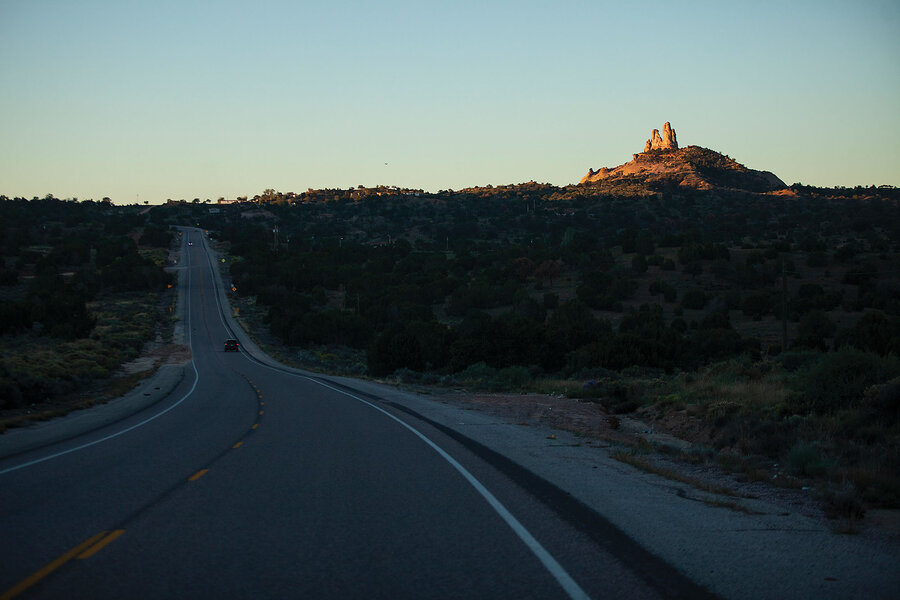
Gallup, New Mexico | Nov. 06, 2026, 5:00 a.m. ET | 15 min read I. A memory of water East of Gallup, New Mexico, just off Route 66, the road into uranium country lets go of the river and the land begins to climb.The cliffs begin a dark red, then a lighter red. Bands of pale stone rule straight across some like lines on a ledger. Juniper hold on where they can. On the rim, a formation of rock stands up like a steeple, and the Diné, who were naming this country long before anyone here had seen a church, call places like this tsé íí’áhí (ts-eh ee-ee-AH-hee), or “standing rock.”Miles up the way, the Rio Puerco eventually finds the road again on its North Fork. It runs when it runs. For most of the year, it is a wash of sand between low banks, the kind of river that is mostly a memory of water. The rock formations here stand over the Grants Mineral Belt. Between 1944 and 1986, nearly 30 million tons of ore came out of Navajo lands under leases with the Indigenous nation. The wider belt provided nearly half the uranium the United States used to produce nuclear weapons during the Cold War. The Diné word for it is łeetso: yellow dirt. Some elders say the word also names a monster.At Church Rock, the richest ore lay deep. Shafts dropped 1,700 feet into sandstone, and the mines were wet. Groundwater came into the workings faster than men could dig, and it had to be pumped to the surface so that a shift could go down at all.The mines sent that water into the Puerco, normally just a dry riverbed. Downstream, families watered sheep. Children played. This went on for 19 years. The federal government now counts more than 500 abandoned uranium mines on Navajo land. One of them sent its ore to a mill on the road. Before sunrise on July 16, 1979 – 34 years to the day after the first atomic bomb was detonated in a desert south of here – an earthen dam holding that mill’s tailings gave way. Jenna Schoenefeld/StaffA historic image of a dam breach in 1979 is on the wall of The Arbor, a meeting space for the Red Water Pond Road Community Association. The spill was the largest single release of liquid radioactive waste in U.S. history. Ninety-four million gallons of acid waste and 1,100 tons of rock waste rushed through the arroyos and into the Puerco’s bed. Federal assessments called it the largest single release of liquid radioactive waste in U.S. history.That spill carried about a ton and a half of uranium down the river. The pumps, running day and night over the years before and after the spill, would carry about 600 tons.The mill closed in 1982; the last mine here closed in 1986. The federal government began removing contaminated soil from around homes in 2007.But they plan to leave some material underground. This summer, work began on a project to move about 1 million cubic yards of contaminated mine waste out of Northeast Church Rock, off Navajo land – enough to fill 33,000 truckloads over the next four years. It is going to an engineered repository at the old mill, half a mile down the road, that the federal government will manage. “This cleanup is an important step forward, but our work does not end here,” Navajo Nation President Buu Nygren said during an Aug. 12 ceremony. At the same time, companies are working to reboot New Mexico’s uranium production. The U.S. government has made domestic uranium, after years of dormancy, a priority for national security.America’s nuclear reactors require roughly 40 million to 50 million pounds of uranium a year. In 2022, domestic production had nearly vanished. Since then, the industry has stirred back to life in Wyoming, Utah, and Texas. Production reached 2.1 million pounds in 2025, and another 2.1 million in just the first half of 2026 – still only a small fraction of what the country uses.That gap has taken on strategic weight. Congress has barred most imports of Russian-enriched uranium. Canada, Kazakhstan, and Australia now supply about 75% of the United States’ needs. The Energy Department is spending billions to rebuild domestic enrichment capacity, and expanding uranium mining is one piece of a larger effort to rebuild an American nuclear-fuel supply chain.On the road through Church Rock, a company holds a federal license, first issued in 1998, for a mine that would dissolve uranium underground and pump it up through wells.Converging on this one road, New Mexico 566, are forces that have met on American ground before: a federal government that wants the mineral, a company with a license older than the cleanup, a state and a community that wants proof water will be safe. The country has grown on such bargains. The people who live on the ground have been left, each time, to live with what the bargain leaves behind. Here, the last uranium age is being buried at the site of its worst morning – just as a new age is poised to begin.II. The closed circuitFrom the parking lot of the Fire Rock Navajo Casino, on Route 66 in Church Rock, the red cliffs stand close, and Pyramid Rock rises above them. Inside, on an evening during the first week of August, Josh Leftwich set up his slides.He had not chosen the occasion. New Mexico requires a community meeting before it will consider a groundwater discharge permit, and his company needs one. “Going into it was a little unknown,” he says. Jenna Schoenefeld/StaffJosh Leftwich, vice president of U.S. operations for Laramide Resources, stands at the site where the company aims to mine for uranium, in Church Rock, New Mexico, Oct. 13, 2026. Mr. Leftwich is vice president of U.S. operations for Laramide Resources, the Canadian company whose subsidiary, NuFuels, holds the license for the mine up the road. His presentation began with information about both companies and the purpose of the discharge permit they were seeking from the state. It recounted the old ways of mining uranium – “sloppy and uninformed,” with standards from an era that didn’t require seat belts. He also wanted to explain how uranium mining today meets strict environmental standards and has layers of accountability and oversight.He got about halfway through his pitch.Then, a resident came forward and asked for the microphone. Mr. Leftwich handed it over. He did not get it back for most of the evening. What followed was not about a discharge permit. It was about Church Rock’s mining legacy: relatives who had gone underground and then lived with persistent illness; about the morning the dam broke; about a cleanup that had taken four decades to reach the trucks. It was, mostly, about not having been asked. “It just turned into a place for them to kind of grandstand and get their feelings across,” Mr. Leftwich tells the Monitor 10 days later. “I appreciate that there’s some legacy issues. But from our perspective, nothing got accomplished.” “I’ve been through a lot of public meetings,” he adds, “and never have experienced anything like that.”Had he reached the rest of his slides, this is what he would have shown. Jenna Schoenefeld/StaffJosh Leftwich, vice president of U.S. operations for Laramide Resources, shows previous drilling areas nearby. The project at Church Rock would use a mining process called in-situ recovery, or ISR. There is no open pit. No underground shafts. No blasting. No tailings. The site would be 175 acres about seven miles north of town – on private land, but part of a “checkerboard” that includes Navajo allotments and state and federal parcels. It’s basically “a big plumbing process,” Mr. Leftwich says. Wells are drilled into the ground over uranium deposits. Oxygen and carbon dioxide – “very benign” and “kind of like baking soda” – are pumped down some of them. There are no other chemicals. Underground, oxygen dissolves uranium into the groundwater the way sugar dissolves into iced tea, he says. Other wells pump the water up. Resin beads catch the uranium. The water is treated and goes back into the ground. “It’s a closed circuit,” he says. “You are constantly putting water back into the formation.”It’s a proven technology, he says. It has run for decades in Texas, Wyoming, and Nebraska, and accounts for roughly 70 percent of the domestic uranium mined last year. But water is the issue here, and New Mexico and local communities are not convinced. On the morning of the casino meeting, state Attorney General Raúl Torrez petitioned the Nuclear Regulatory Commission to intervene in the license renewal, arguing that NuFuels had not shown that restoring the groundwater is technically feasible. Mr. Leftwich’s answer begins with what is already down there. “This water in these wellfields is already contaminated because it’s full of uranium, radium, radon – all these things, because it’s a natural ore body,” he says. In the ore zone, he says uranium runs about 30 times the drinking-water standard. “What we’re committing to do is restoring back to the baseline conditions.”NuFuels has a federal grant with Los Alamos National Laboratory to study water restoration at Church Rock. The work is ongoing. Asked for an in-situ mine where the water had been restored and the land handed back, Mr. Leftwich pointed to Texas generally. But he emphasizes that no community water system will be affected by this project, and no water will be sent down a wash.“It’s hard to say that we’re close to a community just because of the remoteness of our location,” he says. “There’s not really much of a community out there.” Jenna Schoenefeld/StaffTony Hood stands outside the hogan he is building for himself near where he and his family used to live in Church Rock, New Mexico, Oct. 14, 2026. They relocated for uranium waste cleanup and hope to move back. III. On Rabbitbrush HillThe mesas north of Church Rock held their uranium since long before there were Diné to name them. For the first half of the last century, no one knew to look for it.The surveyors came in the 1950s. Exploration trucks began working the high ground above family grazing land, drilling test holes across the range. Some who lived there drove stakes into the ground to stop the crews from cutting roads through it. The roads came anyway.Then the companies came, one at a time and from different sides. Phillips Petroleum sank an early shaft down the road in the 1960s. Kerr-McGee began exploring in 1966 and opened the Church Rock mines on the west side of the hill. United Nuclear opened Northeast Church Rock in 1967, on the north side, and it grew into the largest underground uranium mine in the country. In 1977, United Nuclear built its mill half a mile to the south. Jenna Schoenefeld/StaffA sign on the fence blocks the entrance to Northeast Church Rock, a uranium mine near Church Rock, New Mexico, that was closed in 1982. The state built New Mexico 566 to serve them, and it ends where the mines did, a little more than 11 miles in, at the gate of Northeast Church Rock, where the waste is now being loaded into trucks. Across the hill is Kerr-McGee’s old mine, Quivira, waiting its turn. The mill, whose dam failed in 1979 and which will hold the repository for that waste, is half a mile back down the road. In the middle of all of it, on a dirt turnoff called Red Water Pond Road, are the homes of people who have traced their families here as far back as seven generations. “In the old days, this place was called Rabbitbrush Hill,” says Tony Hood, pointing to the yellow-flowered bushes that bloom in the area as fall begins. Purple aster grows among them, low to the ground. For a few weeks every year, the hills look painted. “My mom and my grandma, they used the rabbitbrush as a vegetable dye for the rugs,” he says. “They would break some of these off, put it in hot water in a big vat, and put their wool in there.”A short way off is a smaller structure, unfinished. “There’s a little hogan that I was building for my mom and dad.” Its doors face east, as a hogan’s must, toward the morning light. Near the family arbor is an old earthen dam – the kind of thing a mine might have built for its water. “No, no, no,” Mr. Hood says. “This is way before the mine.” His family built it, to hold water for the sheep. As soon as he could walk, he says, he was helping care for his grandparents’ herds.Mr. Hood was becoming a man when the first shafts were dug in his backyard. After drafting school and the Army, in 1974, he was hired by Kerr-McGee as a draftsman and surveyor’s assistant. His job was to map another landscape, this one beneath the country where he had tended sheep.He moved into production mining because it paid better. Always, there was water, coming into the mine fast enough that pumps had to run continuously so men could work below. Jenna Schoenefeld/StaffEdith Hood (seated) talks with attendees at a Red Water Pond Road Community Association meeting at Octavia Fellin Public Library in Gallup, New Mexico, Oct. 14, 2026. His sister Edith Hood went underground, too. From 1976 to 1982, she worked as a probe technician, checking holes the miners had drilled to determine whether they contained uranium worth blasting. Both of them could walk to work from home. Mr. Hood worked for Kerr-McGee for 11 years, until he was laid off in 1985. Edith remembers hearing on the radio that researchers were going to sample for radiation along the road. “By the end, we found out that the biggest reading is right in the middle of our community,” she recalls during an interview with the Monitor. So, in 2006, she helped launch the Red Water Pond Road Community Association, to demand it be cleaned up. “We formed it by ourselves, with no help from outside communities, even the Navajo tribe,” Ms. Hood says. As much as any group, they were the reason the government came to Red Water Pond Road at all. They’ve fought the repository at the mill and the mine proposed up the road for almost 20 years. They were noticed by scholars and journalists – and then political leaders. In 2022, commissioners of the Nuclear Regulatory Commission drove out to the community’s shade house to hear them – a visit the agency had never made for anyone. The government came with shovels first. In an emergency action in 2007, and then under a 2009 settlement with United Nuclear, the Environmental Protection Agency had more than 200,000 tons of contaminated soil dug out of yards and washes. It went onto the mine’s waste pile – the pile now being hauled away.The digging came with a choice, and then another. In 2007, and again in 2011, families were moved out while the crews worked, spending weeks and months in motel rooms 20 miles away. Then, in 2013, the EPA chose its plan for the mine itself – years of excavation and hauling, with the waste going to the mill a quarter mile from their homes – and offered the families alternative housing. It could build them houses three miles away, on land they used but that had no roads, water, or electricity. Or it could help them leave. Jenna Schoenefeld/StaffTeracita Keyanna is active in the community association, which advocates cleanup and opposes new mining. She braids the hair of her daughter, Katherine Keyanna, at their home in Gallup, New Mexico. “They gave us an option to move out,” Mr. Hood says. About six years ago, he took it, moving a few miles down the road to trust land where his father’s family had ties. His sister moved roughly 20 miles away to Gallup to care for her grandchildren.The cleanup that finally began this past summer is not the one they asked for. From 2009 on, the community association opposed the EPA’s plan to consolidate the mine waste at the old mill, on top of the 1979 tailings. They wanted it taken out of the community altogether. In 2023, the NRC approved the repository anyway.“It’s going practically across the street,” says Teracita Keyanna, the association’s vice president.IV. When the water always ranThe road to Larry King’s house crosses the Puerco. A week after a rain, there were cattle standing in the mud of the riverbed. Past the crossing, his pastures open out just off New Mexico 566, and across the state road lies the fenced ground of the Old Church Rock Mine.The mine NuFuels is planning would sit a quarter mile from his home. Two of the license’s four sites are here. On Section 8, where the wells would go first, the company owns both the surface and the minerals. On Section 17, which takes in the Old Church Rock Mine and the land where Mr. King’s family has run cattle for three generations, it owns only the minerals. The surface is held by the U.S. in trust for the Navajo Nation. Federal courts have put the two sections on opposite sides of a line: In 2000, the U.S. Court of Appeals for the 10th Circuit held that Section 17 is “Indian country”; in 2010, it held that Section 8 is not. A 2005 Navajo Nation law bars uranium mining within its lands. Jenna Schoenefeld/StaffLarry King stands on the land outside his home in Church Rock, New Mexico, Oct. 15, 2026. A planned uranium mine would sit a quarter of a mile from his home. The families of Red Water Pond Road left because of what the first uranium age left behind. Mr. King believes he might have to leave because of what the second one wants.“Being so close to here, it’s going to affect us, my family here – and the threat of moving out, having to move out, and the threat to our existing aquifer,” he says. “A lot of these monitoring wells will go up a few feet from our front yard.”Laramide says they take Mr. King’s concern seriously. “I would distinguish that concern from suggesting that Laramide currently intends to remove Mr. King from his home,” emails Ann Baines, the company’s director of investor relations. “Any future activity involving Section 17 would require the applicable surface-access rights, consultation and regulatory approvals.”The company’s first work on his land, she says, will be something else: cleanup of the old mine across the road, under an agreement with the EPA, which she expects could begin this fall.Mr. King has fought the license since 1998, when he and other residents won standing as parties to the case before the Nuclear Regulatory Commission. Their efforts have so far been unsuccessful.Laramide, the Canadian mining firm, has tried to get its message across, just as Mr. Leftwich tried at the casino: Though the legacies left by the old era are real, in-situ recovery mining is designed to meet far higher environmental standards and is far less disruptive than traditional mines. Mr. King knows the legacies well. United Nuclear hired him in October 1975, and he became an ore prober, walking into freshly blasted drifts with a Geiger counter while the dust was still thick. Jenna Schoenefeld/StaffA dried tributary that leads to the Puerco River near Church Rock, New Mexico, is seen on Oct. 15, 2026. “To me, that was my job, my life,” he says. “I paid my bills.”On the morning of July 16, 1979, he was underground before 6 a.m., taking measurements, when the talk started moving through the workings. “Did you see the dam?” he recalls people asking. Driving home at 2:30 p.m., he looked toward the tailings ponds and saw the gap. He recalled seeing wide cracks in the dam weeks before. “I just thought, you know, these are mining companies. They should have the knowledge,” he says. “They’ll fix it. So I didn’t think anything of it.”What came down the wash ran through his family’s property. He remembers the foul odor and the yellowish color, he told Congress in 2007, and an elderly woman who burned her feet in it while herding sheep. Years later, when crews laid new water lines in the bed of the Puerco, he saw the same color in a layer eight feet down.His father ran cattle on the family land, which meets the Puerco on its east side. There was no piped water then. “He ran the fence line into the wash so the cattle could drink,” Mr. King says. “He thought it was safe.” The mine water stopped when the pumps did. The wash runs now only after a rain, and when it does, the cattle still go down to it through the gap in the fence his father left for them. The mine that made the river run back then is gone. The one that would follow it wants the water underneath. Jenna Schoenefeld/StaffEdith Hood visits the land where she used to live with her family before relocating because of uranium waste cleanup. V. Red Water Pond RoadRed Water Pond Road is named for a pond that is not here. It lies to the northwest, but the families took the pond’s name for their own.In Diné tradition, when a child is born, the umbilical cord is buried near where the family keeps its livestock, so that the child will always come back.The ground here embraces generations of Diné. “It’s a physical tie, but it’s a spiritual tie that brings us back home,” says Ms. Keyanna, the Hoods’ niece and a community association leader. “That’s where we’re connected. That is why we want to go back.”Her aunt goes back already. “Even though they tell me to stay out of there, it’s my home,” Edith Hood says. “So I go there.” Jenna Schoenefeld/StaffVegetation grows where a sheep corral used to be in Church Rock, New Mexico, Oct. 14, 2026. In Diné tradition, the umbilical cord of a newborn child is buried near the family’s livestock, to ensure the child will always return. Tony Hood, who hopes to move back home when the uranium waste is cleaned up, thinks his umbilical cord was buried near here. Every July 16, she and her neighbors walk to the place where the dam broke and say healing prayers over a wash that has no water in it.There are two burials in this country now, a quarter mile apart. One is the waste of the first uranium age, going under clay and rock at the mill so that it will never move again. The other is the cords of the families, put in the ground so that their children will always return. Deepen your worldviewwith Monitor Highlights.Politics with respectGet political stories with respectful analysis.There‘s a world of new ideas in everyBooks newsletter.There‘s more to life, enrich yours withCulture & Learning weekly.Follow humanity‘s discoveries withScience & Nature stories in your inbox.Gain a spiritual perspectivefrom the stories in your inbox.Want to understand the deeper impact of critical events? Learn the Monitor‘s insight.Already a subscriber? Log in to hide ads. Tony Hood stands on Rabbitbrush Hill, between the depression where the mine’s headframe used to stand and the hogan he still owns, but does not dwell in.He is waiting for the land to be cleaned up, he says. So he can move back home. ALREADY A SUBSCRIBER? LoginReal news can be honest, hopeful, credible, constructive.The Christian Science Monitor was founded in 1908 to lift the standard of journalism and uplift humanity. We aim to “speak the truth in love.” Our goal is not to tell you what to think, but to give you the essential knowledge and understanding to come to your own intelligent conclusions. Join us in this mission by subscribing.
As the US seeks uranium sitting under Navajo land, a historical tension resurfaces
Full Article
Original Source
Read the full article at Csmonitor →KhanList aggregates and links to publicly available news content. We do not host full articles from third-party sources. Always verify important information with original sources.