
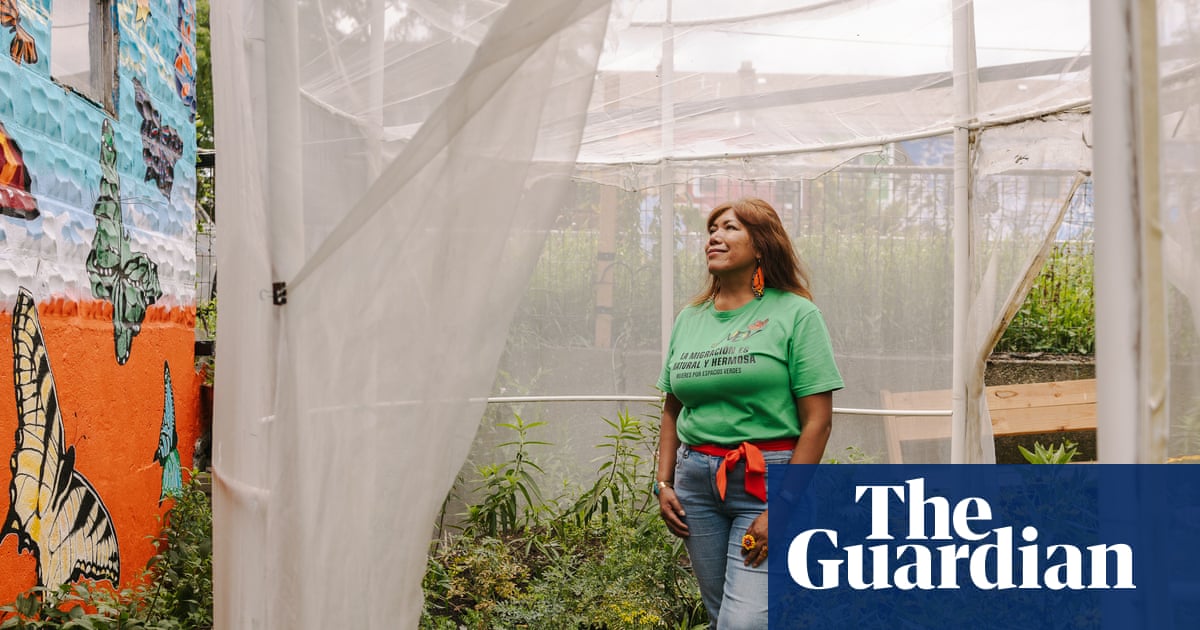
Along the concrete streets of Chicago’s Pilsen neighborhood, a vividly colored home stands out among the rest.Over the past few years, Claudia Galeno-Sánchez has transformed her modest family home, which she shares with her husband and two children, into a sanctuary and educational space dedicated to the monarch butterfly.Galeno-Sánchez has restored monarch habitat in her front and back yards by planting native milkweed and wildflowers. Every fall, she and her kids now enjoy marveling at these delicate creatures as some pay them a visit during their nearly 3,000-mile journey to Mexico, which unfolds until late October. Galeno-Sánchez painted her home with the help of neighbors, her kids, and the renowned muralist and painter Héctor Duarte. “Before becoming a mom, I didn’t know much about the environment,” the 49-year-old said in Spanish. “Knowing that we are losing species and the planet is warming, I feel that while I’m alive, it’s my time to do something. Not only for my children but for future generations,” said Galeno-Sánchez.Galeno-Sánchez is not alone; she is part of a nationwide movement of people planting native milkweed plants and reducing pesticide use on their lawns to help the species feed and flourish. A monarch butterfly feeds on nectar-producing plants in Chicago’s Pilsen neighborhood. During a visit to her home town in Puebla, Mexico, a decade ago Galeno-Sánchez was bewildered when she saw markedly fewer of them than her childhood memories of colorful butterfly-filled skies. It led her to question, “What’s happening with the butterflies?”Studies show that over the past 20 years, monarch butterfly populations, both eastern and western, have been in severe decline due to habitat loss from deforestation, extreme weather caused by climate change, and pesticide use harming the plants they rely on to survive.Recent attempts by advocates in the US to protect the monarch under the Endangered Species Act have failed under the Trump administration. In recent days, the decision has been delayed until June 2030.While the eastern monarch butterfly population has increased over the last couple of years, drawing heavy media attention and praise, experts warn the decline is outpacing the growth, and the species remains at risk of extinction.Still, the numbers offer a glimpse of hope for the species and admirers like Sánchez. Galeno-Sánchez demonstrates a white monarch butterfly egg on a milkweed leaf to a group of visitors during Chicago’s Climate Week in the summer. A tiny monarch butterfly egg is seen on a milkweed leaf in Galeno-Sánchez’s backyard during the summer breeding months. Without prior knowledge, but with good intentions, Galeno-Sánchez says she first thought saving the monarch butterflies meant rearing caterpillars indoors and then releasing them as butterflies, but later learned this can hinder their ability to survive in the wild.“We have to plant their natural habitats out there, because they are not human babies; they are another species,” said Galeno-Sánchez. “They need to be exposed to sunlight, to changes in temperature, even predators make them stronger to migrate.”Galeno-Sánchez’s home has now become a resting stop for the butterflies as they seek nourishment during their annual migratory journey from the northern US and Canada to Mexico and back.It’s an experience she resonates with, having migrated to the US as a child without her parents to live with family in Chicago. A photograph of Galeno-Sánchez’s parents. The butterflies have become her refuge since her father’s passing. During the summer, monarch butterflies in Chicago breed, lay eggs and prepare to migrate to Mexico. Due to her immigration status at the time, Galeno-Sánchez was unable to be with her father during his final moments after a battle with cancer. The painful experience has motivated her to share her story, one that she feels many immigrants can relate to.“The monarch butterfly migrates. We migrate. The only difference is that the monarch butterfly does not require a passport, “ said Galeno-Sánchez.Since starting the butterfly sanctuary, Galeno-Sánchez has broadened her efforts by planting native plants throughout her neighborhood, benefiting other pollinators and wildlife.So far, between her home and nearby schools, she has created eight native plant projects and has started giving milkweed plants to a community garden in an industrial area. Through donations, she buys plants and gives stipends to community members who help water and maintain them. Community members help water and maintain the native and wildflower gardens Galeno-Sánchez started at nearby schools. The non-profit “Women for Green Spaces”, which Galeno-Sánchez helped found, hopes to partner with schools throughout Chicago to teach kids the importance of caring for the environment.Galeno-Sánchez sees her work as part of a greater mission to remind people of the interconnectedness of different species and their role in supporting a healthy ecosystem.“By protecting them [the butterflies], we are protecting other pollinators and eventually protecting humankind.” Galeno-Sánchez at one of the lush gardens she helped start to restore habitat for monarch butterflies at a nearby school in her neighborhood. The Guardian receives support for visual climate coverage from the Outrider Foundation.
As monarch butterflies migrate for the fall, meet the Chicago woman trying to protect them
Full Article
Original Source
Read the full article at Theguardian →KhanList aggregates and links to publicly available news content. We do not host full articles from third-party sources. Always verify important information with original sources.