
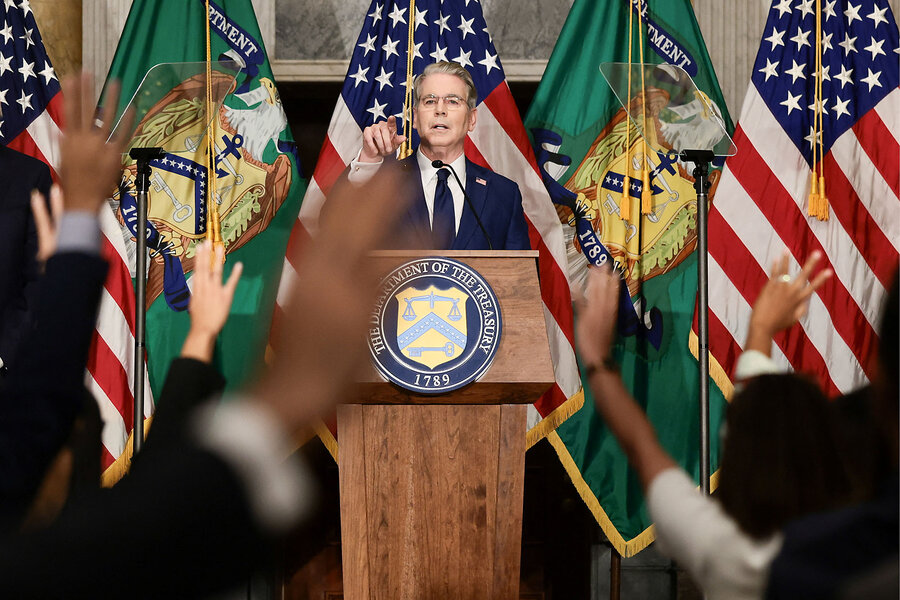
As military costs mount in a nearly six-month stalemate with Iran, President Donald Trump is taking a new route: economic warfare.In a news conference on Monday afternoon, Treasury Secretary Scott Bessent announced Operation Economic Outcast, a “zero leakage” crackdown on Iranian oil smuggling and sanctions evasion. Mr. Bessent described an unprecedented effort to isolate Iran from the global economy, threatening crippling sanctions against countries that do business with Iran.But the secretary also said the United States would not impose these secondary sanctions right away, instead giving each country a timeline to shut down their Iran-related activity and calling the operation a “warning shot.” Why We Wrote This Iran is one of the most heavily sanctioned countries in the world. But the Trump administration hopes it can turn up the pressure even more, threatening nations that do business with Tehran. Iran is already one of the most heavily sanctioned countries in the world. But the Trump administration believes it can turn up the economic pressure even more – and is hoping that pressure, combined with the steep costs of the war and related social disruption, could create a scenario in which Tehran is finally ready to fold.In a Truth Social post last week, Mr. Trump said that the new economic pressure – dubbed “Economic D-Day” – would be “the most crushing economic operation ever taken against any country.” Majid Asgaripour/WANA/Reuters Iranians walk and shop in the Grand Bazaar in Tehran, Aug. 23, 2026. However, Monday’s announcement did not include any specific penalties against China, which is the largest buyer of Iranian oil. Mr. Bessent declined to name which countries the U.S. would target under this operation or answer questions about China. Many experts had expected the U.S. might target large Chinese banks that do business with Iran.Richard Nephew, a fellow at the Washington Institute for Near East Policy, who served as deputy special envoy for Iran in 2021, says he might take the operation seriously if the administration later announced such a step. But until then, he said the announcement was more talk than action.“They’re just attempting to put a positive spin on what is effectively a status quo set of measures,” he said.Iran declared on Sunday that it is not afraid.“All of their actions – whether blockades or other military moves they have made – have failed, and this new issue of theirs will fail as well,” said Iranian Foreign Minister Abbas Araghchi in a video posted on Telegram.Iran is used to sanctionsExperts point out that the threat of economic penalty is nothing new for Iran. Mr. Nephew says the U.S. has imposed a range of sanctions on Iran over the past 30 years, gradually moving from targeting specific goods or activities to punishing entire sectors of its economy – to the extent where it’s difficult to pin down any sectors that remain untouched.“What you’re really down to is [Mr. Trump] filling in the cracks of an existing sanctions regime that is already pretty broad and pretty deep,” he says.One new tactic is to take a harsher stance toward countries that do business with Iran. The administration hopes that by pressuring countries to cut economic ties with Iran – and penalizing those that don’t with sanctions – they can isolate the country and force it into cooperation.Yet that is easier said than done, especially when it comes to China. The administration might be loath to spark an economic war with Beijing, particularly ahead of President Xi Jinping’s planned visit to the U.S. next month, and at a time when U.S. voters already hold a negative view of the economy heading into November’s midterm elections.Ali Vaez, the deputy program director for the Middle East and North Africa at the International Crisis Group, says the U.S. has “maxed itself out of leverage” when it comes to sanctions. And even if the U.S. can find a way to inflict more economic pain, Iran is better able to withstand it than most countries.Because Iran is an authoritarian regime, he adds, its leaders can push the economic burden onto their population. And he thinks those leaders are probably skeptical that giving in to Mr. Trump’s demands would result in real relief, since the president has pulled out of previous agreements.“There’s always this elusive search for one more turn of the screw that would magically result in the collapse of the Iranian economy,” he says. But “there’s no economic breaking point for a regime that does not hesitate to transfer the pain of economic strangulation to its population.”Possibility of regime collapseMr. Nephew says sanctions can be effective under some circumstances. But the demands the administration appears to be making of Iran are too existential, he says.“The problem we have today is that we are not trying to hurt them to get to a deal the Iranians could accept,” says Mr. Nephew. Historically, “where [sanctions] have failed, they failed because the demands being made are too severe.”Ludovic Hood, a senior fellow at the conservative Hudson Institute who spent 20 years as a diplomat, mainly in the Middle East, doesn’t think it’s out of the question that stricter sanctions could lead to a situation in which members of the Islamic Revolutionary Guard Corps sense things are crumbling – if the U.S. economic pressure is combined with Iran’s already skyrocketing inflation and rumblings of popular discontent. At his Monday news conference, Mr. Bessent encouraged Iranian soldiers to defy their commanders.“I do think that there’s a unique opportunity whereby the regime is about as vulnerable and brittle as it’s ever been,” says Mr. Hood.
As Iran stalemate drags on, US tries to tighten the economic vise
Full Article
Original Source
Read the full article at Csmonitor →KhanList aggregates and links to publicly available news content. We do not host full articles from third-party sources. Always verify important information with original sources.