
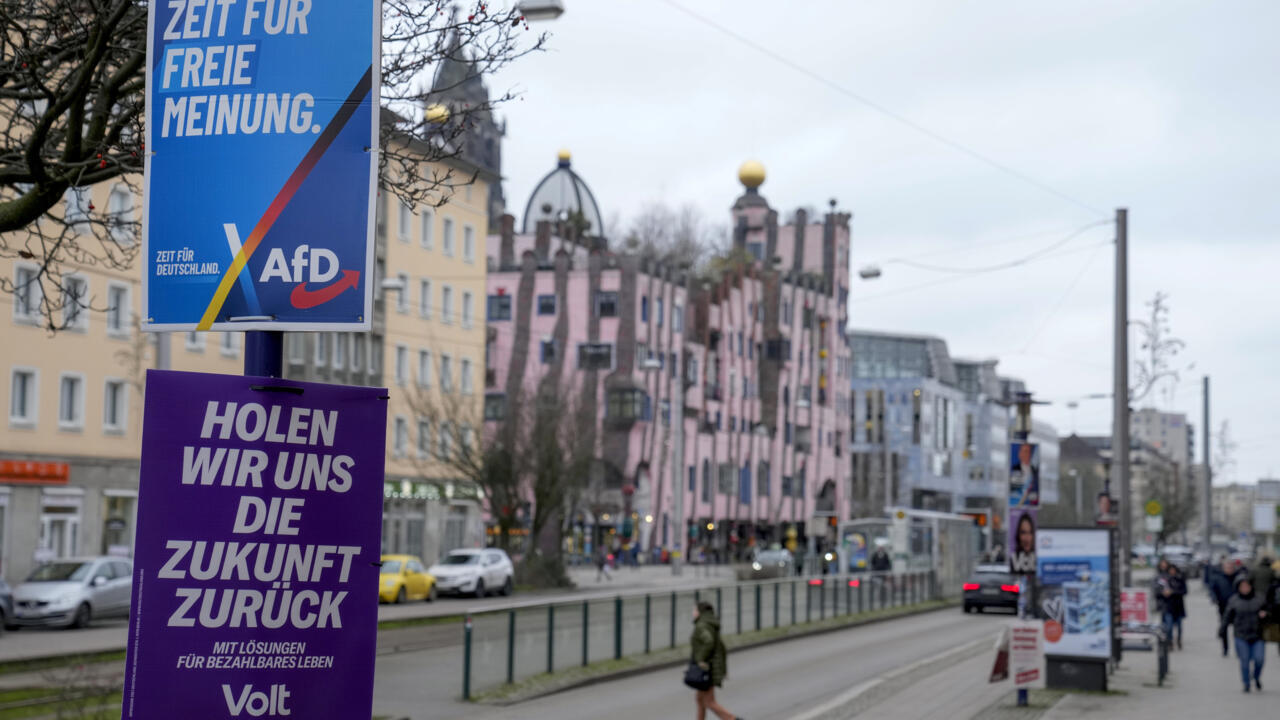
Berliners go to the polls on Sunday to elect the city-state’s parliament and district councils, in a vote taking place just two weeks after the far-right Alternative for Germany (AfD) secured a historic victory in the eastern state of Saxony-Anhalt. The implications could extend beyond Germany. The AfD won 43.8 percent of the vote in Saxony-Anhalt on 6 September, falling three seats short of an absolute majority in the state parliament. The result has intensified debate about the strength of the democratic centre in Germany and beyond. The AfD has received support from figures associated with United States President Donald Trump, including alt-right billionaire Elon Musk, while also positioning itself alongside Hungary’s former leader Viktor Orban and Russian President Vladimir Putin. In France, Marine Le Pen is leading in polling ahead of the 2027 presidential election, with recent surveys giving her between 29 and 36 percent in the first round. Against this backdrop, what does the AfD’s breakthrough mean for Germany, Europe and the future of the political right? RFI spoke to Bernd Hüttemann, secretary-general of the German chapter of the European Movement, a non-partisan civil society organisation that promotes European integration. Bernd Hüttemann, secretary-general of the European Movement Germany, interviewed in Paris, 12 September 2026. © RFI/Jan van der Made RFI: Berlin’s elections are taking place shortly after the AfD’s historic victory in Saxony-Anhalt. What does that result mean for German politics? Bernd Hüttemann: It is something very dark, because it has really started a new era in Germany. For the first time, there is a right-wing extremist party that could potentially take power at state level. Saxony-Anhalt is a small state, but the Länder [federal states] are powerful in Germany. They are responsible for areas such as education, policing, security and a large part of public administration. So the result will change things at that level. It will not necessarily change the balance of power at federal level, because Saxony-Anhalt has relatively few votes in the Bundesrat [upper house of the German parliament]. But if the democratic majority becomes nervous and starts following extremist ideas, that can become very dangerous. AfD candidate Ulrich Siegmund speaks in front of a poster reading "It starts here" at a rally after the Saxony-Anhalt regional elections in Magdeburg, eastern Germany, 6 September 2026. @ AP Photo/Matthias Schrader Merz ‘deeply shocked’ as far-right victory tests Germany’s political firewall RFI: If you look at the map of the 2025 election results, it appears that AfD is most popular in former East Germany. How do you explain people who lived under an authoritarian communist system now voting for an extreme-right party? BH: There was always an East-West divide. As a young West German in the 1980s, I saw a great deal of propaganda saying that East Germans were different from us. They were portrayed as living under a very bad social system and an undemocratic regime. After the Berlin Wall came down, the divide became more complicated. Around one-third of East Germans moved to the West, particularly young people, women, skilled workers and liberal-minded citizens. At the same time, many West Germans moved east and took senior positions. Judges, professors and many other professionals came from the West. It is not pleasant for people in the east to feel that there is a ruling class imposed from outside. East German workers build up a section of the Berlin wall, on 15 August 1961. @ AFP That does not mean that all of these voters are anti-democratic. But many people have little experience of taking social responsibility outside the state. They do not want to join political parties or associations. They simply want an easier life, especially after the hardship they experienced before the Wall fell. So this is not only about an East-West divide. It is about whether authoritarian ideas can find fertile ground. That is certainly more likely in eastern Germany. RFI: Do you believe Germany’s political diversity can act as a safeguard? BH: Yes. Germany is a very diverse country. It contains Catholic, Protestant, atheist, Muslim and East German traditions, among many others. Its political system is also complex: it is federal, decentralised and based on cooperation with many social forces. That makes Germany complicated and slow, but it also makes it more resilient. I would not be excessively concerned. The important thing now is for democratic movements and parties to stay together. Map of the 2025 German election results, with the Christian Democrats (CDU, in grey) dominating in former West Germany and the Alternative for Germany (AfD, shown in blue) dominating in what was communist East Germany. © Image generated via Perplexity RFI: How much influence do Trump-style populist politics and US-based propaganda have on the AfD and German politics more broadly? BH: The AfD has a problem here. Particularly in eastern Germany, there is not a strong appetite for American influence. On the other hand, the party has very few friends. It has Vladimir Putin. Viktor Orban congratulated the party. There are links with MAGA supporters and with Elon Musk. The party’s psychology is perhaps this: nobody likes us, the public rejects us and everybody is trying to exclude us. So we align ourselves with people who are even more extreme. But it could backfire. People in western Germany, as well as many liberals in the east, do not necessarily like this association. US billionaire Elon Musk attends the AfD's election campaign kickoff in Halle via video link, on 25 January 2025. @ AP - Sebastian Willnow Can Europe withstand the ripple effect of the MAGA political wave? RFI: Marine Le Pen is leading polls ahead of France’s 2027 presidential election. Could the AfD’s breakthrough influence the discourse here? BH: The fear of Germany that existed during my childhood is not as widespread as it once was. But now there is a kind of flashback. People are asking: Germany was one of the most liberal countries in Europe in recent decades, including on issues such as refugees. Is it now showing its ugly face again? That may also explain Marine Le Pen’s efforts to distance herself strategically from the AfD in the European Parliament. There was a well-known meeting in Paris with Alice Weidel, the AfD leader, where Weidel reportedly entered through a back door to avoid being photographed with Le Pen. If France, a proud nation, moves towards the right, it will want to draw a clear line between itself and German extremism. But that is not good for Europe, because we do not need a return to nationalism. We do not need national answers to nationalist movements in Germany. We need European answers – particularly when it comes to war, China and the United States. Europe has to remain united, and it is also developing closer links with Canada.
As far right gains ground in Germany, Berlin election tests Europe's centre
Full Article
Original Source
Read the full article at Rfi →KhanList aggregates and links to publicly available news content. We do not host full articles from third-party sources. Always verify important information with original sources.