
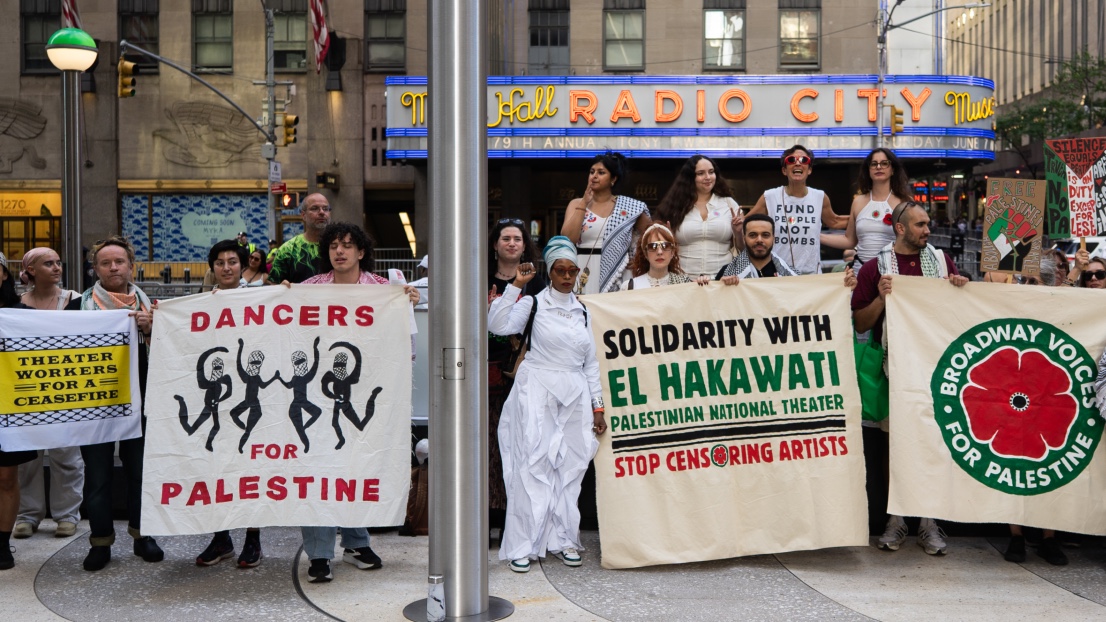
Despite a growing insistence on Palestinian rights in the theatre industry, Palestinian performers remain without a seat at the tableSix months into Israel's assault on Gaza in March 2024, when more than 120 Palestinians were being killed in air strikes each day, Broadway performer Allie Trimm was approached by the writer of a project she had just been fired from. "You and I are not so different. We both don't want to see innocent people get hurt," the writer told her. "We just have a different idea of who's innocent." Trimm, an actress and singer since the age of nine, had become an advocate for Palestinian rights after images of children torn apart by US-supplied weapons flooded her social media feeds, as they had for countless other Americans since the Hamas-led attacks on southern Israel on 7 October 2023. Just under 1,200 people - Israelis and foreign nationals - were killed that morning, including some by the Israeli military. New MEE newsletter: Jerusalem Dispatch Sign up to get the latest insights and analysis on Israel-Palestine, alongside Turkey Unpacked and other MEE newsletters Israel's subsequent assault on the Gaza Strip, later assessed to be a genocide by the United Nations and Holocaust scholars, has killed 74,000 Palestinians to date, with more than 22,000 children among them. Researchers with the Lancet Global Health Journal have said those figures are likely a severe undercount. Trimm told Middle East Eye that industry professionals called her a "jihadist" and "antisemite", and warned her that she was putting people in danger through her advocacy. "How is humanising Palestinian people being equated with antisemitism?" she said. "This is the first issue that I've really experienced with such intense silencing around [it], and... Well, why? Why is it this thing that we can't talk about?" 'Censorship' In November 2024, the International Criminal Court (ICC) issued an arrest warrant for Israeli Prime Minister Benjamin Netanyahu, his former defence minister Yoav Gallant, and three Hamas leaders who were assassinated by Israel. The move upped the ante on Israel as international condemnation of its conduct in Gaza escalated. The US has since vowed to dismantle the ICC "brick by brick". Trimm told MEE she wasn't employed for some nine months that year before she landed a leading role on Broadway's smash hit Wicked in 2025 - where she was previously a standby, or emergency fill-in - playing Glinda, the "good witch", now recognised globally through Ariana Grande's portrayal in the two-part film. Allie Trimm as Glinda at the curtain call for her first show as a principal cast member in Wicked at the Gershwin Theater in New York City, on 4 March 2025 (Conor Clancy) That contract ended in March of this year, six months into the US-brokered ceasefire announced on 10 October 2025, and at the start of the US-Israeli war on Iran, which drew headlines away from the wasteland that Gaza had become. It took nearly half a year before Trimm came forward publicly about the pressure she faced to stay silent on Palestinian rights while performing in one of the most lucrative and long-running musicals in the world. On 15 September, she posted a video on Instagram, emboldened by how rapper Macklemore handled his own firing from Ed Sheeran's tour by billionaire Robert Kraft. "While I worked at Wicked, I was told that there's an 'if' and a 'then'. If I keep talking about Palestine or Palestinian human rights on the internet, then I can expect the phones to stop ringing and all of the perks that should come with my contract to cease," Trimm said in her video. While the show's producer, Marc Platt, never had a one-on-one meeting with her, Trimm expressed concern with views he espoused on a podcast that include suggesting criticism of Israel is "Jew hate", and that actors in Hollywood who have called for a ceasefire in Gaza are "not completely informed". When the man at the top holds that position, the chilling effect trickles down to the company, Trimm told MEE. 'If I keep talking about Palestine or Palestinian human rights on the internet, then I can expect the phones to stop ringing' - Allie Trimm, Broadway performer "I started experiencing kind of pretty intense censorship," she said. "I reached out to the union for help when I was experiencing this. I also retained a lawyer. I was extremely distraught during the entire ordeal, and the union told me that I should double-check because the government has changed the definition of antisemitism, and I might very well be being antisemitic." The Trump administration has adopted the International Holocaust Remembrance Alliance's (IHRA) definition of antisemitism. Critics of the IHRA definition say it conflates antisemitism with anti-Zionism, including criticism of historic and current policies that led to the creation of the state of Israel in 1948 and the expulsion of hundreds of thousands of Palestinians from their homes. MEE repeatedly reached out to Actors Equity, the union representing 51,000 professional actors and stage managers, but did not hear back. Platt had most recently made headlines for reprimanding stage and screen star Rachel Zegler for posting "Free Palestine" on social media, which his son said hurt the box office returns for Platt's film, Snow White, in which she played the titular character. "I was singled out in this process" at Wicked, Trimm said in her video, which has garnered nearly 60,000 likes. "I was singled out, and I was the only employee that was subjected to this censorship and this monitoring." To look at how this industry has been impacted by the global fallout from Israel's ongoing assault on Gaza, MEE spoke with more than half a dozen performers, directors, and writers who have worked or continue to work in New York City's musical theatre scene, either on Broadway - meaning one of the 41 venues that seat at least 500 people in midtown - or Off-Broadway, including some regional theatres. 'The most Zionist of all' In June, 26-year-old Ali Louis Bourzgui won Broadway's highest honour - a Tony - for Best Performance by an Actor in a Featured Role in a Musical for the vampire rock musical The Lost Boys. It was by many accounts a major upset, given 80-year-old André De Shields was widely expected to get the trophy for his performance in Cats: The Jellicle Ball. "The people of Palestine," Bourzgui said in his speech, "deserve a free life, a full life, without occupation." The room responded with raucous applause. In this country's for-profit entertainment industry, it was a stratospheric shift. And that shift may have been inevitable with the changing demographic. "For Arab theatre makers and artists: May we continue to tell our stories and show our faces so our humanity becomes undeniable and our families can no longer be written off as merely collateral damage," Bourzgui, whose father is Moroccan, continued. "May they know the beauty of our kisses upon each cheek and the romance of a language rooted in passion for love and life itself." Ali Louis Bourzgui poses with the Best Performance by an Actor in a Featured Role in a Musical award for The Lost Boys at the Tony Awards on 7 June 2026 in New York City (Mike Coppola/Getty Images) The Tony Awards Instagram account typically posts videos of the speeches minutes after they take place. With Bourzgui, the clip was posted three days later, on 10 June, following an online outcry. "There was a lot of drama above the surface and under the surface in the theatre world about this speech, which clearly called for a free Palestine and end to the genocide," Nick Laparra, a social impact adviser for artists and the co-founder of Broadway Voices for Palestine, told MEE. The group had been holding a demonstration outside Radio City Music Hall, the venue for the awards in New York City, as they were handed out. CBS, owned by Paramount Skydance and pro-Israeli tycoon David Ellison, has the exclusive rights to broadcast the Tonys. "There was disagreement on whether the video should have been online, because it got taken down, and it was down for several days until the Tony Awards official account posted the entire clip, and then, and only then, did The Lost Boys, their official account, accept the collaboration on Instagram and post the full video." MEE reached out to Bourzgui's team for this story, but his publicist, Lisa Goldberg, said he would not be available for comment. Laparra called Broadway "the most Zionist of all the entertainment industries". "As soon as [performers are] posting about a 'Free Palestine', 'Stop the Blockade', 'All Eyes on Rafah', all these different ebbs and flows of the genocide over the last three years, there's been relentless pushback," he said. 'Most of everybody is pro-Palestine. They just can't speak up. They need this job. This is their dream job' - Nick Laparra, Broadway Voices for Palestine "Artists must pick a side," he added. "Palestine is the moral issue that separates." Laparra acknowledged that awareness and education on Palestinian rights have grown exponentially. "We have a lot of the biggest shows on Broadway represented in our group, and a lot of Off-Broadway, and a lot of the smaller shows," he said. Of the stagehands and performers he meets, he continued, "Most of everybody is pro-Palestine. They just can't speak up. They need this job. This is their dream job. So many [have] to navigate the complexities of this." "The problem... lies with the management. It lies with the investors." But "they can only do so much", which is why the tide is turning, one performer who is about to embark on a prominent role in one of next year's most highly anticipated shows on Broadway told MEE. The performer has chosen to withhold their name to speak more freely on the issue. "We're having conversations now that would have been a dream to have five years ago," they said. "I think people are existing too much in cognitive dissonance. I think the industry is reflective of what's happening in the country... it can only be defended by the media and by the levers of power for so long before people stop. We will continue to see progress as time goes on. Israel now has never been so unfavourable." Function Like any cultural institution, Broadway holds up a mirror to society. "Broadway reflects changes in the culture, and reflects political attitudes and changes in the city culture," Adam Feldman, a veteran theatre critic for TimeOut and president of the New York Drama Critics' Circle, explained to MEE. "One of the things that happened after the Covid shutdown was the Black Lives Matter movement became much more of a focal point for American discourse, and so in response to that, when the theatre came back, you did see a lot more plays... by black playwrights," he added. "That does, to some extent, push or reflect a political viewpoint." Two shows attempted to tackle Israel's wars and occupation this season: Giant, starring John Lithgow, which closed in June on Broadway; and Birthright, a play with a young ensemble cast that closed in August Off-Broadway. Giant largely centred on criticism of Israel falling into antisemitism. Birthright examined Zionism and landed on how no side is actually right. "Audiences don't like being lectured to," Feldman told MEE. "Yes, even when it's politics that they share, or maybe even especially when it's politics that they share, because it seems a bit redundant... one of the things that art does particularly well is set up space for exploration of complexity." The 2025-2026 season on Broadway saw 14.5 million attendees and brought in a whopping $1.91b while still operating at a loss, despite the ever-increasing cost of a night out at the theatre, and amid an affordability crisis in the US that is dominating the discussion ahead of the November midterm elections. The Broadway League, which is the trade association that represents producers and theatre-owners, has said a quarter of all ticket sales in the 2024-2025 season went to international tourists, many of whom will fly in just to see a show (or several). That's because the calibre, by all accounts, remains unmatched, though it is often challenged and inspired by productions staged in London's West End theatre district. The other outsized flashpoint in the lead-up to the midterms is arguably Israel, particularly among Democratic Party voters, where a deep divide has grown between the corporate pro-Israel establishment and the critical progressive wing, most vocally led by New York City Mayor Zohran Mamdani. Democratic voters have traditionally made up the majority of those working in the liberal theatre space, and especially in the immovably blue New York City, where in addition to the Broadway scene and its adjacents, national touring productions will also rehearse in the city before taking off for sometimes years-long stints on the road. Forced far Off-Broadway What Palestinian artists argue is that they don't want to be spoken about when they could be doing the speaking instead - especially when the issue of Palestine has dominated the global political discourse for three years and created a fallout so profound that a US think tank developed an entire strategy on how to contain it. "Time and time again, we've seen these very clear examples of a blatant message that Palestine has no place in the theatre, and then, meanwhile, we're seeing amidst a genocide plays like Giant and Birthright being given massive platforms and selling out their runs without any backlash," Fouad Dakwar, a New York City-based Palestinian-American musical theatre artist, told MEE. He has created his own semi-autobiographical project, Fouad of Nazareth - a nod to his birthplace - which can next be seen at New York City's Festival of New Musicals later this month. The event is effectively an audition where new works could get picked up by commercial producers or non-profit outfits for further development. Palestinian-American artist Fouad Dakwar performs at the album release concert for his show 'Fouad of Nazareth' at Ars Nova in New York City, on 5 March 2026 (Valerie Terranova/Supplied) "I think what this all comes down to [is that] theatre in particular is such a gatekept art form," he added. "Broadway is a collection of theatres, and the people who own those Broadway theatres have the final say of what gets in the theatre." Dana Saleh Omar, a Palestinian-American performer based in Chicago, said getting to the hiring stage at all is the problem. "People that have been speaking out - you've noticed - none of them are Palestinian, and that's because they don't hire us in the first place," she told MEE. Palestine-centred projects have seen high-profile cancellations at popular Off-Broadway venues like the New York Theater Workshop (NYTW) and The Public Theater. In 2006, the NYTW scrapped My Name is Rachel Corrie, which was coming to the US from a run at London's Royal Court. When it later found a home at a different venue, The New York Times described it as a work "sympathetic to Palestinians". Corrie, a 23-year-old US citizen, was killed in 2003 by an Israeli bulldozer in her attempt to protect a Palestinian home from demolition by Israeli forces in the occupied West Bank. The Israeli military said its investigation concluded that her death was an accident. In 2016, the Public cancelled a planned run of Jenin Freedom Theatre's The Siege, about five Palestinian fighters who took refuge in the Church of the Nativity during the Second Intifada. The following year, it found a home elsewhere in the city, while a three-hour play called Oslo received rave reviews on Broadway. As its name suggests, it explores the backchannel dealings of the Norwegian diplomats who are credited with ultimately bringing together Israeli Prime Minister Yitzhak Rabin and Palestinian Liberation Organisation chief Yasir Arafat to the White House to sign the Oslo Accords in 1993. While Rabin and Arafat are never seen in the show, the seemingly uncouth Palestinian negotiators, Ahmed Qurei and Hassan Asfour, were portrayed by Iranian actors. Oslo swept the Tony Awards in 2017. Then in 2018 came the musical The Band's Visit on Broadway, which also scooped up the most coveted trophies at the Tonys that year. It tells a story of an Egyptian military band that accidentally finds itself in the middle of a northern Israeli desert village, where a tender relationship develops between an Egyptian officer and an Israeli woman. The show does not address the occupation, but for Palestinians, the undercurrent is impossible to ignore. Omar was a standby on the show's national tour, which closed in 2022, after which she joined a regional production of the musical that was staged in Arkansas and Illinois between October 2023 and March 2024 - arguably at the height of Israel's assault on Gaza, and its simultaneous crackdown in the occupied West Bank, which has killed more than 1,100 Palestinians in the last three years. Palestinian-American performing artist Dana Saleh Omar stands outside The Public Theater in New York City, on 17 July 2026 (Mounira Elsamra/MEE) "It was very difficult," she told MEE earlier this year. "There is no Palestinian voice in that show, and especially when I was doing it in October of 2023, I felt that immensely... I kind of felt resentful of it because of that." Would she do the show again? "No, I wouldn't," she responded. In early 2024, at a critical juncture in Israel's war on Gaza, Itamar Moses, the writer behind The Band's Visit, premiered his latest play, The Ally, at the Public, featuring visceral conversations about Zionism and including an outspoken Palestinian character. The New York Times review noted he "insisted he never tried to stack the deck to make sure one particular side of any argument seemed to win or lose definitively". Stuck Omar is now forging her own path by telling her own stories. "Art is something that I think can really speak to people in different ways and for different reasons, and that's why I love it so much... That's why you got to keep doing things that you want to see." In April 2025, Omar co-wrote and starred in her first short film, Stuck, in which a Palestinian woman wakes up dazed on the morning of 7 October 2023, entirely unaware of how much the world had just changed. 'We're so much more than our oppression. We're so much more than our trauma' - Dana Saleh Omar, Palestinian-American performing artist A younger version of the woman's father appears to her, in a bid to be a supportive presence, and perhaps impart lessons as she navigates the following hours. That character is more or less based on Omar's own father, Saleh Beshara Omar, who passed away in August 2025, she told MEE. "This project is in honour of him and his revolutionary spirit. I watched him be an activist my whole life," Omar said. "It's not our exact story. Stuck is kind of an amalgamation of a bunch of different Palestinian stories that I've picked up along the way, and this is like an alternate universe version of me that has never really used her voice until now." The short is at seven film festivals this year, and is showing this month alone at both the Toronto Palestine Film Festival and the Eastern Oregon Film Festival. "We're so much more than our oppression. We're so much more than our trauma. And if you don't give us chances to tell not just our sad stories, but our hopeful stories, our superhero stories, our everything... people can see that we're more than that," Omar said. The singular wholly Palestinian story that was showcased at a major venue since 2023 in New York City was the very traumatic A Knock on the Roof by Khawla Ibraheem, a one-woman play about a mother in Gaza who has rehearsed her life-saving run for every time a smaller bomb strikes the roof, warning of an incoming Israeli missile. It was part of the 2024-2025 lineup for the NYTW, which followed a more than 100-day HIV medication strike by one of the theatre's former resident playwrights who pleaded with the NYTW to call for a ceasefire in Gaza. It's unclear exactly how that highly publicised move impacted the venue's decision-making, if at all, but there was no publicly available statement calling for a ceasefire, and certainly not one that spells out the criteria listed by Theatre Workers for a Ceasefire, which now has 3,800 signatures from 80 organisations. "A lot of shows now are co-productions that need big-name stars attached, or big-name producers, and as a result, I think a lot of these theatres are terrified to do anything that rocks the boat, politically or otherwise," Dakwar, who has signed the pledge, told MEE. "If they were to lose one donor or one board member who gets them a substantial fund... Shows are just not able to be profitable with the current expenses." Mounting a show on Broadway in particular can run into the tens of millions of dollars before a single audience member has walked through the doors. This has led one of musical theatre's titans - and richest people - Andrew Lloyd Webber, to warn the costs are "unsustainable". 'We need so much more' MEE reached out to multiple Broadway producers as well as The Broadway League, and all declined to comment for this story. Diversifying the theatre space, much like Diversity, Equity, and Inclusion practices at the corporate level, has proven both innovative and lucrative, inviting a new audience to the box office. But in this political moment, meaningful change in hiring practices must go hand in hand with the normalisation of the discourse on Palestinian rights, an award-winning director of stage and screen, who spoke to MEE on condition of anonymity, explained. 'If you phrase it the opposite way, it’s technically illegal, right? Like to say, ‘I don’t want to work with someone because they are pro-Israel’' - Award-winning director The Palestine conversation "has been a source of connection" to find allies - sometimes more powerful ones - in the industry, the director, who explicitly identified as Jewish, said of the support groups that have formed around the subject. "For many of the actors that I spoke to, there was a job security question about what it meant to have these conversations... One of the things that we were excited about was showing actors that there are folks who do have hiring power, like myself, who have the same views that they do, and that they're not alone in those views in our community." The director pointed to an instance where they were interested in hiring a particular actor, and a producer texted them and said not to, because the actor in question is "antisemitic". "I said, 'What do you mean?' And then that producer referred me to a post that the actor had made, and the post was purely pro-Palestinian. And I then said, 'I don't think they're antisemitic. Let me explain'," the director recounted. The actor was ultimately not hired for other reasons, MEE was told. "If you phrase it the opposite way, it's technically illegal, right? Like to say, 'I don't want to work with someone because they are pro-Israel' could get me in trouble," the director added. While artists have to open doors for one another, a change in culture must also come from the top down, Clay Singer, who recently wrapped up a run in Masquerade Off-Broadway and Rhinoceros at American Repertory Theater in Massachusetts, told MEE. "Our mayor," he said, taking a moment to reflect on New York City's progressive kingmaker Mamdani, who has been a vocal critic of Israel and an advocate for Palestinian rights. "You watch the way that he speaks, and you watch the way that he navigates his power, and it's almost shocking because I don't think we have had a leader like this that we can look to as a light in a while, and I think... we can rally behind his voice." But Mamdani, like countless others voicing similar concerns, has been called an antisemite by Republicans and some Democrats, and the Israeli prime minister even made the point a key focus of his speech at the United Nations General Assembly last month. "As a Jewish person, I firmly believe condemning Netanyahu’s genocide on the Palestinian people has nothing to do with antisemitism," Singer said. "So much of Judaism is rooted in questioning, in seeking justice for the vulnerable and the suffering. It’s wrong to turn our eyes away from the violence Netanyahu has inflicted on the Palestinian people." On Wednesday, 10 days out from the one-year anniversary of the ceasefire, Israeli air strikes killed eight Palestinians in Gaza, among them women and children, as well as journalist Muhammad Abdel Aziz al-Najjar. According to the Palestinian Journalists' Syndicate, he is the 263rd journalist to be killed in the enclave. Speaking to MEE while taking her film on the road this week, Omar said the mounting toll on Palestinians on the ground made it uneasy to "celebrate the wins" when she has them. "It's not enough, you know? It's never enough for these innocent people that continue to be brutally murdered. We need so much more." Mounira Elsamra in New York contributed to this story.
'Artists must pick a side': How Israel's assault on Gaza is shifting the culture on Broadway
Full Article
Original Source
Read the full article at Middleeasteye →KhanList aggregates and links to publicly available news content. We do not host full articles from third-party sources. Always verify important information with original sources.