
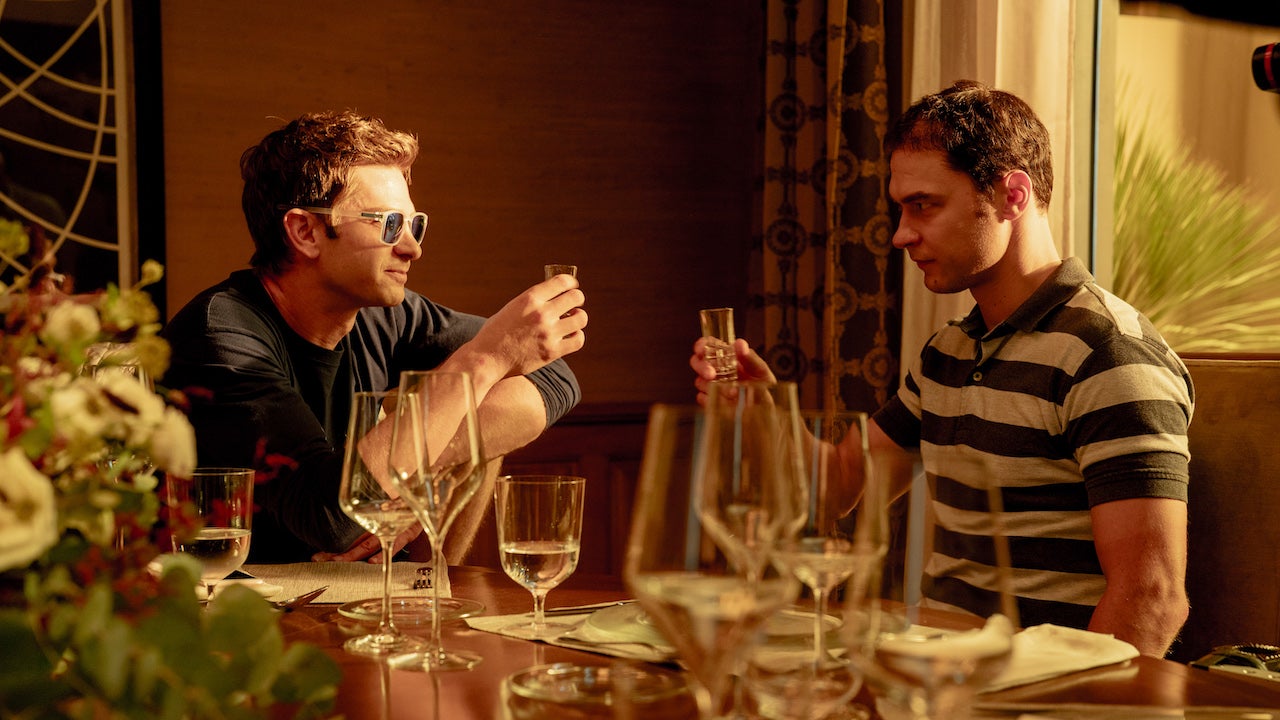
“Artificial” arrives with such capital-“I” importance in this moment of anxiety over artificial intelligence that there is a version of the film that could have soared on the strength of its message alone, craft be damned. Thankfully though, Luca Guadagnino is not content to eulogize us without a sense of style. The film covers two decades worth of ground around the advancement of machine-learning research, charting the rise of OpenAI co-founder and CEO Sam Altman, and while it can feel ungracefully didactic at moments, it deserves adulation for being unapologetically clear about its humanist message even while the tech oligarchs increasingly resort to obfuscation to assuage anxieties. The fact that Guadagnino and his collaborators have made a film that pulses with humanity, one whose craft acts as an antithesis to the love for algorithms and technology its characters espouse, is its clever sleight of hand. This film may be the world’s obituary, but in its thrilling, creative and provocative telling, it also reminds exactly what makes human beings – and their art, specifically – special. Hopefully, this is a film that can be more than a reminder of all that we might lose. In regards to the proliferation of AI in our lives and what super intelligence might mean for the paradigm of the world, I do not think we need to be told to be afraid. “Artificial” gives a new dimension to that fear, moving away from the abstract nature of doomsday and fastening something more tangible and, therefore, more terrifying. Guadagnino’s film is disarmingly funny in the way he critiques figures like Dario Amodei, Elon Musk and Altman, but just the same, he complicates our ability to laugh too much because what unfolds is not in the far past. These people are alive today, time having sharpened their worst impulses into blades they have pierced the whole world with. They wanted to shape and sculpt the world into their image back then but lacked the resources to make their fantasies reality. Now, it is technology that has to catch up to their twisted dreams. Part of the film’s tragic register is the way that Simon Rich’s script goes to painstaking lengths to show the good intentions from which our present hellscape has sprung. When we meet Ilya Sutskever (Yura Borisov) in 2003, he’s an eccentric, eager, prodigy incapable of lying, whose passion for creating artificial superintelligence is only matched by his desire to create standing desks out of Pringles, toilet paper and desk drawers. He works with Toronto University professor Geoffrey Hinton (Mark Rylance) and their early years are rooted in a genuine sense of discovery and curiosity. The two join Google, but once Altman (Andrew Garfield) and Elon Musk (Ike Barinholtz) catch wind of what Sutskever is building, they recruit him to join their team. Sutskever, guided myopically by the genuine belief that power computer programs can end world problems around hunger, illness and even death, fails to see the devils he is getting into bed with. While you are unlikely to leave “Artificial” unaware of who the villains are, Guadagnino resists easy judgment and refrains from leveling aspersions only at those who are more overt about their vices. Borisov, tender, delicate and sensitive, expertly plays Sutskever’s crystal clear ambitions as his greatest strength and weakness. He is so pure in his pursuit of research, so unwavering in his belief in artificial intelligence’s messianic powers, that he is resistant to a more measured and patient timeline of development. “Have you ever considered the link between knowledge and patience?” Hinton tells him in their very first meeting. The tragedy of course, is that Sutskever learns, but only when he sees the people around him, like Altman and Musk, driven by the spirit to be first at the cost of being ethical. It is in this way, that “Artificial” avoids the trap of being outdated by nestling its anxieties in timeless tensions, in the battles between progress and accountability, calm and speed, restraint and hunger. What we see is not just history being retold, but myth being made. Indeed, does knowing the serpent’s motives beforehand make the desecration of a garden of Eden go down any easier? That is the tribulation Sutskever faces when Altman takes off the demure wool to reveal the predator underneath, and as a foil to the earnest, unshakeable idealism that Borisov imbues his performance with, Garfield’s is mesmerizing to watch. The actor perfectly captures what makes Altman so charismatic and alluring, and Garfield plays up how the entrepreneur was a master of seduction in all respects. Altman frequently grabs people at the nape of their neck, bringing them into his orbit where they cannot escape the gravitational pull of his cerulean eyes. Garfield likewise lets us forget about the petty rage that brews under Altman’s skin, understanding that behind every “No worries!” is a crash out waiting to happen. It is not just in Altman’s mannerisms where Guadagnino’s sensual tendencies as a creative shine. His filmmaking here is a deepening of his provocations around food, desire and power. Nary is there a scene where characters are not eating some form of roast meat (or in Altman’s case, obnoxiously slurping on a green smoothie), and Malik Hassan Sayeed’s cinematography delights in capturing not just its consumption, but also in the messy aftermath left behind that service workers have to clean up. It is a microcosm of these larger attitudes around innovation, that these men can feel free to pursue what they want and leave the collateral to the “lesser beings.” Take another moment where we see Altman’s and Musk’s crew celebrating a technological breakthrough. As we see them rage, popping champagne near their crotches, teeth stained with half digested chips, the camera frames these crusty man children not unlike the way we might see apex predators in the wild or in a nature documentary. The presentation is damning and affecting: these are people ruled solely by appetite. In this way, Guadagnino never ceases to remind that for all of these people’s delusions of grandeur, they are still childish, not just in how they party, but in their unwillingness to consider any other’s well being but their own. Ironically, even as it trenchantly dissects our present moment, every creative decision radiates with that delightful unpredictability that only art created by humans can embody. The film’s quirks are evidence of humanity, from the desaturated framing a campfire sequence that makes all the OpenAI employees look like vampires starved of light, to the ways that Damon Albarn contributes not just several original songs to the film, but interlaces the score with analog sounds, to the aforementioned party sequence, where Guadagnino frames everyone except Altman and Sutskever in slow motion, showing how they are quite literally out of time. Truly, every creative decision points to the fact that there is a human behind the telling of this story. To reference any of the tech titans’ contemporary sins would risk only further dating this review (though if you will humor me, I find it quite humorous that Anthropic tried so hard to get faith leaders’ and theologians’ stamp of approval that their LLM, Claude, has a soul), so allow me to leaven the dough of fear with more ancient wisdom. In Pope Leo XIV’s “Encounter with the World of Cinema” address, he wrote in praise of human art: “Not everything has to be immediate or predictable. Defend slowness when it serves a purpose, silence when it speaks and difference when evocative. Beauty is not just a means of escape; it is above all an invocation. … It articulates the questions that dwell within us, and sometimes, even provokes tears that we did not know we needed to express.” With “Artificial,” Guadagnino articulates with licentious flourish the ways in which we are already doomed, while also telling a story that offers hope that the human spirit, creativity and ingenuity are too diverse and rich to ever be pinned down to an algorithm.
‘Artificial’ Review: Yura Borisov and Andrew Garfield Fight and Flirt Over the Fate of Our Technological Future
Full Article
Original Source
Read the full article at Thewrap →KhanList aggregates and links to publicly available news content. We do not host full articles from third-party sources. Always verify important information with original sources.