
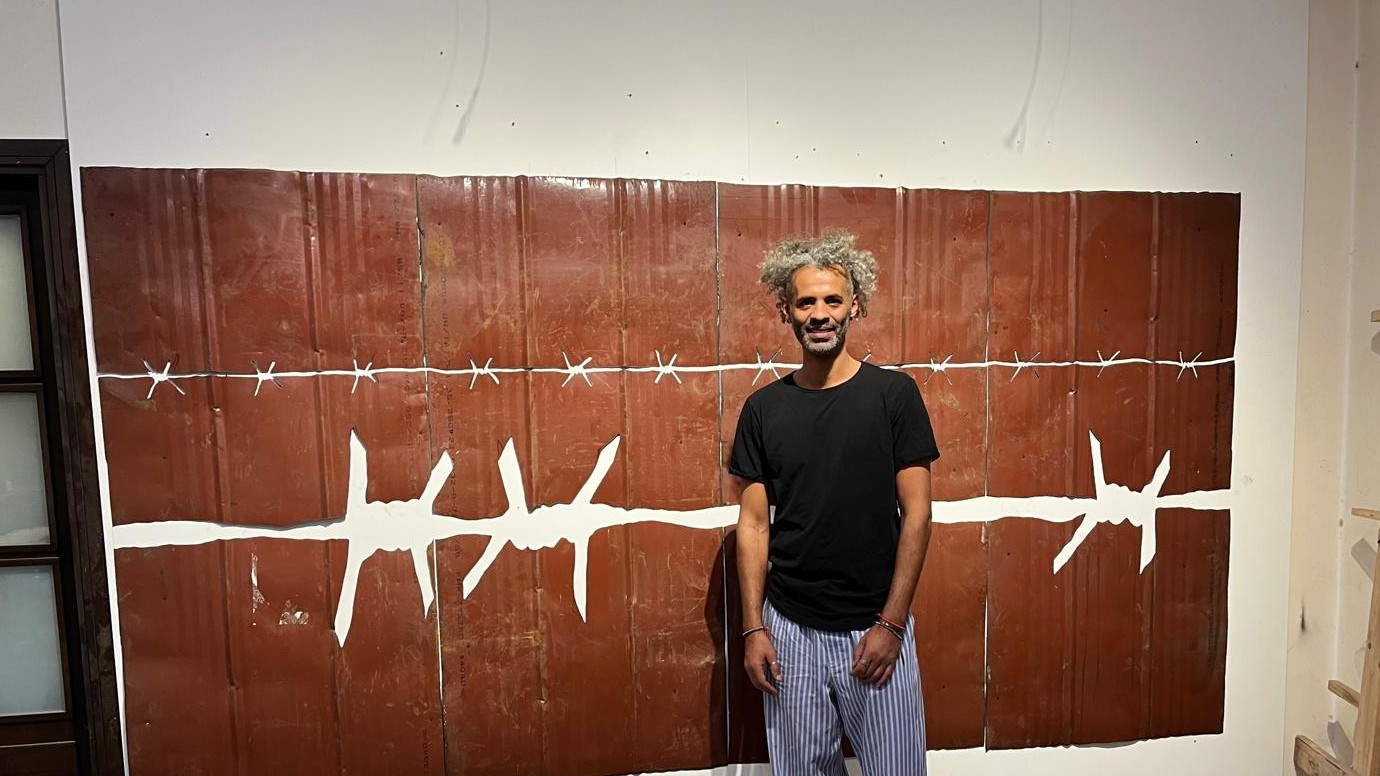
The large studios of Abdul Rahman Katanani and Ayman Baalbaki are filled with canvases and installations about memory and destruction, drawn from the Israeli wars that shaped both artists’ youth. These magical spaces, one in an anonymous building in busy central Beirut, and the other far from the city in a village high in the hills, speak for Lebanon and Palestine. They also define the two artists and their families. Katanani’s materials are barbed wire, corrugated metal sheets, olive branches, petroleum barrels and discarded clothes from his birthplace, the Sabra and Shatila refugee camp. “I’ve always wanted to use the materials of the camp. These materials are our shadows. No... they’re us,” he told Middle East Eye. New MEE newsletter: Jerusalem Dispatch Sign up to get the latest insights and analysis on Israel-Palestine, alongside Turkey Unpacked and other MEE newsletters The harsh materials yield startling lyrical shapes, such as a nine-metre wave in barbed wire, a child playing, a lotus flower and a bright early collage of clothes, including the unexpectedly intimate detail of underwear. Once, he built a replica of the Palestinian camp of his childhood, shown inside an art gallery. Ayman Baalbaki in his studio (Victoria Brittain/MEE) Baalbaki’s very large mixed-media paintings are distinctive. They feature multiple thick layers of paint, often acrylic, in both intense and subtle colours. Many form part of a mesmerising series. One such series, Destruction and Loss, depicts the ruin of Beirut’s iconic buildings, like his 2015-16 iconic painting of the Barakat Building on the corner of Damascus Road on the Green Line of the 15-year-long civil war. A hundred years ago, the magnificent house with its sandstone arches and halls in Ottoman style was a centre of Beirut’s grandeur. The civil war reduced it to a huge shell; its scarred beauty is pockmarked with bullet holes on the outside. Inside, sandbagged sniper positions overlook over every angle of the crossroads. Among the city’s modern skyscrapers, it is preserved as the Museum of Memory, partially referencing the city’s tragedy of the “disappeared”. Another series of his showcases veiled men, mostly in red keffiyehs, with only the eyes partly showing, each one inviting a different impression, under the title Al-Mulatham (The Veiled), Heroes and Disillusion. A recurring theme is the sharply contrasting backgrounds of brightly flowered dress material – a reference to southern Lebanon’s rural areas. One wall of the studio has gifts hung together, one of Katanani’s joyful children of corrugated steel, and others painted by his father, Fawzi Baalbaki. Brothers in art Repetition of themes and materials in these friends’ work echoes the recurring violence in their shared history: Israel’s six attacks on Lebanon, 18 years of Israeli occupation of the south, 15 years of civil war, 29 years of Syrian military presence, prisons and assassinations, and at least 17,000 people who have remained missing for decades, disappeared by one of the various factions vying for power. For more than a decade, the two men have been friends as close as brothers - although they had met before, as they were working with the same gallery. They come from very different backgrounds. Baalbaki is part of a family of well-known artists from the southern Lebanon village of Odaisseh on the border with Palestine. His father is Fawzi Baalbaki, who was also an actor and a writer. His uncle Abdel Hamid and his brother Saeed are also well-known artists. Like his father, Ayman spent three years in Paris, in two elite art colleges. Baalbaki’s grandfather’s home, the family’s roots, was destroyed in Israeli attacks and occupation of the south. “In 1979 the Israelis came into our village, and in various grocery shops and other places they left lists of names of leftists and pro-Palestinian people who could never return. Among them were my father, my uncle and their friends,” he told MEE. Following years of Israeli military attacks and the occupation of the south, many of Baalbaki's father’s precious paintings were destroyed or stolen and sold by the Israelis. He spent the civil war years with his mother and brother in Wadi Abu Jamil, the emptied Jewish area on the front line between the eastern and western parts of Beirut and the rival militia groups who dominated those years. “I lived between four ruined buildings," he said. "My mother must have somehow broken in to find a space. I was young, I saw erasure and young people kidnapped.” A way out of the camp Katanani was born eight days after the 1982 massacre at Sabra and Shatila, in which at least 2,000 Palestinian civilians were killed by right-wing Lebanese militias allied with the Israeli forces. He spent his youth with his family in a room in the damaged former Gaza Hospital in the Shatila camp in Beirut. As a boy, Katanani worked as a porter for his father, a carpenter. With few employment opportunities available to him as a Palestinian in a refugee camp, he drew a weekly caricature for its residents and made posters for Unrwa, the UN agency for Palestinian refugees. Abdul Rahman Katanani in his studio outside Beirut (Victoria Brittain/MEE) When he was 14 or 15, a friend recommended that he go to the Fine Arts College. “I had no clue what that meant,” he said. He went when someone paid his fees for a year, and he later held a scholarship to the American University of Beirut for a short time. The camp was so cut off, he said, that it bred “a kind of psychological problem, seeing everyone outside as an enemy”. “We knew nothing of the outside. We didn’t know the difference between the Communist Party and the Phalange,” he told MEE. “I always just wanted the camp children to have a way out, a free life. We all belong to a free space – not to this space.” Katanani’s own way out began when his drawings and murals were seen by a French delegation visiting the camp. His caricatures were then shown in French and Spanish universities, and in 2005 at a graffiti festival in France. A French passport allowed him to take up several residencies abroad. "I met a lot of artists and found myself among people who were pro-Palestinian – it changed me a lot," he said. In Paris, he spent 15 months at the Cite Internationale des Arts among 60 artists of various nationalities, many of them musicians, and turned his own studio into a gallery. "It was an intense personal experience," he said. As he visited museums and galleries, he began to ask himself what set artists apart. "What is the character of an artist? Am I an artist, or not? How does an artist contribute to society?" Today, Katanani’s studio, featuring one wall hung with the tools for metalworking and woodworking, looks out onto a deep tree-filled valley. It is now his family home, which he shares with his mother, an expert embroiderer with the legendary group In’aash, his twin brothers, their two identical little daughters, and two cats. Baalbaki, too, remains rooted with his family. In a recent interview, his father Fawzi spoke of how much he owes to his sons, Ayman and Saeed. “Ayman in particular plays a major role in the work I do now. To me, he’s like a guardian angel.” Ayman jokes that his father has chosen his current work “to escape to joy – my generation is more the inverse.” Travel experiences shared with Katanani, including artist residencies, have been intense, especially in places like Morocco and Latin America. For Baalbaki, as a student in Paris, Diego Rivera’s work particularly attracted him due to “a certain open-mindedness”. Visiting Rivera’s country was life-changing, he said: “Mexico changed my vision of the world.” 'Work is resistance' The two friends were together in Egypt on 7 October 2023, when Hamas launched an attack and Israel responded with its genocidal war. After the events that day, they knew they had to immediately get back home. Katanani remembers how afraid and paralysed he felt, and that he went into a “deep depression”. Fifteen members of his family were killed in Gaza. Baalbaki also remembers feeling "totally paralysed" at the time. That feeling continues, he says, so for him "work is resistance". Both men have their work on show in museums, private collections and international art fairs in many countries. Rose Issa, a Lebanese-French curator of art exhibitions across Europe and the Middle East, has known both artists and their work for many years. “These are very exceptional people, with extreme generosity of mind, heart and talent, which you can feel in their work," she told MEE. "Their work is stunning. Unforgettable.”
Art against erasure: A Palestinian sculptor and a Lebanese painter on war, exile and memory
Full Article
Original Source
Read the full article at Middleeasteye →KhanList aggregates and links to publicly available news content. We do not host full articles from third-party sources. Always verify important information with original sources.