
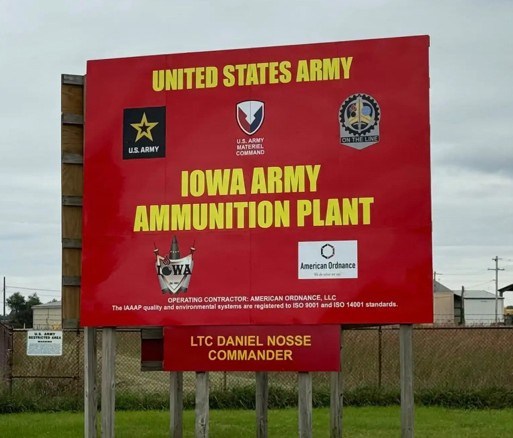
The Army has delayed the controversial detonation of an unstable ammunition stockpile stored at an Iowa munitions facility until Monday, the acting secretary of the Army confirmed, following a barrage of complaints from officials and communities in the projected path of its blast plume. Citing public safety and communication, Adam Telle said he had directed officials to postpone the blasts — originally planned for Friday — until Monday, just three days later. “This will delay the detonation until the latest possible moment prior to a forecasted temperature drop, which would risk further destabilization of the material,” he said in a Thursday statement posted to social media. The Army fears that dropping Iowa temperatures could cause an inadvertent explosion. “The primary concern that we have right now is that lead azide can become more volatile when it is exposed to lower temperatures, and as the weather in Iowa gets colder, we’re very concerned that there could be uncontrolled detonation,” Army spokeswoman Justine Barati told Iowa Public Radio. The controlled demolition, originally planned for Friday at the Iowa Army Ammunition Plant, is intended to dispose of more than 9,000 pounds of degraded lead azide, an extremely sensitive compound the military often uses in blasting caps and detonators. The plant, located near Burlington, makes medium- and large-caliber ammunition for the Department of Defense. Lead is a highly toxic substance that is especially dangerous for young children and pregnant people, as it can affect brain development and cause permanent health issues. It can enter the body through ingesting contaminated food or water or inhaling dust or fumes that contain the chemical. According to the National Institute of Environmental Health Sciences, there is no safe level of lead in a person’s bloodstream. Lt. Col. Daniel Nosse, commander of Iowa Army Ammunition Plant, and other subject-matter experts answer questions from residents and city officials regarding the planned controlled detonation of lead azide during an open house at the Armed Forces Reserve Center on Oct. 15, 2026. (Lori McFate/U.S. Army) Protests erupted in Iowa last week and an online petition to stop the detonation had garnered more than 14,000 signatures as of Friday. A bipartisan group of lawmakers signed a letter this week urging the Army to delay detonation until it can explore alternatives, noting that communities in Iowa and Illinois were only informed about the operation this week. “Our offices have received reports of poor communication from the Army and EPA about the detonation plans and anticipated monitoring after the detonation,” the legislators wrote. “In addition, there are significant concerns about appropriate Army and EPA oversight of this contractor-operated facility, the site of which remains on the Superfund list. We urge you to examine the contractor’s handling of this and other hazardous material to prevent any future issues.” Officials said the stockpile had become too unstable to safely move. According to the Army’s 41-page environmental assessment, the compound cannot be chemically degraded — an alternative to detonation — because the lead azide has crystallized and is therefore extremely sensitive to movement. “The chemical neutralization process requires significantly more “hands-on” time and physical manipulation of the drums by personnel over a prolonged 7- to 22-day period, drastically increasing the probability of accidental, fatal detonation during handling,” the report said, adding that because of the fluid mixture currently surrounding lead azide, complete chemical neutralization was uncertain. The lead azide barrels will be detonated inside concrete bunkers covered with earth and surrounded by sand-filled barriers approximately two stories tall, the Army said, adding that operators will soak the soil above the bunkers and spray water throughout the detonations in an effort to reduce the amount of lead-contaminated dust that spreads beyond the installation. The U.S. Environmental Protection Agency issued an emergency permit for the detonation, stating that “explosion risk from the degraded condition of the lead azide presented an imminent and substantial threat to human health and the environment.” The permit requires the Army to sample potentially affected areas before and after the blast, and to clean up contaminated areas. In its warning to the public, the Army said modeling predicted higher levels of lead particles in the air after the detonation and released maps showing areas where exposure is more likely, subject to wind and weather. The service warned people to avoid the affected areas, stay indoors, keep doors and windows closed and clean indoor and outdoor surfaces. Middleton, Iowa, residents have been advised to stay in place from 8 a.m. to 2 p.m. local time or shelter at the Armed Forces Reserve Center.On Wednesday, the map of lead surface dispersion stretched dozens of miles, while the lead air dispersion map showed potential contamination spots traveling northward over time. In 2023, inspectors found that Iowa Army Ammunition Plant workers had incorrectly detonated explosives and in 2024, the EPA fined the Army and the plant operator — American Ordnance — for alleged violations, the War Horse reported. To ramp up projectile production by the end of 2027, the Army modernized the plant and is creating new facilities in other states.
Army delays detonation of unstable ammunition stockpile until Monday
Full Article
Original Source
Read the full article at Militarytimes →KhanList aggregates and links to publicly available news content. We do not host full articles from third-party sources. Always verify important information with original sources.