
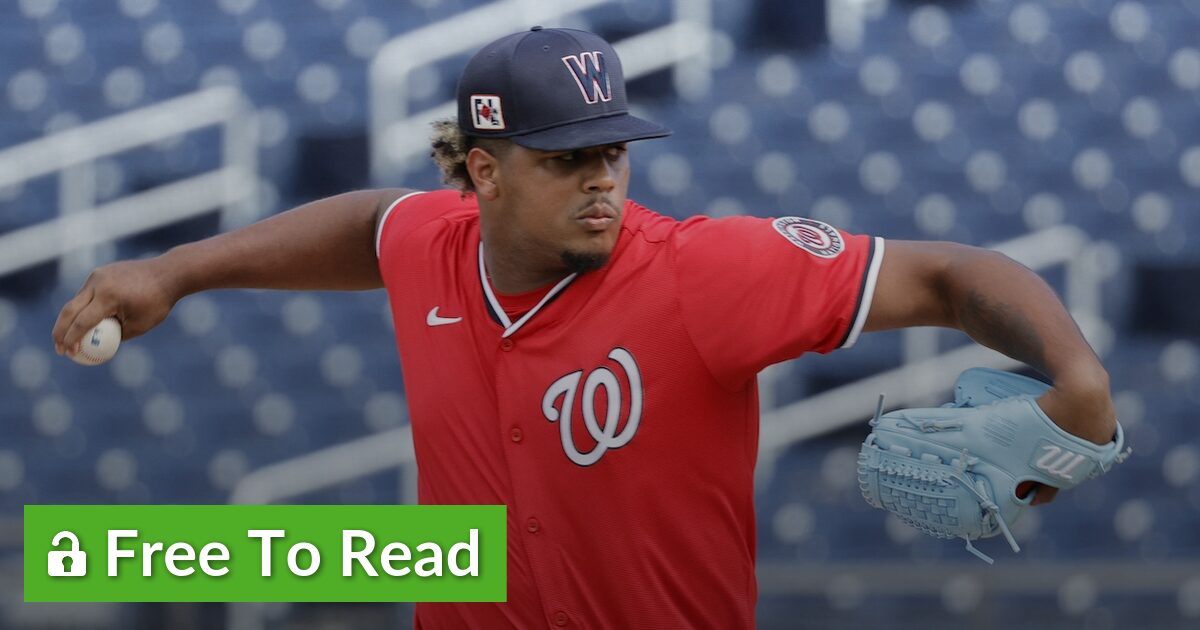
Jarlin Susana Photo: Reinhold Matay-Imagn Images I’m rolling out a bunch of notes from my recent trip to Arizona. Last week, I wrote about some of the top hitters in the Arizona Fall League, as well as a few backfields standouts for the Royals, Giants, and Padres. Today, we’ll dive into some of the pitchers from the AFL. Jarlin Susana, RHP, Nationals Susana has one of the strongest arms in professional baseball. The big righty sits 101-103, and generates it with a low-to-moderate effort delivery. For all its velo, Susana’s fastball doesn’t have bat-missing shape, and even the Fall Leaguers he faced were generally able to get the bat on the ball. His feel for release was off to start the game, and he frequently missed up early in the outing. Hitters couldn’t barrel it in the zone, though, and that will likely continue to be the case for Susana as long as he’s able to live anywhere near that velocity band. Susana worked with two breaking balls. He used an occasional upper-80s slider, usually just as a way to get hitters off his primary secondary, a mid-80s sweeper. There aren’t a lot of guys who can get 15 inches of break on an 85-mph sweeper, but few pitchers have Susana’s arm talent. Ultimately, it’s important to not overthink it with Susana. Even though he has a small arsenal with round-down shape traits on his fastball, he has elite arm strength and a delivery that suggests he’ll be able to throw strikes in the long run. He’s going to be hard to hit. Briggs McKenzie, LHP, Braves McKenzie was a very lean lefty when Atlanta picked him in the fourth round of the 2025 draft. He’s filled out considerably in pro ball — in a good way — and his fastball is up a few ticks year over year. You Aren't a FanGraphs MemberIt looks like you aren't yet a FanGraphs Member (or aren't logged in). We aren't mad, just disappointed. We get it. You want to read this article. But before we let you get back to it, we'd like to point out a few of the good reasons why you should become a Member. 1. Ad Free viewing! We won't bug you with this ad, or any other. 2. Unlimited articles! Non-Members only get to read 10 free articles a month. Members never get cut off. 3. Dark mode and Classic mode! 4. Custom player page dashboards! Choose the player cards you want, in the order you want them. 5. One-click data exports! Export our projections and leaderboards for your personal projects. 6. Remove the photos on the home page! (Honestly, this doesn't sound so great to us, but some people wanted it, and we like to give our Members what they want.) 7. Even more Steamer projections! We have handedness, percentile, and context neutral projections available for Members only. 8. Get FanGraphs Walk-Off, a customized year end review! Find out exactly how you used FanGraphs this year, and how that compares to other Members. Don't be a victim of FOMO. 9. A weekly mailbag column, exclusively for Members. 10. Help support FanGraphs and our entire staff! Our Members provide us with critical resources to improve the site and deliver new features! We hope you'll consider a Membership today, for yourself or as a gift! And we realize this has been an awfully long sales pitch, so we've also removed all the other ads in this article. We didn't want to overdo it. In case you didn't read all that, here's the short version. Membership includes:✓Ad-free browsing✓Unlimited FanGraphs & RotoGraphs articles✓Historical & platoon projections✓Leaderboard & player-page stat heatmaps✓One-click data exports✓Customizable player-page dashboards✓Dark & Classic site modes✓Weekly Members-only mailbag✓FanGraphs Walk-Off, your year in review✓Optional homepage photo removal✓Gift articles to non-Members✓Full postseason coverage McKenzie is a smooth operator with a clean and easy low-three-quarters delivery. If there’s a nitpick, it’s that his arm stroke, while loose, is fairly long. In my look, he sat 92-94 and successfully elevated the fastball for a whiff three times. His long, sweeping curve flashes plus, and he has feel for landing it in the zone and running it off the plate. He didn’t always find the handle on his change, but it too looks projectable, with late fade and sink at its best. He has impressive touch and feel for a pitcher his age, and projects to have above-average command. It’s the foundation of a mid-rotation starter. Braxton Bragg, RHP, Orioles Even though he missed all of 2026 after undergoing Tommy John surgery, we kept Bragg in the top 10 of a deep Orioles system on the strength of his pitchability and his suite of above-average offerings. In the outing I caught, Bragg’s velocity wasn’t quite at its peak, as he sat 92-95 while touching 96. He also threw a couple of very good changeups that had hitters out front. His slider was fringy, slurvy and either side of 80, which is down a few ticks from where it was in 2025. As is the case with most TJ returnees, it’s important to give guys a lot of grace as they get back up to speed. We’ll have to wait for 2027 to see if Bragg’s stuff is all the way back. Jake Bloss, RHP, Blue Jays After throwing unusually hard in his return from Tommy John surgery, Bloss was back near his usual band, if not a tick lower, in his first AFL start. He sat 93-95 with carry and induced a lot of weak contact with it. Both his slider and curve looked sharp. The former was firm, around 90 mph, with a little more run than his 12-6 hook. His mechanics looked normal. He worked with a high-three-quarters slot, a long stride down the mound, and a very short arm swing. He has a slight heel grind and falls off toward first, though not violently. Provided that he can hold his stuff over longer outings — he only worked two innings in this game — Bloss still has the stuff and control of a starter. Miguel Mendez, RHP, Giants Mendez is a rail-thin right-hander with a fast arm. He’s still more projection than polish, but he has made some progress year over year. The arm speed on his changeup looks better, and his mechanics are noticeably closer to those of his fastball than they were when he was in A-ball in 2025. I projected the pitch as a 50 during our last list cycle, and I’ll need to revise that upward half a grade on the next list. On the flip side, Mendez’s velo was on the low side for him (94-96 in this game, 95-99 normally), and his slider lacked its customary bite. Heading into 2027, I’m curious whether a new org can help him get stronger and sturdier. Kannon Kemp, RHP, Padres After an oblique injury limited Kemp to a dozen outings this year, the 22-year-old is getting some much-needed work in the AFL. He’s a power pitcher with a head whack and a very short, though not hidden, arm swing. Scattered with the fastball, he nonetheless missed half a dozen bats with the pitch while sitting 97-98 over his inning plus of work. A sinking change is his best secondary; he couldn’t locate his upper-80s slider to competitive spots. The velocity was interesting, as it’s a couple ticks higher than where he sat last year and even a little above where he was late in the summer after returning from the IL. It’s too early to give up on Kemp as a starter, but it’s nice to know he could have two plus weapons in relief if his career goes that direction. R.J. Sales, RHP, Nationals Sales is a loose righty of average build. He has a quick and tight arm swing, and hides the ball well. He touched 97 and can get the fastball to both sides of the plate. He threw two breaking balls in my look, an upper-80s slider that missed a handful of bats, and a slower, similarly shaped breaker with a little extra length. He had pretty good feel for the former, and showed an ability to hit both the back foot and the back door. He also tossed a couple changeups, none of which was particularly effective. Perhaps unsurprisingly for a guy who missed most of the year, Sales’ velocity and command deteriorated over the course of the outing. He walked the first two hitters he faced in the sixth — to be fair, this is the first time I’ve ever seen a starter work that long in the AFL — and his fastball had dropped to the 92-93 mph range by that point. The fastball/slider mix is enough to be pretty good in relief on its own, but if he can find a workable changeup, he has the other traits to start. Grant Richardson, LHP, Athletics Richardson was still recovering from Tommy John when the A’s selected him in the sixth round of the 2025 draft. He returned to the mound to make a handful of starts at the end of the summer and is picking up more innings in the AFL. He came out sharp in his first start, sitting 95-96 with a flat, late-breaking slider that missed several bats. He also has a curve, though he changes his slot a little bit on it, as well as a change. The slider stood out to me, but one scout I spoke to liked the cambio even more. Richardson’s stuff dipped in his second inning, and he didn’t stick around long. He flashed three above-average offerings at the outset, though, and enters 2027 as a very intriguing southpaw to follow. Antonio Gomez, RHP, Yankees Gomez, once a power-over-hit catcher in the Yankees system, is a recent mound conversion. You can see why, as he sits 97-98 and touches triple digits. He also has a power slider in the low 90s, and while he doesn’t always find the handle, at their best, those two pitches diverge from each other in a devilish manner. He has a busy, high-effort delivery and isn’t a lock to throw strikes. Sam Horn, RHP, Dodgers Horn, a two-sport star, signed for $500,000 in the 17th round of the 2025 draft, but he still had designs on competing for the starting quarterback job at the University of Missouri that fall. Unfortunately, he broke his leg on his first snap of the season, ending his football aspirations and causing him to miss the entire 2026 campaign on the diamond. In his pro debut in the AFL, he looked sharp for a guy with very little high-level experience. He sat 93-96 with a sinking fastball and paired it with an average sweeping slider. He works with a slow, controlled motion with a crossfire delivery and a high-three-quarters slot. It’s very early days for him, but you can see a path to a couple above-average offerings and enough strikes to be interesting. Peyton Olejnik, RHP, Angels The 6-foot-11 Olejnik is a sleeper of mine. He has good body control for his size and a deep mix of stuff that flashes average or better. He didn’t have a good outing in this look, unfortunately, as he struggled to find the dish and got hit hard when he left mistakes out over the plate. He’s one where I’d be inclined to stay patient. His battle to grow into his body is going to take longer than it would for most prospects, so even if he’s likely a reliever in the end, it makes sense to keep starting him for the reps. He flashed an above-average slider and change, and with his extension, he could get his fastball (which sat 92-94 in this look) into that range in short stints as well. Joe Ariola, LHP, Diamondbacks Ariola was one of the few breakouts in Arizona’s system this year. He’s a short strider with below-average extension, though that actually pairs well with his long and high-spin curve. In both this outing and most of the regular season, he hit the box plenty, and he has late-inning upside in relief. Quick Hits A few final observations to close. Adam Smith (Mariners) has average arm strength and flashes a 55 slider, but he could use a more invisible hand, as he’s an open strider with limited deception. Josh Hansell (Royals) missed five bats in a short outing with his plus curve. He’s been a starter with Kansas City, though he projects as a reliever, where he can spam the curve and mix in a mid-90s fastball to keep hitters honest. Harry Blum (Red Sox) is a slow-twitch athlete and scattered his stuff, but he sits in the mid-90s and has a good hard slider. He’ll be at least an HM on Boston’s list. Michael Watson (Cardinals) touches 95 and can spin it. His standout trait, however, is a booming and potentially distracting grunt, the loudest I can recall hearing from a pitcher. Luke Fox (Dodgers) is a potential Rule 5 target, if the major league phase of it actually happens this winter. He’s a lefty with a low slot, and is up to 95 with a couple of workable breaking balls. His delivery isn’t particularly loose, but he’s always thrown strikes. Garrett Wright (White Sox) is a downhill thrower with a high release. He’s up to 98, and his vertical slider is a nasty, plus secondary. It’s a funky enough look that the tonic for his wildness might just be “throw it down the middle.” Pierce George (White Sox) touched triple digits, but he went down in pain while holding his pitching arm in the game where I saw him. Per James Fegan, he suffered an olecranon fracture in his elbow. It looked painful, but the good news is that he’s expected to be ready for spring training.
Arizona Fall League Pitcher Scouting Notebook
Full Article
Original Source
Read the full article at Blogs →KhanList aggregates and links to publicly available news content. We do not host full articles from third-party sources. Always verify important information with original sources.