
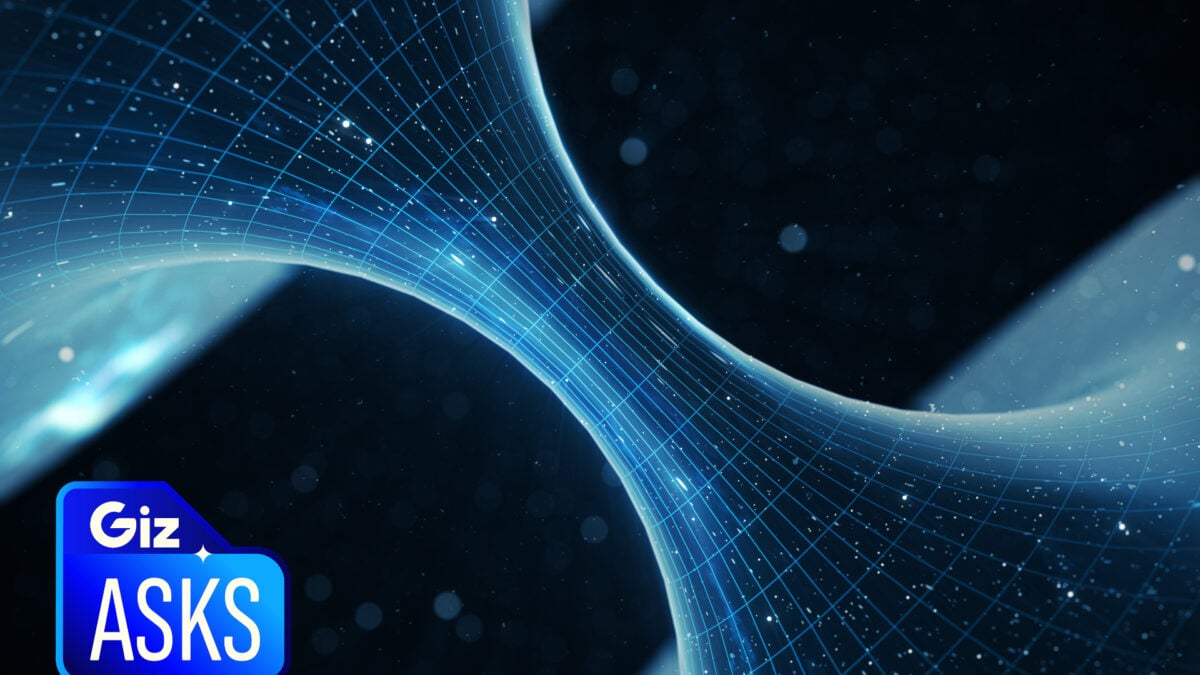
To quote an astrophysicist’s answer to a young student’s question, a wormhole is “like a tunnel between two distant points in our universe that cuts the travel time from one point to the other.” If wormholes exist, they could be like a time machine, or, if you’re a scientist, answer some of the most challenging questions about the true nature of our universe. But in reality, scientists have yet to find any actual wormholes—assuming that they’re still trying to find one. Here at Giz, we’re all about bringing the Y2K revival to theoretical physics. As per a previous Giz Asks about string theory, an apparent “cold case” in popular science doesn’t necessarily mean the scientists themselves have given up on the idea. Sure, not everything might be as sexy as the stuff in old documentaries and sci-fi novels—but progress takes on many forms. For this Giz Asks, we asked scientists if the inquiry into wormholes has run into a scientific dead end. That is, regardless of whether we think wormholes exist, do we currently have the means to explore this concept fully? What kind of theoretical or experimental advances would we need to overcome those challenges? Or has the research branched out into related yet distinct fields, like quantum gravity. And maybe the phrase “dead end” is an unfair way to describe an otherwise thriving field. If so, what are some notable developments for us to keep an eye out for? The following responses may have been lightly edited and condensed for clarity. Enrique Gaztañaga A cosmologist at the University of Portsmouth in the U.K. I don’t think wormholes are a scientific dead end. I think what has changed is what we expect them to be useful for. The popular image is of a wormhole as a tunnel through spacetime that somebody might one day travel through. That possibility faces formidable difficulties. The original Einstein–Rosen bridge associated with a black hole is not traversable, and keeping a macroscopic wormhole open generally requires very unusual forms of stress-energy. We also have no observational evidence that such objects exist. But from the point of view of fundamental physics, wormholes have arguably become more interesting rather than less interesting. Their role has shifted from speculative transport systems towards questions about quantum gravity, horizons, entanglement, and information. One of the most striking developments is the idea usually summarized as ER=EPR: that the Einstein–Rosen bridge connecting two black-hole regions may be deeply related to quantum entanglement between them. Whether or not this identification is ultimately fundamental, it changes the question. A wormhole may not primarily be something that allows matter to travel from one place to another. It may instead tell us how apparently separate regions of spacetime belong to a single quantum state. That possibility is especially interesting for the black-hole information problem. Classical general relativity divides spacetime into regions separated by horizons, while quantum mechanics insists that the complete evolution should remain unitary. Wormholes and Einstein–Rosen bridges provide a geometrical language in which information that appears inaccessible from one semiclassical region can still belong to a larger global quantum description. So I would say that wormhole research has not stalled so much as migrated. If the question is, “Are we getting closer to building a tunnel to another galaxy?”, probably not. If the question is, “Are wormholes helping us understand how spacetime, quantum information, and gravity fit together?” then they remain very much alive. My own interest is closely related to this second interpretation. I am exploring whether a complete quantum description of black holes and cosmological bounces may require complementary spacetime sectors that look disconnected from the perspective of a classical observer but belong to one global quantum state. From that viewpoint, the enduring importance of the Einstein–Rosen bridge may be less as a passage through space than as a clue that our classical picture contains only part of the full geometry. Intriguingly, this idea may even have an observational connection. The largest scales of the Cosmic Microwave Background show a measurable preference between even and odd parity. In my work, I am exploring whether this parity asymmetry could be a fossil of a more fundamental PT-symmetric quantum state, in which opposite spatial and temporal orientations belong to a single complete description, but the classical universe we observe corresponds to only one branch. If that interpretation is correct, the CMB may already contain an observational trace of precisely the kind of quantum completion that wormholes and Einstein–Rosen bridges encourage us to think about. In that sense, wormholes may turn out not to be roads through spacetime at all. They may be telling us something more fundamental about what spacetime is. Juan Maldacena A theoretical physicist at the Institute for Advanced Study and inaugural laureate of the Breakthrough Prize in Fundamental Physics. Wormholes that would allow you to travel faster than light in the ambient space are not allowed by basic principles of general relativity and quantum mechanics. So, they are unlikely to exist. There is a large variety of other wormholes that lead to very interesting physical effects or that they are useful for certain computations. Some of these wormholes are closely related to quantum entanglement. Ali Övgün A theoretical physicist at Eastern Mediterranean University in Northern Cyprus. My answer is no: I do not consider wormholes a scientific dead end. They remain an open question about what gravity permits and a useful tool for exploring the relationship between spacetime and quantum physics. However, we should distinguish their theoretical value from the evidence for their existence. We currently have no confirmed observation of an astrophysical wormhole. The main hurdle is physical consistency. Writing down equations describing a wormhole does not establish how nature could form one, support it, or keep it stable when matter passes through it. In ordinary general relativity, traversable wormholes require unusual energy conditions near their throat. Quantum fields can exhibit negative energy, but this comes with restrictions. Ford and Roman showed how quantum energy bounds severely constrain many proposed wormhole geometries. These are substantial obstacles, although they should not be treated as a universal proof that every possible wormhole is forbidden. Research has also developed strong connections with quantum gravity and quantum information. For example, Gao, Jafferis, and Wall demonstrated that quantum effects can make a wormhole traversable in a particular gravitational setting with an interaction between its boundaries. Maldacena, Milekhin, and Popov subsequently constructed a four-dimensional model supported by quantum effects. These results establish possibilities under specific assumptions; they do not provide a practical recipe for building a wormhole. The 2022 quantum-processor experiment illustrates another direction. Researchers studied quantum-information dynamics interpreted through a wormhole description. They did not create a physical tunnel through our spacetime. Such experiments offer a way to investigate aspects of the proposed connection between gravity and entanglement, with important limitations arising from the small systems involved. There is continuing work on possible astronomical signatures, too. In my recent paper with Reggie Pantig, we studied how surrounding plasma could affect the photon rings of a particular wormhole model. An important lesson is that a proposed signature can depend on the environment as well as the spacetime geometry. An unusual image alone would therefore require careful interpretation before being attributed to a wormhole. I would be cautious about interpreting reduced public excitement as reduced scientific significance. In my view, meaningful progress requires models that connect a credible supporting mechanism with formation, stability, and predictions that can be tested against competing explanations. Better observations and larger quantum experiments can help, but the theoretical work is equally necessary. Even establishing firm limits on which wormholes can exist would teach us something valuable about gravity. Giz Asks is a recurring Gizmodo series in which experts answer big questions in their own words, offering a range of perspectives on the ideas, discoveries, and debates that affect our lives and shape our understanding of the world.
Are Wormholes a Scientific Dead End?
Full Article
Original Source
Read the full article at Gizmodo →KhanList aggregates and links to publicly available news content. We do not host full articles from third-party sources. Always verify important information with original sources.