
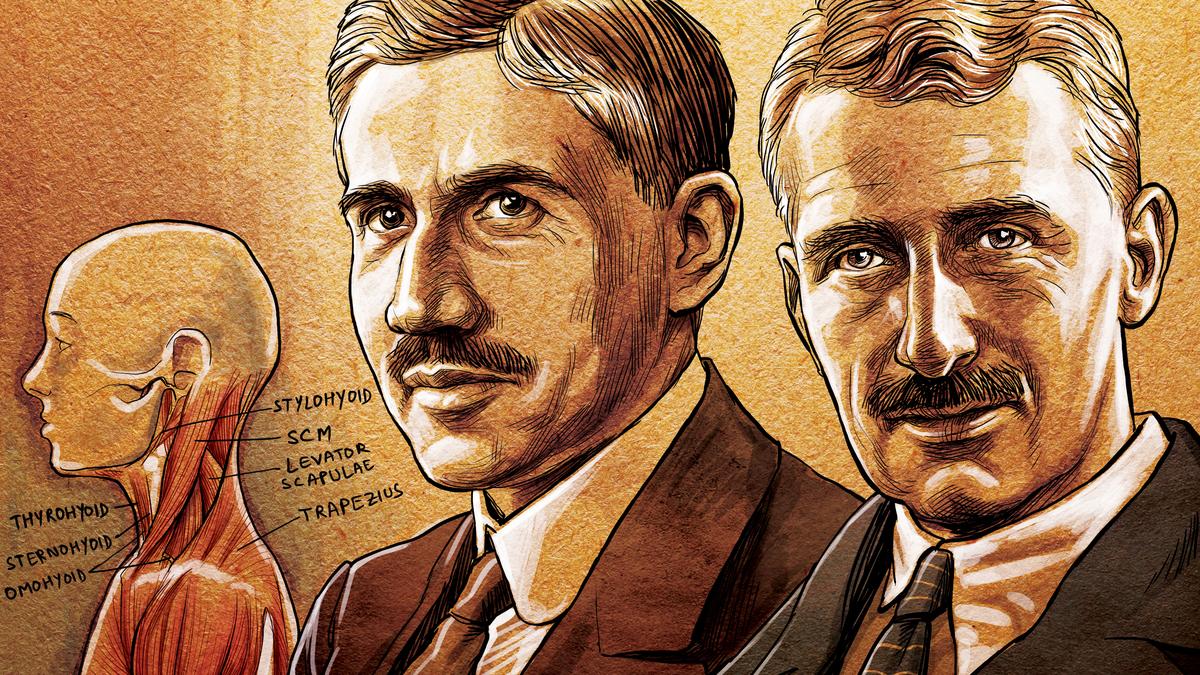
Archibald V. Hill and Otto Meyerhof studied how muscles use chemical energy to contract and recover. Hill measured the heat produced by working muscles, while Meyerhof traced the relationship between oxygen consumption and lactic acid metabolism. Their work earned them the 1922 Nobel Prize in Physiology or Medicine.The prize was divided equally. Hill was recognised “for his discovery relating to the production of heat in the muscle”, while Meyerhof was recognised “for his discovery of the fixed relationship between the consumption of oxygen and the metabolism of lactic acid in the muscle”. The prize was awarded for 1922 but presented in 1923 because the Nobel Committee had initially decided that no 1922 nomination met the required criteria.Measuring muscle heatHill approached muscle physiology as a problem in physics as well as biology. Working largely with frog muscles, he developed precise methods for measuring the very small amounts of heat generated during contraction.The changes were tiny. In one experiment described in his Nobel lecture, a single contraction of a frog’s sartorius muscle at 20°C raised its temperature by no more than about 0.003°C. Hill used sensitive instruments and carefully controlled contractions to separate heat produced during activity from heat generated during recovery.His measurements showed that heat production did not end when the muscle stopped contracting. A second phase, which Hill called recovery heat, continued after contraction and depended on oxygen. When oxygen was removed, this recovery heat was abolished.This was important because it showed that the energy changes associated with muscle contraction and recovery occurred in distinct phases rather than as one continuous process.Meyerhof traces the chemistryMeyerhof investigated the chemical side of the same problem. In experiments on frog muscle, he measured heat production and oxygen consumption and followed the conversion of carbohydrates into lactic acid.He showed that during muscle activity, lactic acid was formed from carbohydrate. During recovery, some of the lactic acid was oxidised while the remainder was converted back into carbohydrate. These observations helped establish the relationship between oxygen use and lactic acid metabolism for which he received the Nobel Prize.Meyerhof’s work went further. Between 1918 and 1922, he provided evidence that glycogen was converted into lactic acid when oxygen was absent. He also found that only a fraction of the lactic acid produced during anaerobic muscle activity was subsequently oxidised in the presence of oxygen, with much of the remainder being reconverted to glycogen.Two sides of muscle metabolismHill and Meyerhof were investigating different aspects of the same physiological problem. Hill measured the physical consequences of muscle activity -- heat, work and energy expenditure. Meyerhof examined the associated chemical reactions.Their findings connected the physical and chemical sides of muscle metabolism. Hill’s measurements of recovery heat could be explained by Meyerhof’s observations on lactic acid and oxygen consumption. Hill himself acknowledged that Meyerhof’s biochemical work helped complete the picture that physical measurements alone could not provide.A link to modern metabolismMeyerhof’s research contributed to the emerging understanding of glycolysis, the pathway through which cells break down glucose and other sugars to obtain energy.His observations also led to what became known as the Pasteur-Meyerhof effect: respiration can suppress the breakdown of carbohydrates through glycolysis. His work provided early evidence that energy transformations in living cells could involve cyclical processes, an idea that became important in the development of modern intermediary metabolism.The terminology and biochemical models have since changed substantially. Muscle metabolism is now understood to involve multiple pathways and energy carriers, including ATP, rather than being explained simply through lactic acid.An interesting part of Meyerhof’s scientific career is that he did not remain committed to every interpretation that emerged from his early work.The discovery of creatine phosphate in 1926 led him to question the idea that lactic acid itself was directly responsible for supplying the energy required for muscle contraction. He subsequently revised aspects of the model that had become associated with his work.The Nobel recognitionHill and Meyerhof delivered their Nobel lectures on December 12, 1923. Hill’s lecture was titled The Mechanism of Muscular Contraction, while Meyerhof’s was titled Energy Conversions in Muscle.Their work established quantitative approaches to studying muscle metabolism, bringing together measurements of heat, mechanical work, oxygen consumption and chemical changes.More than a century later, the details of muscle energy metabolism are understood in far greater molecular detail. But Hill’s measurements of heat and energy and Meyerhof’s work on oxygen, glycogen and lactic acid were important steps in establishing muscle as a system whose mechanical activity could be linked to measurable chemical and thermodynamic processes.
Archibald V. Hill and Otto Meyerhof’s Nobel-winning work on muscle metabolism
Full Article
Original Source
Read the full article at Thehindu →KhanList aggregates and links to publicly available news content. We do not host full articles from third-party sources. Always verify important information with original sources.