
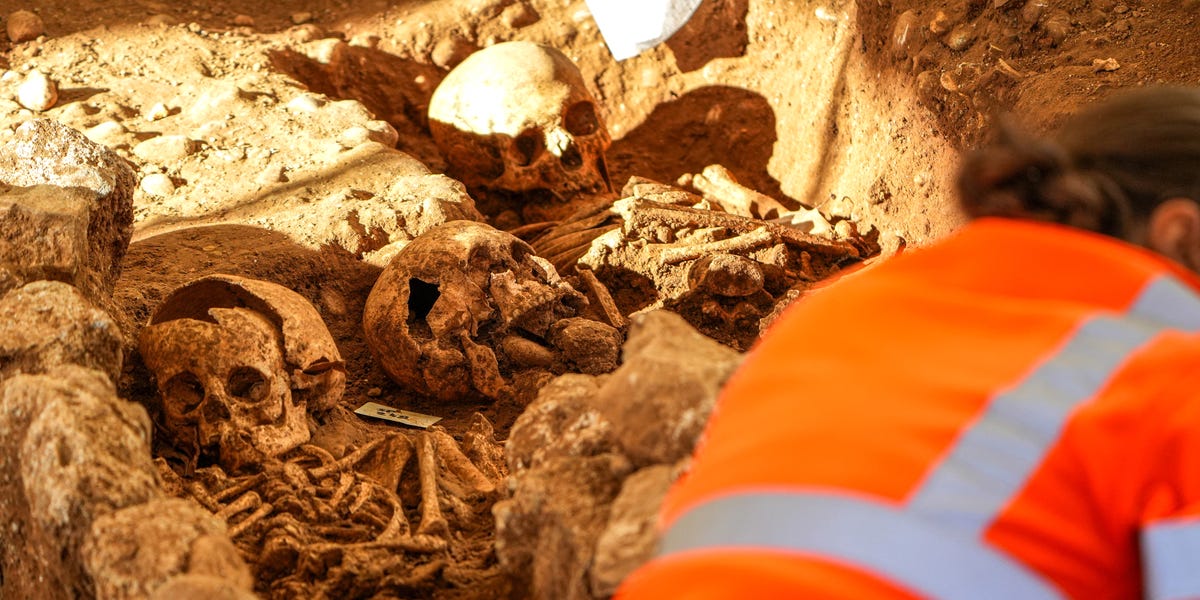
3 min readHere’s what you’ll find when you read this story:A project to dig a new canal in France uncovered a medieval cemetery at the Beaurains-lès-Noyon archaeological site.The staggering number of graves—546 so far—doesn’t match the quiet, rural location.For now, researchers can only guess the reason for such a massive burial ground.Archaeologists have spent nearly a year unearthing over 500 medieval graves in France, and the finds show no signs of stopping. Officials leading the Seine-Nord Europe Canal project expected to encounter plenty of archaeological discoveries during construction, but they weren’t planning on finding a 30,000-square-foot burial ground containing (at least) 546 medieval graves.Élodie Wermuth, archaeologist with the private firm Éveha that’s working on the project, said excavations at the Beaurains-lès-Noyon archaeological site from January into September have surprised officials. “Five hundred forty-six graves—and bearing in mind that we have only uncovered a portion of them—is a significant number for a rural setting,” she said, according to France Info.The 2026 excavations followed assessments of the site in 2024 by the Regional Directorate of Cultural Affairs, which confirmed the discovery of skeletons in the trenches of the planned canal. It didn’t take much time for the teams to unearth the graves, with many located just under the topsoil.“There is a small building—stripped of its stones—around which the graves are arranged,” Wermuth said about a site likely used between the 11th and 14th centuries. “In terms of form, this is quite standard. Cemeteries from the High and Late Middle Ages were highly organized.” Cemetery plans in that era rarely followed more modern patterns of individual graves being lined up. Instead, graves were stacked on top of each other—five layers deep, in this case—to fit as many graves as possible close to the building.Still, just what exactly put over 500—and counting—individuals in the ground at such a random location remains a bit of a guess. Experts believe there was once a late Middle Age settlement at Bas-Beaurains, but little is known about it. Wermuth said the village must have been impressive, though, since the cathedral at Noyon was already built by the 11th century.The first theory surrounding the bodies came from local officials, who observed pathological lesions on the early skeletons. Could the canal project have uncovered a leprosy colony? Leprosariums were built at both Noyon and Bas-Beaurains, but since there’s no hospital at the site, confirming leprosy is tough. “However,” Wermuth said, “since we have only uncovered part of the site, it is possible that such structures extend elsewhere.” On the other hand, as crews continued to excavate, they found men, women, and children all buried at the site, leading to a second theory that the graves simply represent a parish cemetery.But in some of the deepest graves, researchers located “individuals with severe medical conditions that would have limited their mobility,” Wermuth said, adding another wrinkle to the debate.Excavations will continue nearby in preparation for construction while experts plan carbon dating on the skeletons (and examination of burial goods) to confirm the timeline of the remains. They hope that combining the biological study of bones with historical records may lead them to a clear answer about the 546 bodies they’ve already uncovered.Tim Newcomb is a journalist based in the Pacific Northwest. He covers stadiums, sneakers, gear, infrastructure, and more for a variety of publications, including Popular Mechanics. His favorite interviews have included sit-downs with Roger Federer in Switzerland, Kobe Bryant in Los Angeles, and Tinker Hatfield in Portland.
Archaeologists Found Something in the Way of Canal Construction: 546 Dead Bodies
Full Article
Original Source
Read the full article at Popularmechanics →KhanList aggregates and links to publicly available news content. We do not host full articles from third-party sources. Always verify important information with original sources.