
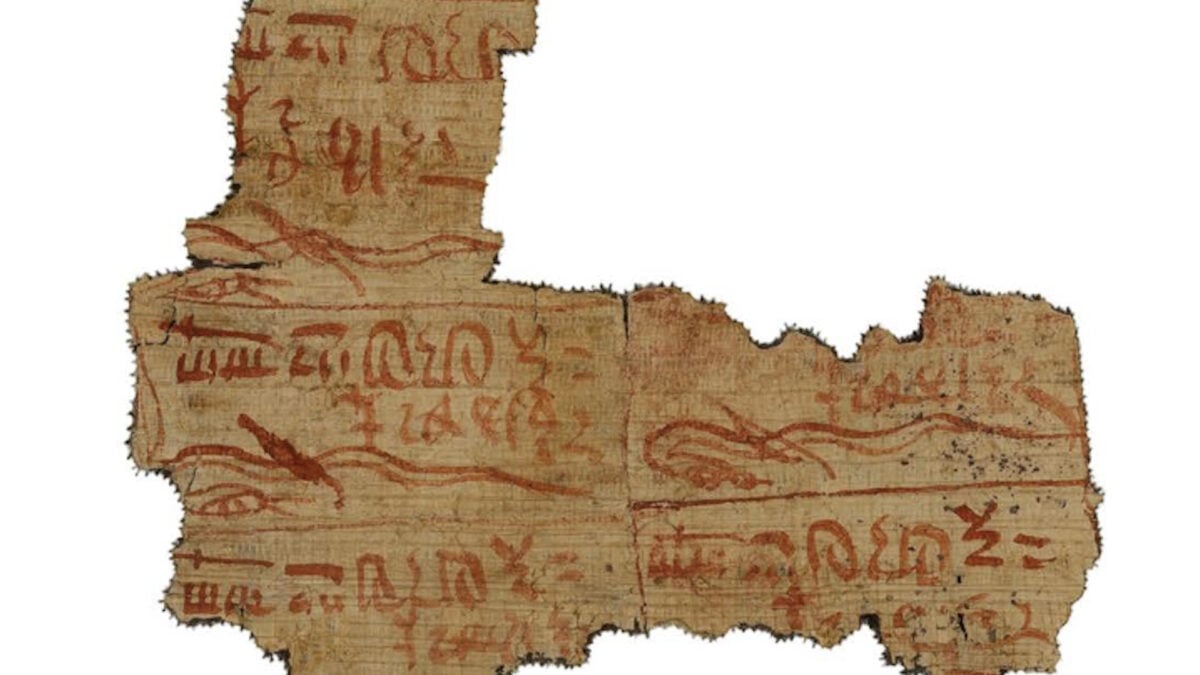
A collection of burned and punctured papyrus fragments found in an ancient Egyptian temple is shedding light on a ritual designed to destroy one of mythology’s most fearsome serpents. Dating back roughly 3,000 years, the fragments depict Apophis, the god of chaos and darkness believed to threaten the sun god Ra on his nightly journey through the underworld. The recently discovered remnants provide rare physical evidence of an ancient Egyptian ceremony known as the “Apophis ritual,” in which priests used curses, stabbing, and fire to symbolically defeat the evil deity. The findings are detailed in a study published in the Journal of the Egyptian Language and Antiquities. Eternal battle In ancient Egyptian mythology, the Ra travels through the underworld every night before emerging again at sunrise. During this journey, Apophis attempts to destroy Ra, preventing the sun from rising and plunging the world into darkness. The Egyptians believed that maintaining the natural order of the universe depended on Ra defeating Apophis. Their nightly battle represented the eternal struggle between ma’at (order, balance, and harmony) and isfet (chaos and disorder). To defeat his enemy, Ra relied on a collection of spells which were gathered in a text known as “A Book of Overthrowing Apophis.” The ritual is mainly aimed at defeating Apophis, but it was also used for other purposes, such as cursing an enemy of the pharaoh. Until now, the only detailed account of the so-called “Apophis ritual” came from a manual dating to the late fourth century B.C., leaving Egyptologists with little physical evidence of how widely the practice was carried out or who was involved. During excavations at a temple in the ancient city of Thebes, a team of researchers stumbled upon 40 charred and pierced papyrus fragments. The fragments were found in a trash dump outside the temple’s northern enclosure wall. Although small and badly damaged, they turned out to be remnants of an ancient ritual specifically designed to destroy Apophis. “These tiny fragments give us a new indication of how widespread curse rituals were in ancient Egypt,” Fredrik Hagen, professor of Egyptology at the University of Copenhagen and lead author of the study, said in a statement. “Our finds and the subsequent analysis of the ritual confirms that it was a regular part of temple life, but a quick look at references to the ritual in other contexts also show that it was widely used outside temples, and that it was a common feature of Egyptian culture more broadly.” Ancient curses Although researchers were under the assumption that the Apophis ritual was reserved for religious leaders, the recently discovered papyrus fragments suggest that it was far more common than previously believed. “We know that literate people, including those who were not priests, had access to magical rituals and functioned as magicians and healers. It is clear that people approached scribes for help in performing magic, both for protection and for attacking others,” Hagen said. “That includes the curse rituals that we can now see were far more widespread than previously thought.” Based on the number of fragments, the researchers suggest that the ritual was performed on at least 20 separate occasions. This doesn’t establish that the ritual was performed daily, but it does indicate that it was a relatively regular activity at the temple. Many of the fragments were badly damaged. Some had been almost entirely consumed by fire, leaving behind only small surviving pieces with charred edges, while others contained unusual holes that researchers believe may have been made by stabbing them with a knife or spear. These marks could be traces of the very ritual the papyri were created for. According to instructions preserved in a later Egyptian ritual manual, priests seeking to destroy Apophis would spit on his representations, trample them, strike them with a spear, stab them with a knife, and ultimately set them on fire, all while reciting spells. “Many of the 40 fragments show signs of having been pierced and charred, which matches the ritual instructions remarkably well,” Hagen said. “For the ritual to be successful, the materials had to be destroyed by fire, so we are extremely fortunate to have found any of them in a condition that still allows them to be recognized and studied.”
Archaeologists Find Rare Evidence of Ancient Egyptians’ Ritual Battle Against Apophis
Full Article
Original Source
Read the full article at Gizmodo →KhanList aggregates and links to publicly available news content. We do not host full articles from third-party sources. Always verify important information with original sources.