
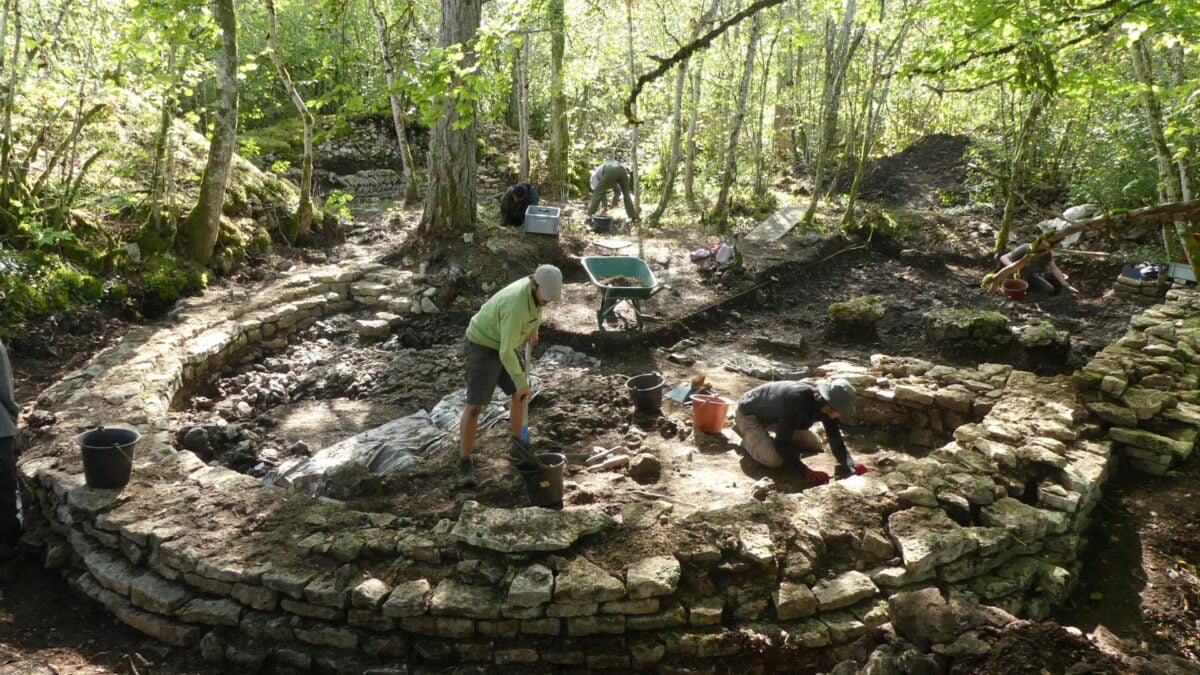
Rome’s grip on modern-day France loosened around the 5th century CE. But traces of Roman influence persisted for much longer—particularly in the way wealthy communities built their homes. During the latest rounds of excavations at Mount Saint-Laurent, French archaeologists uncovered a small hilltop settlement containing multiple buildings with distinct Roman elements, one of which was dated to between the 6th and 7th centuries. The site hosted multiple masonry buildings, glass fragments likely from lamps and tableware, and suspended floors indicative of a hypocaust—a Roman underfloor heating system. Taken together, the evidence suggests that high-ranking individuals lived at the site, which is also consistent with early medieval texts noting the importance of Mesmont, France, where the hill is located. Hypocaust pillars and suspensura fragments, left in the corner of a room in the building excavated in 2026. Credit: A. Guicheteau/Inrap The findings were announced in a recent statement (translated via Google) from the French National Institute for Preventive Archaeological Research (Inrap), whose experts led the research. A historical settlement According to Inrap, humans have occupied Mount Saint-Laurent as early as the Neolithic (between 6,000 and 2,200 BCE), but it appears to have been abandoned during Roman times. People clearly returned soon after, however, as early medieval texts refer to Mesmont as the “chief town” of the region. The city also frequently comes up in hagiographies—Christian biographical works—that detail the lives of notable saints from the era. A drone view of Mount Saint-Laurent. Credit: J. Berthet/Inrap For instance, Bishop Gregory of Langres reportedly appointed his grandson, Eustace, to head the monastic community in Dijon. But before that, Eustace was a priest at Mesmont, according to the statement. These individuals “belonged to the highest senatorial aristocracy of Late Antiquity and the early Middle Ages,” Inrap explained, and the Gregorii family was just one of many others said to have some connection with Mesmont. To be clear, the team hasn’t determined whether the newly discovered site belonged to a specific saint and doesn’t claim to have done so. However, the new findings present physical evidence that strongly supports historical records, which is an important connection. A wealthy patron Archaeologists have studied the site as early as the 18th century, but more modern campaigns began in 2019, which was when the team, led by Inrap researcher Antoine Guicheteau, established the presence of a small hilltop settlement. This was followed by another survey between 2022 and 2024. During these two projects, the team excavated the large stone church—initially discovered in the 1970s—and identified archaeological elements that helped the researchers contextualize the site. There was an “abundance” of window glass fragments, light fixtures, a chancel screen, and what may have been a liturgical bench, which makes it highly likely that the building was a church of some kind. Lidar survey of the current Mesmont cemetery. The basilica plan of the cemetery’s enclosure wall is visible. Credit: M. Thivet/Inrap For the latest round of investigations, the team focused on a building to the west of this area. Here, the researchers found numerous Roman-style pipes, pillars, and remains of suspended concrete floors that likely formed a hypocaust. The structures overall used high-quality materials, and the general layout boasts a “certain complexity.” In addition to intricate pottery and glass fragments, the signs point to the presence of wealthy individuals capable of financing these projects, the team explained. A Roman ‘palace’? That said, the team noted how the site has already been frequented by metal detectorists, whose looting likely caused an “irretrievable” information loss. This is partly why the team isn’t yet certain who lived here, although we may be able to make an educated guess based on hagiographies. Perhaps as a testament to this uncertainty, Inrap headed its announcement by questioning whether this was a “palace” from post-Rome France—at the very least, the intricate, high-quality structures do indicate that the buildings weren’t just regular homes. And importantly, the findings further our understanding of a period “still too often perceived solely through the lens of barbarian invasions or the reign of the ‘do-nothing kings,’” the researchers added.
Archaeologists Find Possible ‘Palace’ Where Roman Life Continued After Rome Fell
Full Article
Original Source
Read the full article at Gizmodo →KhanList aggregates and links to publicly available news content. We do not host full articles from third-party sources. Always verify important information with original sources.