
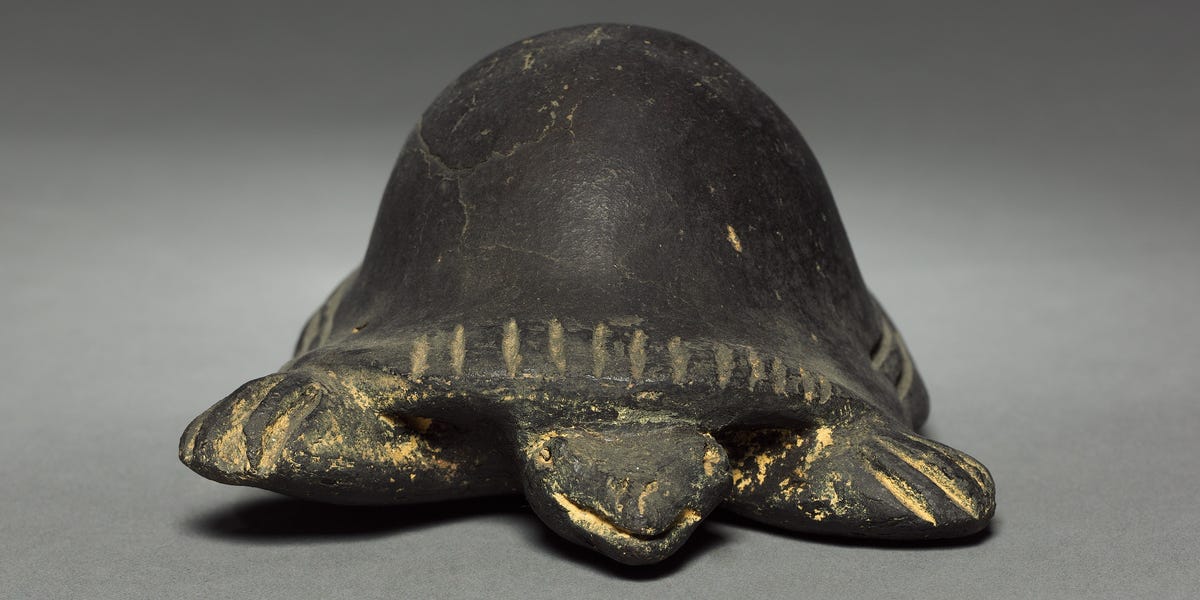
3 min readHere’s what you’ll learn when you read this story:Researchers excavating İn Cave at Turkey’s Gedikkaya Hill uncovered 25 limestone turtle figurines from the Epipaleolithic Period.The crudely carved turtles were planted in the soil around a curved stone feature, suggesting they served a ritual purpose.Experts still don’t know what the turtles meant—they may symbolize longevity, or simply honor the turtle-shaped hill.The 25 recently discovered, rudimentarily-carved stone turtle figurines surrounding a curved architectural feature in a cave under Turkey’s Gedikkaya Hill must have had some sort of ritual meaning. Experts aren’t yet sure what it was, but they have some ideas.“The turtle figurines we found this year have taken the ritual context of the cave to a different level,” said Deniz Sarı, an archaeology professor at Bilecik Şeyh Edebali University, according to the Hürriyet Daily News, adding that most of the turtle figurines were made somewhat amateurishly.Pinpointing the original purpose of the 25 figurines will prove tricky, since they range in age from roughly 14,500 B.C.E. to 11,200 B.C.E., according to radiocarbon dating, placing them within the Epipaleolithic Period.All of the turtles were made of limestone and some were coated with clay. The largest of the carvings reaches nearly a foot in length and about eight inches wide. Researchers believe the turtles had ritual meaning and that they were purposefully placed in the cave near a stone architectural feature.Sarı sees an echo of the practice in Hıdırellez, a spring festival still observed across Turkey and the Balkans in which participants bury slips of paper carrying their wishes. “During Hidirellez, people make offerings, write their wishes on pieces of paper and then bury them somewhere,” Sarı said. “Here, too, there is an architectural arrangement forming circular rings. Around these, we found turtle figurines, mostly half-shaped or quickly fashioned from limestone, inserted into the ground.” The fact that ancient people dug the figurines into the soil around the stone suggests a ritual context and not some haphazard approach, according to a translated report from Anadolu Agency.Archaeologists first took note of Gedikkaya Hill in the 1960s, but the cave itself wasn’t identified until 2017. Excavations have continued there ever since. Teams have found evidence showing humans lived near the hill off and on during the Epipaleolithic, Neolithic, and Chalcolithic periods. Early cave finds included animal remains and stone tools, including a raptor claw and tortoise shell fragments. Deeper in the cave, two curved rows of stones surrounded a large natural stalagmite, creating a sort of ritual pit.That early tortoise find adds intrigue to the newly discovered turtle figurines. Experts believe the ancient people at the site may have thought the hill looked like a turtle, leading to a “mountain cult” with the figurines meant to represent the shape of Gedikkaya Hill. Still, turtles have long represented longevity and endurance and are commonly featured in symbolic uses, especially in that region. While the true purpose of the turtle ritual remains up for debate—whether a traditional meaning or a specific link to the local landmark—it’s clear that the site held some sort of societal value for thousands of years.Tim Newcomb is a journalist based in the Pacific Northwest. He covers stadiums, sneakers, gear, infrastructure, and more for a variety of publications, including Popular Mechanics. His favorite interviews have included sit-downs with Roger Federer in Switzerland, Kobe Bryant in Los Angeles, and Tinker Hatfield in Portland.
Archaeologists Dug up 25 Turtles Carved During the Ice Age. Their Purpose Is Still a Mystery.
Full Article
Original Source
Read the full article at Popularmechanics →KhanList aggregates and links to publicly available news content. We do not host full articles from third-party sources. Always verify important information with original sources.