
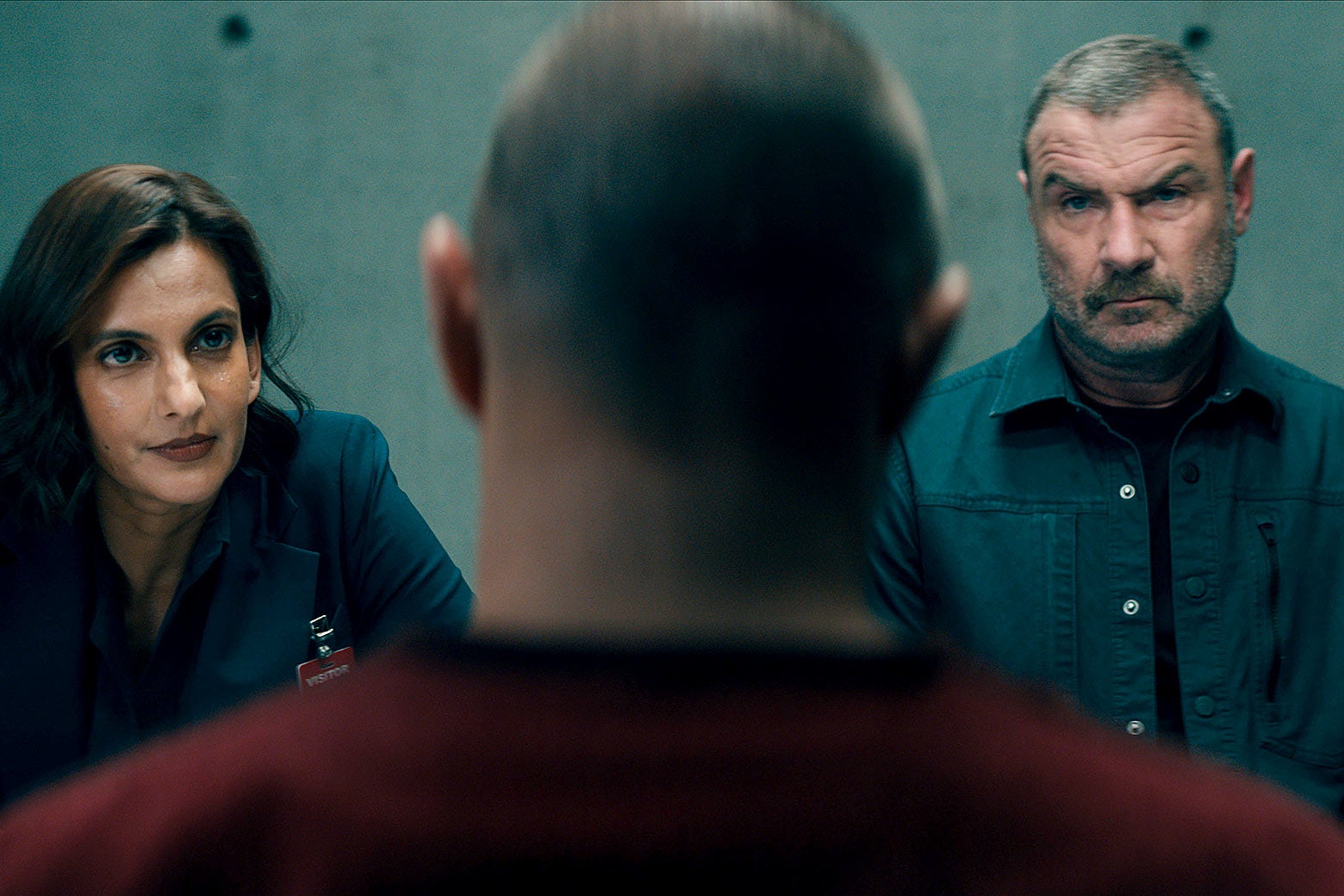
Television Considerable talent is wasted in Apple TV’s star-studded new show. By Enter your email to receive alerts for this author. Sign in or create an account to better manage your email preferences. Unsubscribe from email alerts Are you sure you want to unsubscribe from email alerts for Laura Miller? Oct 30, 20261:56 PM Apple TV Sign up for the Slatest to get the most insightful analysis, criticism, and advice out there, delivered to your inbox daily. This article contains spoilers for the first two episodes of Nocturne. “Great, the last thing this case needs is a catchy nickname,” quips Alexandra Quinn (Poorna Jagannathan), the acerbic FBI agent in Nocturne, a new serial-killer thriller from Apple TV. Nocturne itself—based on the 2012 novel The Sandman by the best-selling author in Sweden, a husband-and-wife team writing under the pen name Lars Kepler—isn’t so scrupulous. Among the shopworn clichés of the genre deployed by Nocturne: a brilliantly manipulative serial killer (Stephen Graham) imprisoned in a high-security facility; the ex-cop (Liev Schreiber) who caught him and who is haunted by a tragic past; the revelation that the killer has an accomplice at large, doing his bidding and mimicking his crimes; weird symbols carved on tree trunks near murder sites; a child whose disturbing drawings offer a clue; multiple chase scenes through semi-deserted warehouses where hanging plastic sheets wave eerily in the breeze, and so on. The one sorta fresh thing that Nocturne ostensibly has to offer is its rural setting in Pennsylvania’s Delaware County, a choice that inevitably summons memories of HBO’s hit 2021 series Mare of Easttown, starring Kate Winslet. Detective fiction has a limited number of effective formulas, but with them it can open up places and cultures with the facility of a top-notch locksmith. (That’s why so many of the best series in the genre have a place name in their title: Twin Peaks, Broadchurch, Fargo, Shetland.) I regret to inform you, however, that Nocturne is no Mare of Easttown. Considerable acting talent has been wasted on this series, from Graham (who both created and starred in Adolescence) to the Tony Award–winning Schreiber to Rory Culkin, who plays Karl, a nurse at the psychiatric hospital where the serial killer, Jurek Walter, is incarcerated. Nocturne, which debuted its first two of six episodes on Friday, opens with a scene of the patient in the cell next to Jurek’s whispering to his neighbor through the stainless-steel toilet as if it were an intercom (an improbable security breach in a facility that otherwise takes meticulous precautions). What Jurek talks the other guy into doing from a cell over is a demonstration of his preternatural persuasive powers, although we never really get to see how he does it. When Karl, a new hire, is assigned to administer Jurek’s meds, his boss doesn’t tell him that the patient’s regular dose has been swapped with a drug that will incapacitate him long enough for Karl to retrieve the shiv Jurek has hidden under his mattress. This ridiculous gambit is necessary, the head of the hospital later explains, because if Karl had known going in what he was supposed to do, Jurek would instantly have read his mind. Naturally, Karl soon falls under Jurek’s spell, although it’s not easy to see why. Graham might have been able to pull off this role if Nocturne’s script had been less ham-fisted. Instead, he alternates between stony impassivity and piteous mewling, neither of which sells him as a psychological puppet master. We’re meant to believe that Karl is a lefty pushover (as he drives off on an errand for his new pal, his car is shown to have a bumper sticker reading “Tax the Rich”) who, in spite of his training and his boss’s warnings, falls for Jurek’s accounts of abuse and injustice at the hands of hospital staff. Karl’s complicity extends to dropping off notes to Graham’s so-called attorney via a dead drop at yet another semi-abandoned warehouse, an unconventional communication method for a legal professional that Karl never seems to question. Culkin, with his huge eyes and cave-dweller pallor, is miscast here, an unconvincing social justice warrior when he might have been an excellently creepy serial-killer protégé. When law enforcement gets frustrated by the privacy regulations of the psychiatric hospital, the officers send in Saga (Zazie Beetz), a young undercover agent with local roots, and a daughter-surrogate of the series’ main character, former homicide detective Jonah Lynn (Schreiber). Absurdly, Saga poses as a mental patient in order to get close to Jurek. Ridiculous devices like this one won’t necessarily sink a detective series if its other elements are crafted with care. Netflix’s Dept. Q is an example of how great dialogue, characters, and performances can compensate for a preposterous premise. But Nocturne’s ho-hum script and flimsy characters don’t do much to distract from its other shortcomings. Then there’s the DelCo setting, which barely registers at all. “Have you ever worked in a small town?” the local police chief (played by the wonderful character actor Bill Camp) asks a bossy FBI chief who helicopters in once the investigation hits a snag. He then goes on to insist that the (fictional) town of Fairhaven itself will be the investigation’s most crucial asset. This comes as a surprise, since Nocturne makes no attempt to portray Fairhaven’s community—not even an establishing shot of Main Street, let alone anything to compare to the rich world of Easttown. Mare of Easttown offered a gritty but lovingly textured portrait of Mare’s working-class home: her neighbors, friends, ex-husband, kids, mother, even the detective’s past as a star player on her high school basketball team. Nocturne, by contrast, assures us that the town has been traumatized by Jurek’s lurid crimes, which involve burying several people alive. Like Dept. Q, the series is based on an outlandishly sadistic Scandinavian thriller that owes more to horror than detective fiction. Fairhaven just wants to move past its serial-killer history, the police chief insists, but it seems bizarre that a small Pennsylvania town where a series of such baroque crimes took place would not still be swamped with ghoulish tourists, podcasters, and cable-TV documentary producers a mere three years after Jurek was convicted. That would make for some fascinating atmosphere and local color. But Nocturne, alas, lacks the imagination to add anything new to the serial-killer genre. Apple Books TV Thrillers
Apple’s Star-Studded New Adaptation of a Bestseller Tries to Capture the Magic of Mare of Easttown. If Only.
Full Article
Original Source
Read the full article at Slate →KhanList aggregates and links to publicly available news content. We do not host full articles from third-party sources. Always verify important information with original sources.