
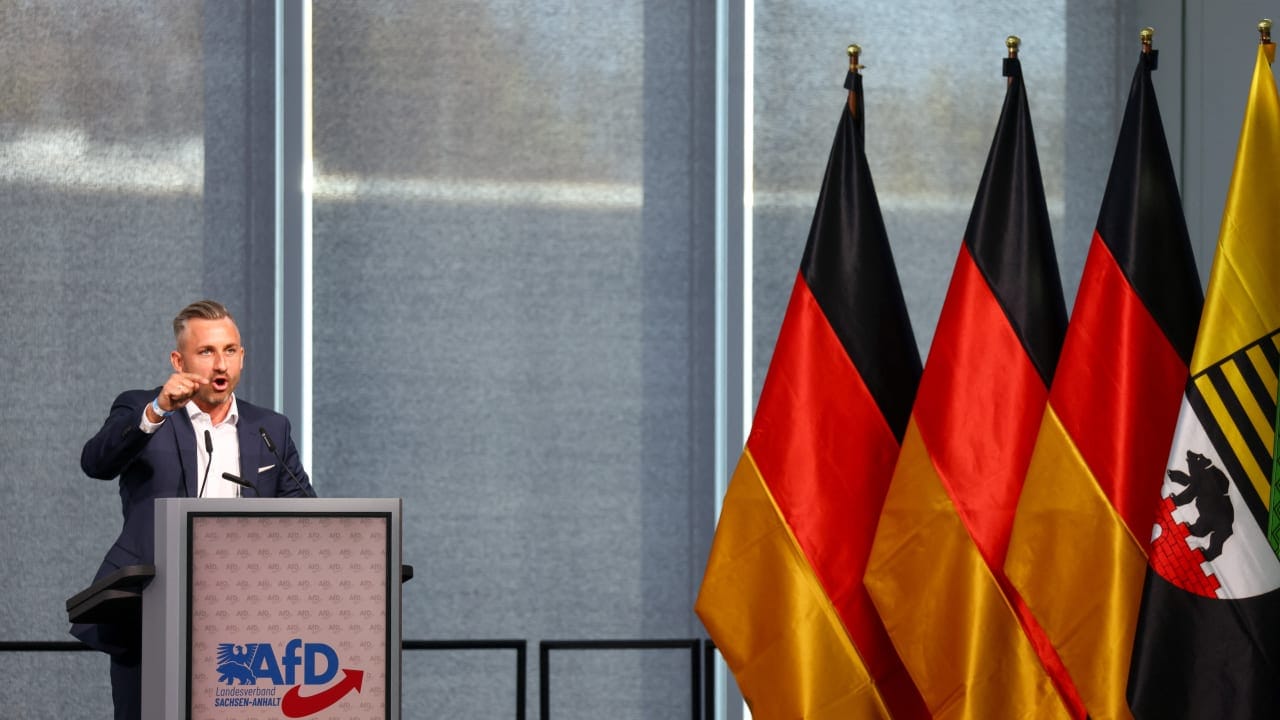
The AJC report found that while Germany’s AfD party denies antisemitism, “antisemitic ideas, codes, and narratives” are present throughout its rhetoric, mobilization strategies and memory politics.Follow us on GoogleUlrich Siegmund, top candidate of the far-right Alternative for Germany (AfD) party in Germany's Saxony-Anhalt state election, speaks at a party convention in Magdeburg, Germany, April 11, 2026.(photo credit: REUTERS/CHRISTIAN MANG)AUGUST 27, 2026 18:10Updated: AUGUST 27, 2026 18:16A new analysis published by the American Jewish Committee (AJC) claims that antisemitic ideas, conspiracy narratives, and historical revisionism are deeply embedded beneath the surface of Germany’s Alternative for Germany (AfD) party.Authored by Prof. Dr. Lars Rensmann, a Professor of Political Science at the University of Passau who specializes in modern political ideologies, democratic theory, and the comparative study of antisemitism, the report, published on Tuesday, is titled “‘Friendly Faces’ of antisemitism? Political Antisemitism in the Alternative for Germany Party.”Rensmann said that political antisemitism functions as a connective element within the party’s broader opposition to modern, pluralist democracy, noting that while the party does not present itself as openly antisemitic and regularly denies harboring antisemitism, “antisemitic ideas, codes, and narratives permeate its rhetoric, mobilization strategies, and memory politics.”The report said that the AfD has evolved from a Eurosceptic protest party founded in 2013 into the central political force of Germany’s far Right, serving as a durable parliamentary actor and the largest opposition party in the Bundestag.According to Rensmann, this transformation has been accompanied by a radicalization in which the party positions itself against liberal democracy while cultivating authoritarian, ethno-nationalist, and conspiratorial worldviews.Supporters of the far-right Alternative for Germany (AfD) gather to hear AfD lead candidate Ulrich Siegmund speak at an AfD campaign rally prior to state elections in Saxony-Anhalt on August 24, 2026 in Naumburg, Germany. (credit: SEAN GALLUP/GETTY IMAGES)AfD frames politics into virtuous people versus corrupt domestic elites. external forcesThe analysis outlines how the AfD frames politics through a stark friend-enemy logic, dividing society into a supposedly virtuous people versus corrupt domestic elites and external forces. According to Rensmann, this framework “closely mirrors patterns of modern antisemitism, which historically constructed Jews as hidden enemies linking internal ‘traitors’ with external threats.”Rather than naming Jews explicitly, Rensmann argued that the AfD usually relies on coded language. He noted references to “globalists,” “cosmopolitan elites,” or “shadowy financial powers draw on long-standing antisemitic stereotypes.”The study further stated that the conspiracy myth of a planned “Great Replacement” of the native population “echoes classic fantasies of a Jewish world conspiracy without explicitly mentioning Jews.” Investor George Soros serves as a recurring personification of these ideas, with Rensmann noting that “AfD representatives repeatedly portray him as a sinister puppet master orchestrating migration, climate policy, and social change.” The author argued that “such narratives revive the core motifs of antisemitic conspiracy theories while maintaining plausible deniability.”The analysis explained how the party’s ideology has been shaped by ethno-nationalism and the demand for remigration, accompanied by the rehabilitation of Nazi rhetoric. Rensmann argued that this worldview is historically inseparable from antisemitism because it frames cultural homogeneity as a prerequisite for survival and attributes national decline to subversive outside influences.Appropriation of Nazi slogans, ideas, and symbols by party leadersThe report highlighted political and legal responses to the frequent appropriation of Nazi slogans, ideas, and symbols by party leaders, such as the SA slogan “Everything for Germany,” noting that the AfD said these references are entirely innocuous and are criticized or prosecuted in bad faith by representatives of the state.Rensmann noted that rehabilitating this language is structurally linked to antisemitism because it reactivates the national-revolutionary imagination of the Nazi era, which historically blamed Jews for modernity, liberalism, and pluralism.Furthermore, the paper examines historical revisionism and secondary antisemitism arising from defense against memory as political motives of the AfD.Rensmann argued that the party rejected the “cult of guilt,” claiming that this stance relativizes Nazi crimes, prevents national pride, and in effect marginalizes Jewish perspectives on history. According to the report, this promotes what scholars describe as secondary antisemitism, defined as “hostility toward Jews arising from resentment about Holocaust remembrance and perceived moral demands.”Within this framework, Rensmann said that “Jews appear implicitly as those who prevent a positive national self-image by insisting on confronting German crimes.”Party's attempts to shield itself from antisemitic accusationsThe report also noted how the party attempts to shield itself from accusations of antisemitism by pointing to its supposed pro-Israel positions as proof that it harbors no hostility toward Jewish people.Rensmann argued that this maneuver is entirely instrumental and defensive, noting that “instrumental ‘pro-Israel’ rhetoric” is deployed by the party “only insofar as it appears to confirm the AfD’s own ethno-nationalist and anti-migration agenda,” such as expressing hostility toward Muslim migrants.Rensmann said that this supposed solidarity is selective and disingenuous by highlighting instances where the party exhibits underlying anti-Israel or hostile positions when Israel’s actions or existence do not serve nationalist talking points.He noted that the party’s foreign policy positions frequently align with anti-Western and authoritarian regimes hostile to Israel, and that its leadership has routinely voted against or opposed cooperative diplomatic frameworks involving Israel while weaponizing the Jewish state merely as a rhetorical tool against political opponents and Muslim immigration.The paper concluded by stating that far from being an isolated problem, political antisemitism functions as a key mobilizing resource within the AfD’s broader challenge to liberal democracy.Rensmann argued that understanding this dynamic is essential for assessing the risks the party poses to democratic culture, minority rights, and social cohesion in Germany.Follow us on Google
Antisemitic ideology deeply embedded within the far-right German AfD party, new AJC report shows
Full Article
Original Source
Read the full article at Jpost →KhanList aggregates and links to publicly available news content. We do not host full articles from third-party sources. Always verify important information with original sources.