
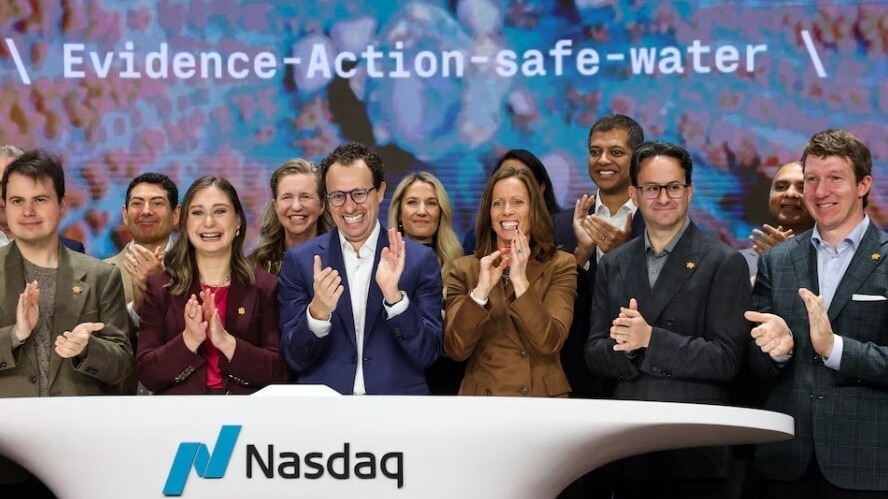
Of late we are going through a dry patch as far as breakthrough AI models are concerned. But the world of AI is abuzz with everything else. This week was all about Anthropic IPO and the Nvidia saga, but by the end of the week Claude set the tongues wagging after solving Riemann Hypothesis, a 167 years old problem.Anthropic had an eventful week. On Thursday, the company rang the bell at Nasdaq and immediately became one of the biggest corporations in the world. It debuted with a market capitalization of little over $1.5 trillion and surged past the $2 trillion mark quickly, before its investors — and possibly thousands of employees who are now millionaires — started a selloff to cash-in on the opportunity. ANT, which is the Anthropic stock symbol, did slide in the next 24 hours. It was expected due to profit booking. These are early days and the future looks fairly okay for Anthropic, granted the real-world applications of AI materialise in substantial way in the coming months and years. That, though, is not a certainty. The Nvidia saga, discussed in Part III of this newsletter, is casting a shadow on all things AI. Financials are yet not aligned for any AI company. Take Anthropic for example. One calculation by the Financial Times suggests that to justify its valuation, and to help investors earn decent returns, Anthropic will have to quickly race to an annual revenue of $600 billion if it wants at least 20 per cent returns on its estimated $1 trillion proposed investment in AI. In 2026 its revenue is going to be only around $45 billion. An annual revenue of $600 billion would not be easy. It is also, given the promise of AI, not that far-fetched. Anthropic founder and CEO Dario Amodei seems to have a plan. On Thursday Dario issued a quick message celebrating his company’s IPO. In that he gave a glimpse of what Anthropic is now chasing. The company does not seem interested in chatbots anymore. Instead, the focus is on institutional users instead of individuals. The idea is that if you have AI smarter than any human, then you deploy it in tackling big challenges. And in the process earn big bucks. One area that Anthropic is going after bigly, to borrow a phrase from Donald Trump, is medicine. It is a sector where there is a lot and a lot of money. Just ask Novo Nordisk. In his brief statement Dario said, “I believe sufficiently powerful AI, working in concert with humans, could compress a century of scientific and medical progress into a decade.” He talked of how he lost his father to cancer and how “in the future fewer families miss a cure by just a few years” because AI will make treatments faster. Solve big questions, remake the world, and revenue will come — that seems to be the idea. “Medicine is just a particularly vivid example, but there are many others,” said Dario. “Our customers— the world’s most ambitious companies, nonprofits, and individual people — are already applying the intelligence we’ve built to stimulate economic growth, lift people out of poverty, protect democracy and free societies, even make everyday services like the DMV work better.” It’s clear: Claude will do heavy lifting. Other AI systems can create images, do homework for students, and do late-night chit-chat with people who probably find them unemployed due to AI.As if to bolster the argument, Anthropic announced a breakthrough just days after its IPO. It said one of its mathematicians worked with Claude to solve the Riemann Hypothesis. The proof is in over 2.5 lakh pages Claude has written while solving this 167-year-old Mathematical puzzle. Riemann is considered one of the most important mathematical questions of our times given its application in fields like cryptography and computing. So far it has been assumed the Hypothesis, which ascribes a pattern to how prime numbers like 1, 2, 3, 5, 7, 11, 13, 17 and so on appear, is accurate. But a conclusive proof that it is indeed true, which is what Claude has apparently found, matters. Over the next few months it will need to be validated but the proposed solution is significant because of two reasons. One, if everything checks out then Riemann Hypothesis has been conclusively proven to be true. Big! And two, it has been solved by AI in a way that is impossible for humans — through brute force with its analysis and solution running into over 2.5 lakh pages.So, what is next for Anthropic? I believe the company is pivoting towards using AI to tackle big challenges. The results will not be appearing anytime soon. But in another 6 months to one year we will know whether Anthropic is currently overvalued at Nasdaq or undervalued. In this waiting lies the opportunity for punters of the stock market. For the rest of us, it is business as usual for now. Sarvam pivots, sparks a debate on Indian AISarvam started with a bang and a promise. One of its stated aims is to create a frontier model that is completely Indian. The company in July this year announced it was working to create India’s first 1 trillion model. It may not be enough to match the frontier models that nowadays have 2 to 3 trillion parameters, but a well-tuned 1-trillion model will be a breakthrough achievement for any Indian company. We hope this model is still coming. Why the hope? Sarvam of late is taking on some side-quests. A few weeks ago, the company announced a partnership with the Indian government to build AI solutions for the Army. This is not a problem per se, but the announcement comes across as a signal that instead of working at the AI frontier, Sarvam is getting into dhandho mode. This week the company announced Token Factory, a new service that will see Sarvam pivot to being an inference provider. In simple words it will mean that Sarvam will provide India-based AI infrastructure to allow Indian companies access to open source models, including Chinese models like DeepSeek and Kimi. The announcement can be perceived in two ways. One, Sarvam sees a business opportunity in being an India-based inference provider that helps Indians companies safely and securely access the world’s top open-source AI models. Sure, these are not its own AI models. But how does it matter if Sarvam is serving the needs of Indian companies and earning money through that, money which it can then use to R&D its own frontier AI models? And two, Sarvam has decided that creating an AI frontier model is an impossibility and that inference business is a low-hanging fruit it should go after. The move sparked an online debate. Some people slammed Sarvam, which has received support from the Indian government to build a frontier AI model in India, for its perceived pivot, and exhorted it stay on the mission — that is build India’s AI model that can be similar to what Americans and Chinese have. Some others said that work on frontier AI models can continue alongside the inference business. A few others, meanwhile, argued that Sarvam is right in its pivot — at the end of the day it is a business and unlike the US labs, which can raise billions of dollars and then burn that money in chasing chimeras, an Indian company cannot afford to have impossible dreams. I wish in the middle of the debate Sarvam had cleared the air. But the company so far has stayed mum. Nvidia continues to slideThree weeks after the Nvidia founder Jensen Huang became talk of the AI town due to his two extramarital affairs, Nvidia continues to be in doldrums. Jensen has been ousted as the company CEO. Rather, he has been unceremoniously kicked out of the company he founded and grew. This week for the first time since his affair with Alice Huang became public, Jensen put out a statement. He apologised. Several times. He talked of his family. He talked of Nvidia. And then he talked of how he would so-very-much be keen on coming back to Nvidia as CEO. The Nvidia board was quick to react. No way, the board said. It is becoming quite clear that Jensen found himself out of Nvidia not only because had a couple of affairs. Sure, morally and ethically he crossed red lines. But something more is going on and there is a whiff of the US government involvement in the whole saga. It seems that some very powerful people, or institutions, wanted Jensen out of Nvidia, arguably the most important company in the world right now due to its key position as an AI leader. Whatever the reasons, Nvidia is taking a beating. Some of its employees are grumbling. There are many in the tech world who want Jensen back. Even the US President Donald Trump wants him back as he made clear on Friday. "I think that I would love to see Jensen be given a second chance... I’d like to see Jensen make a big apology and go back," Trump said.The board is unmoved. Likely because it’s not just about Jensen’s extramarital affairs. Instead, we continue to get a trickle of news stories — all leaked surreptitiously — about what horrible person and boss is Jensen. At the same time, the board is finding it difficult to keep the Nvidia juggernaut going. In the last few weeks, the company has lost little over 40 per cent of its market capitalisation! On Friday alone, when the US SEC announced a probe into its books, the company stock went down by little over 10 per cent. As Nvidia slides, it can potentially start a chain-reaction that may ultimately doom the entire AI rally we have seen in the last few years in the financial markets. This is a possibility we have discussed several times in this newsletter, and this week’s affairs are making it look more probable. Nvidia and Jensen have been playing the role of kingmaker in the AI space for over several years now. If there is an AI bubble, Nvidia sits in the middle of it. Now that Jensen and Nvidia are in trouble, the whole bubble — if it is indeed a bubble — may end up bursting. Though OpenAI CEO Sam Altman is confident that the world will survive without Jensen. Or Nvidia. “I think Jensen has played this extremely special and valuable role as someone to really drive things forward with great vision,” Altman said a few days ago. “(But) the (AI) revenues and demand are growing so strongly that I think the industry will be fine.”Panic in China?The industry might be fine, but Chinese AI space may suffer. This is one part of the AI world that is likely to hit hard because Jensen is no longer in the driving seat. The chatter on AI circles on X hint at some serious panic in Chinese AI space. For the last couple of months Chinese AI labs have been rather muted. There have been some new models, but nothing extraordinarily explosive. People suggest OpenAI and Anthropic have become better at stopping Chinese AI labs from distilling (aka copying) their top models. Now with Jensen no longer at Nvidia to argue against export ban on AI chips for China, Chinese AI companies are staring at serious pain. The Nvidia saga is unfolding at the same time when the US is also moving to stop Chinese AI companies from using AI centres in countries like Malaysia and Singapore. On November 18, Tencent president Martin Lau said the new US move “does set everyone back. It sets everyone back in China.” Ouch!Must WatchAI vs humans in KPMGWe learnt in the Part I of this newsletter that AI is extremely good at logic aka mathematics. Is it equally good at stuff that is not logic, something that is intuitive and a domain of humans? Like asking questions during an audit? KPMG believes that it is.KPMG recently audited a big UK company. In the process it used over 100 AI agents. The whole exercise was named Project Exponential. What did KPMG see? Well, AI did a better job because it “was able to go so much deeper” and asked “better questions.”But there is a silver lining for humans too. Those 100 plus AI agents were working under the guidance of KPMG employees. In fact, in several instances the AI agents failed and humans had to step in. Yet, KPMG hints, the lessons from Project Exponential indicate that in future fewer people will be needed to conduct audits because AI will do plenty.SIX STORIES YOU CANNOT MISS01Google gives IIT Kharagpur $5 million for AI research, Sundar Pichai shares emotional message02This 23-yr-old Indian-origin sold his AI startup for Rs 40,000 crore, now going viral on X03Nothing AI device revealed before launch, looks like a voice recorder04AI vulnpocalypse has hit banks and grounded flights, experts say outages have one thing in common05Google launches Gemini 4 Neon for software workflows, claims 3x faster speed than Carbon06Apple is working on its own AI agent that can use apps, browse the web and write code
Anthropic rings the Nasdaq bell and then solves Riemann Hypothesis, what next now?
Full Article
Original Source
Read the full article at Indiatoday →KhanList aggregates and links to publicly available news content. We do not host full articles from third-party sources. Always verify important information with original sources.