
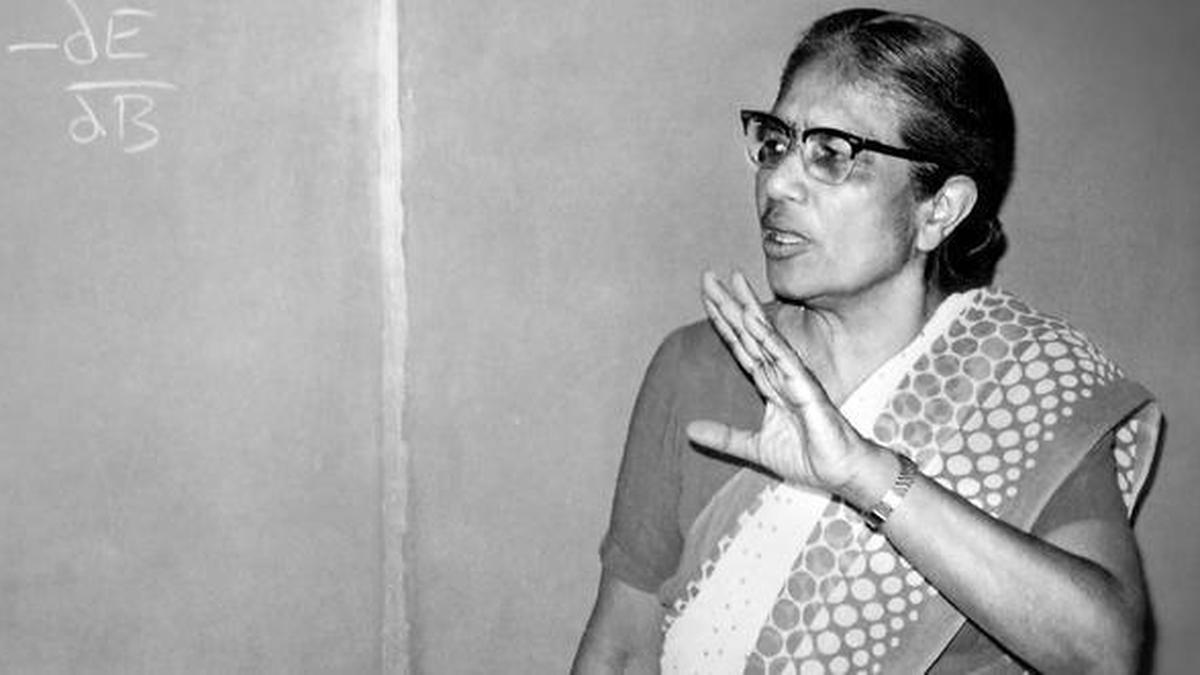
In the high ranges of Peermade, Travancore (the current Peermade of Idukki district in Kerala), in 1918, a young girl was born to Modayil Pothen Mani, a well-known civil engineer cum plantation owner and his wife. Little did anyone in the misty hills of Idukki know that one day the place would be known by the legacy left behind by her. This is the story of Anna Modayil Mani, the weatherwoman of India.Science and childhoodBorn into a prosperous Syrian Christian family with seven siblings, Anna Mani defied all societal norms from a very young age. From being a voracious reader to defying the notion that girls should be groomed for marriage, she stood tall as a bold and curious young girl. Her father, being a strong believer in science, quite strongly followed and taught the importance of never accepting any statement unless it could be tested and verified.From a very young age, Anna was seen to have strong inclinations towards reading rather than any other hobbies considered ‘appropriate’ for girls back in the day. It is often said that she declined diamond earrings traditionally gifted by her family and asked for a set of Encyclopedias. In 1925, when Mahatma Gandhi visited Kerala and spoke about self-reliance, seven-year-old Anna was moved and vowed to wear only khadi clothes throughout her life. Her formative years were thus quite different from those of other girls around her, and all traditional norms were broken when she completed her B.Sc. Honours in physics and chemistry from Presidency College, Madras, in 1939. Career aheadAt a time when barely any women were formally educated and pursuing higher education, Anna not only completed her bachelor’s, but also went on to start her research at the Indian Institute of Science, Bengaluru, under Nobel Laureate Sir C.V. Raman. This was in 1940, and she was working on spectroscopy (the study of how matter interacts with electromagnetic radiation, or light) of diamonds and rubies. Her peer-reviewed research papers are often still cited in the field today. However, the fact that Anna did not hold a master’s degree resulted in her not being able to pursue a PhD — a formal requirement at the time being the same. It never stopped her from pursuing her passion; in 1945, Anna received a government scholarship to pursue education in England. Anna was passionate about physics; however, fate had other plans. The only internship available at the time was in meteorological instrumentation at Imperial College London. This was, however, the start of her journey to becoming the weatherwoman of India. Return to IndiaIn 1948, Anna returned to India after her work in England and joined the India Meteorological Department in Pune. Still climbing the steps towards self-sufficiency post-independence, Anna played a huge role in helping the country become self-reliant in weather instruments. A department which heavily depended on imported instruments soon got recording rain gauges, hygrographs, thermographs, barometers, and anemographs. The journey was not easy, and Anna worked closely with the World Meteorological Organization to verify the accuracy of Indian instruments. All this while being one of the few women in the field. In 1953, she became the head of the instruments division, and under her, more than a hundred weather instruments were designed, standardised, and manufactured in the country.Venturing into unique fieldsAnna dared to venture into areas India had never stepped into before, including solar energy and wind power. Her team set up monitoring stations across the country as part of this exploration. Another field she studied was the ozone layer. As part of the same, she ended up creating the ozonesonde, a balloon-borne instrument measuring atmospheric ozone’s vertical distribution. All this led to her becoming a part of the International Ozone Commission in the years ahead. She also published the Handbook of Solar Radiation Data for India and Solar Radiation over India, which, in a way, became the core reference for those designing solar thermal systems. She also conducted extensive wind speed surveys, laying the groundwork for India’s wind energy development decades before it became mainstream. Anna Mani | Photo Credit: Wikimedia Commons In 1976, Anna retired as the Deputy Director-General of IMD after close to 7 years in the position. She then went on to work at the Raman Research Institute and also collaborated with the Indian Institute of Tropical Meteorology to assess solar and wind energy potential for the Department of Science and Technology. She headed this project until almost the end of her life. She was also honoured by multiple international and national organisations for her work throughout the years.In 2001, she passed away in Thiruvananthapuram after suffering a stroke. A woman who dedicated her entire life to her passion and the growth of a field in India, Anna Mani’s name and legacy live on long after her years.
Anna Mani: a star from the hills
Full Article
Original Source
Read the full article at Thehindu →KhanList aggregates and links to publicly available news content. We do not host full articles from third-party sources. Always verify important information with original sources.