
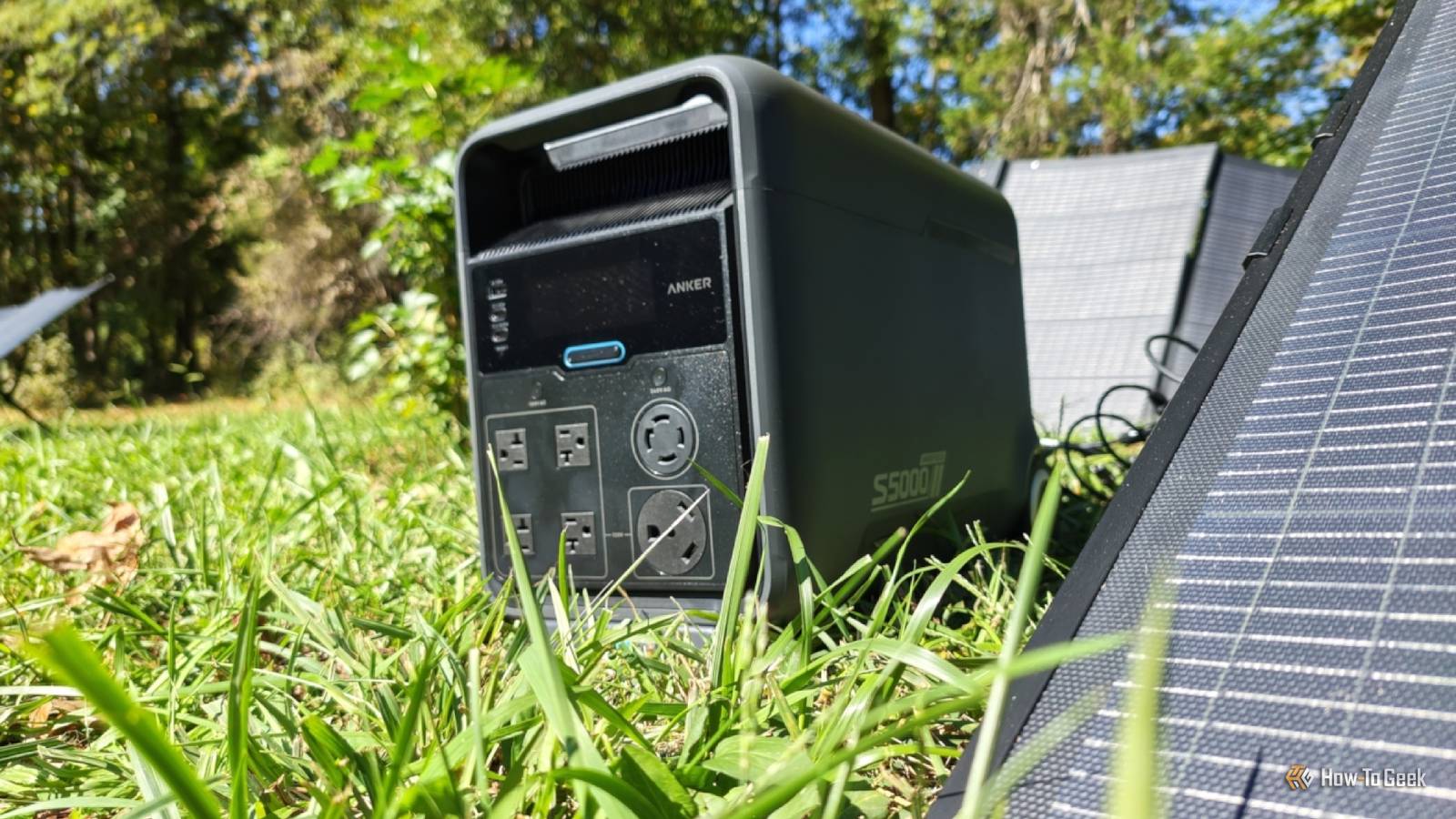
I am a fan of both the Anker SOLIX F3800 and its refined follow-up, the F3800 Plus. There’s a row of them in the pantry of my home. So I’m happy to say Anker has released a spiritual successor: the Anker SOLIX S5000. While it’s not better in every way, it improves in the ways that matter most. I'm not a fan of some changes Anker has made to its newer portable power stations, but it has knocked this one out of the park. Anker SOLIX S5000 9/10 Brand Anker Dimensions 8.2 × 11.1 × 12.7 in The Anker SOLIX S5000 is a 5024Wh portable power station that is the smallest in its class, with nearly half the volume and a quarter of the weight of the Anker SOLIX F3800 Plus. It can output 4500W of power, charge at up to 3000W, and has an idle draw of under 10W. Pros & Cons Nearly half the size and a quarter of the weight of the Anker SOLIX F3800 Plus 5024Wh is a staggering amount of storage for a power station of this size Sleek design feels appropriate for a home Proprietary solar and AC charging ports Less power output than the Anker SOLIX F3800 Plus Price and availability The sticker price for the Anker SOLIX S5000 is $3,600. Based on Anker’s track record and that of most portable power stations, you can expect recurring discounts. Specifications Brand Anker AC Output ports 5 AC Input rating 1800W Solar input rating 3000W USB Ports 3 Battery type LiFePO4 Protection UL9540 Connectivity Wi-Fi, Bluetooth Expandable Up to 30kWh UPS Mode Under 10ms Lights No Battery Capacity 5,024Wh Battery Lifecycle 10,000 AC Output Rating 4500W Dimensions 8.2 × 11.1 × 12.7 in Weight 97 lbs A large portable power station that’s actually portable The Anker SOLIX F3800 was the first portable power station of its size that I had ever purchased. When it was dropped off outside my door, I was shocked to find that I could not get it up the steps. At over 130 pounds, it weighed only a few dozen pounds less than I did. When I later received the updated F3800 Plus to review, it was nearly identical, and its weight was unchanged. So I was shocked when the S5000 arrived. It is a significantly smaller power station, nearly half the size, yet it can store substantially more energy. At 97 lbs, it's still by no means lightweight, but it is light enough now that I can carry it up and down steps on my own (I can finally stop considering buying a ramp from Lowe’s). A power station becomes that much more accessible when you don’t have to be jacked to move it around. Though, to be clear, I still look far from graceful as I raise or lower this thing a mere few inches at a time. While the S5000 feels like a successor to the F3800 Plus, it's not. The S series is a different product line, and this unit instead takes its design cues from the more recently released Anker SOLIX S2000. You could almost describe the S5000 as a longer S2000 with two wheels, a handle, and extra ports. Both the S5000 and the S2000 lack a light on the front. The S5000’s diet shows up in several areas. The build quality of my pre-production model feels less durable than the F3800. The F3800 feels so solid that I'm concerned about it damaging everything it rolls over or bumps into. The S2000 feels just delicate enough that I’m more inclined to baby it. The handle gives me the impression that it might buckle under its own weight. Nonetheless, so far so good. The F3800 has four caster wheels on the bottom, which makes that power station stand upright and easy to roll around. The S5000 has only two wheels and is designed to lie flat. You must lift the front end up and pull out the carrying handle whenever you wish to wheel it around, like the Anker SOLIX F3000. While the S5000 is perfectly capable of tilting back and standing upright, it is not intended to be used in this way. The cooling vents for the power station are on the front and back of the product, so you don’t want one end pressed against the ground for long. A bigger, longer-lasting battery in a smaller package Upon first impression, the S5000 feels like magic. Despite being much smaller, its LifePO4 battery cells are able to store 5,024Wh of power, which is a notable increase over the 3,840Wh in the Anker F3800 Plus. This difference matters even more as you scale up. I could fit four of these side by side in a space that could only hold three F3800S. Likewise, an S5000 with a single expansion battery isn’t that far from an F3800 Plus with two. How is Anker able to make this happen? While battery improvements account for some of it, the S5000 also packs a smaller inverter than the F3800. The S5000 can manage a sustained load of 4,500W, down from 6,000W with the F3800. You can also chain two F3800’s together to reach a total output of 12,000W, a feature that isn’t present with the S5000. So if you have hopes of hooking a portable power station up to a large battery bank and firing up a 5-ton heat pump, the F3800 Plus remains the better option even despite the S5000’s increased capacity. That said, the capacity doesn’t tell the whole story. While the existing F3800 Plus and F3800 have identical batteries, the Plus lasts much longer in real-world use. This is because of the newer model’s significantly lower idle draw. The F3800 drains at around 50W per hour when the AC inverter is on, even if nothing is plugged in. The F3800 Plus reduced this number by roughly half. The S5000 goes down further still and idles at around 10 watts (less than that if you're only using 120V). This means you have a larger battery that drains more slowly. When I connected the S5000 to my electrical panel at around 99% at 9 AM one day, it estimated 11.7 hours of runtime. When I came back three hours later, the display showed 73% and an estimated 8.8 hours remaining. On that same day, when I plugged in an F3800 Plus at 97% and gave it the same steady 400W load, it estimated 7.3 hours. This means the S5000 at a 73% state of charge could run for another hour and still last roughly as long as the F3800 Plus when full. Ports in all the right places Anker’s engineers have learned a lot about power stations over the past few years. Unlike the F3800, the S5000 has all of its ports on the front of the unit. You're not left with some cables sticking out the front and others extending from the side. This means you can better press it up against the wall while it’s in use. Unlike the Anker SOLIX F3000, the four AC outlets on the front are spaced out enough that you have room for larger charging blocks. The S5000 supports 120V and 240V charging, but not at the same time. The 240V charging port allows me to plug the S5000 into a generator inlet port in my home and power my electrical panel. When I do so, the four 120V AC ports are unavailable. That said, the S5000 does now allow you to utilize the 240V port while charging the power station at 120V. This means you can recharge the power station with a generator without having to disconnect it from your home. I don’t own a gas generator, so I’m more affected by the changes to solar input. The original Anker SOLIX F3800 had two standard XT60 ports for solar input. The updated model replaced these ports with two proprietary ones. This proprietary port lets you connect far more solar panels in series, but you must have an Anker-specific cable or dongle to use your existing panels. The S5000 meets in the middle — it has one XT60 port and one proprietary port. This change makes quite the difference to how the S5000 is able to draw power from the sun. Practical changes to solar charging The XT60 port on the S5000 can take up to 1,000W of solar input, while the proprietary port can take up to 2,000W. This means the system maxes out at 3,000 watts, slightly lower than the max 3200W solar input of the F3800 Plus. This change is bigger than the 200-watt discrepancy might suggest. The 1,000W max of the XT60 port is more difficult to achieve than Anker's proprietary port. You must run wires to each solar panel in parallel in order to avoid exceeding the 60V limit. The proprietary port maxes out at 165V, giving you the range to more easily connect solar panels together in series, reducing setup time and the number of cables you must fuss with. That said, I can't say I dislike the change. I usually do not try to charge my power station as fast as possible. More often, I simply connect a 400W portable solar panel to each port. This tends to charge my station faster than it’s discharging as it powers my home. In those rare times when I want to connect all of my solar panels to this one station, I can adjust. This decision ultimately means I can still charge the power station even if I forget to grab Anker's proprietary plug. On that note, Anker also sent me the bifacial versions of its PS100, PS200, and PS400 portable solar panels (the new PS400 is the one without the blue handles in the gallery above). These new versions have aluminum frames and solid legs, making them sturdier than the prior models that I purchased bundled with my Anker SOLIX power stations in the past. These new panels also manage to be lighter. While all three models are great, the PS400 is so much lighter and smaller that I've gone from begrudgingly only pulling out 400W panels during outages to using them all the time to get free energy using my power stations whenever possible. I've enjoyed these review samples so much that I decided to purchase more while they were still on sale for Prime Day. That sale's over, but there will be more. Not every change is for the better The Anker F3800 series uses a standard plug for AC charging, but this isn't the case with the S5000, which comes with a proprietary charger. This is a continuation of a disappointing trend. First, the solar input ports became proprietary, and now the charging plug is too. This is in addition to the fact that expansion batteries only work with the specific model they’re designed for. If I bought a BP3800 expansion battery for my original F3800, it would thankfully be compatible with the F3800 Plus, but it would be incompatible with the S5000. That battery would go a lot farther plugged into Anker’s newest power station, thanks to the significantly lower idle draw, but I would be forced to continue plugging it into the older power stations that won’t run as long instead. Anker isn’t unique in this, but that doesn’t mean it’s unavoidable. Competitor Bluetti has shown that portable power stations can be designed in such a way that newer models work with pre-existing expansion batteries. Should you buy the Anker SOLIX S5000? If you want the longest-lasting power station that won’t look like it belongs at a construction site sitting in the corner of your living room, then you want the Anker SOLIX S5000. While I do have a few qualms, I’m still blown away by how much power is contained in this small package, and this is the issue I felt Anker most needed to address about its prior models. The S5000 may not be as powerful as the F3800, but I believe Anker made all the right trade-offs — so much so that I would recommend paying more for the S5000 over the F3800 Plus, even if you see the latter on sale. Your back will thank you. Anker SOLIX S5000 9/10 Brand Anker Dimensions 8.2 × 11.1 × 12.7 in The Anker SOLIX S5000 is a 5024Wh portable power station that is the smallest in its class, with nearly half the volume and a quarter of the weight of the Anker SOLIX F3800 Plus. It can output 4500W of power, charge at up to 3000W, and has an idle draw of under 10W.
Anker's S5000 is half the power station the F3800 was, and I couldn't be happier
Full Article
Original Source
Read the full article at Howtogeek →KhanList aggregates and links to publicly available news content. We do not host full articles from third-party sources. Always verify important information with original sources.