
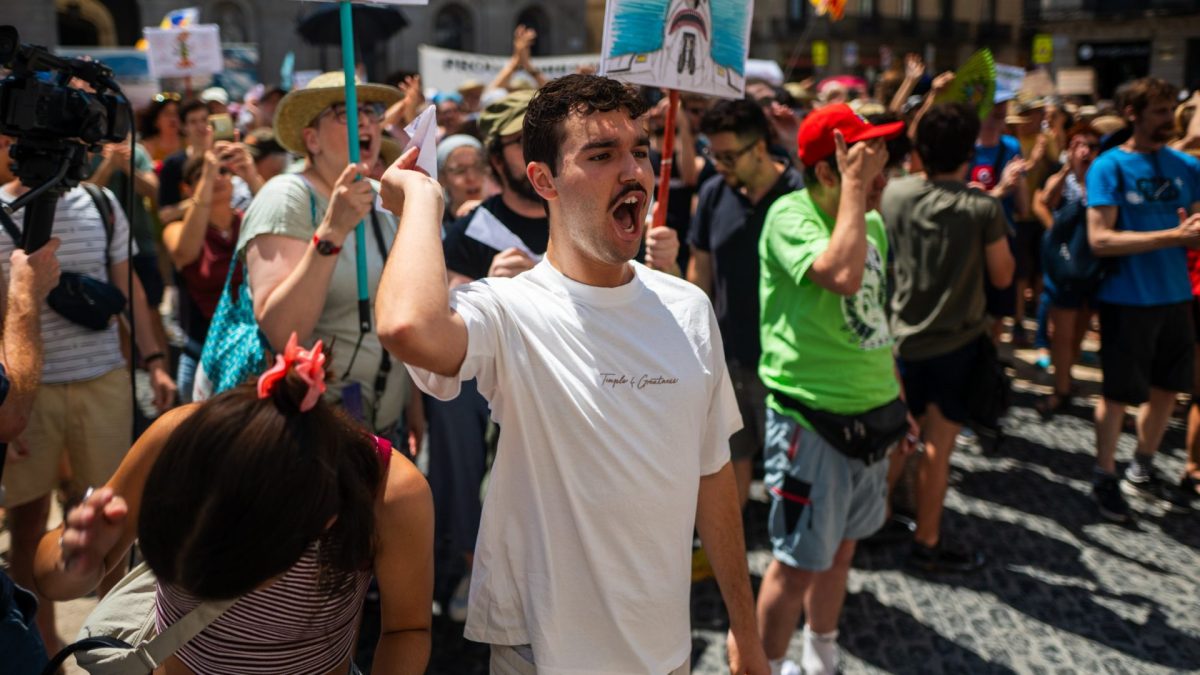
BARCELONA – Pink flamingos are the star attraction in one of Europe’s most important wetlands, located on the outskirts of Barcelona, but their tranquility is often punctuated by the roar of jet engines from the nearby airport. Once, passengers were able to walk from the wetland straight onto the few planes that took off from Barcelona’s airport, but if current plans for a €3.2bn (£2.74bn) expansion go ahead, the airport will become a huge hub catering for up to 70 million passengers a year. Local authorities hope the expansion will be completed by 2033. Shorts The plans fly in the face of Barcelona’s stated plans to reduce visitor numbers amid growing anger from residents, who are planning a mass demonstration on 20 September involving thousands descending on the Passeig de Gràcia train station in the most exclusive shopping street in the city. Residents have staged a series of major protests against mass tourism in recent years, involving water pistols, confrontations with British tourists and placards with messages like “Tourists Go Home” and “Enough! Let’s put the limits on tourism!” Their protests have been echoed across various cities in Spain, notably Malaga, Madrid and Mallorca, where locals say they are being pushed out by overtourism. This summer saw protests in Mallorca where eight demonstrators were injured after police charged and fired rubber bullets, despite a peaceful protest by an estimated 25,000 people. Another large demonstration took place in Malaga, where around 4,500 demonstrated against rising house prices caused by overtourism. “About 80 per cent of the people who come to Barcelona are tourists, so if they end up expanding the airport, it will bring another 10 or 11 million tourists,” says Joan Manel of Zeroport, a group which opposes the expansion of the airport as well as a new cruise terminal in the city. “This will overwhelm even more a city which is already at its limit.” Anti-tourism activists use water pistols during a protest against mass tourism in front of the Park Guell on World Tourism Day in Barcelona on 27 September, 2025 (Photo: Nacho Doce/Reuters) Daniel Pardo, who took part in demonstrations last year in which protesters in Barcelona drenched tourists with water pistols and taped holidaymakers inside a hotel, said: “The demonstration against this expansion is another part of this fight.” “The fight against the expansion of the airport is a fight over the long term,” he added. Barcelona received 16 million visitors in 2025, a 2.9 per cent increase compared to 2024. José Antonio Donaire, Barcelona City Council’s new commissioner for sustainable tourism, recently said the city’s strategy was “not one tourist more”. “We don’t want to grow more,” he told The New York Times last month. “We want the tourists that the city already has. There were 15.7 million tourists in the city in 2025 – that’s the threshold. Sixteen is the maximum.” Donaire said Barcelona was aiming to attract a better quality of residential life in areas which have been hit by tourism, where house prices have risen sharply. The city has taken some measures against overtourism. Mayor Jaume Collboni has pledged to ban all tourist flats from the city by 2028, despite opposition from business lobbies. He also wants to speed up plans to increase a tourist tax for transit cruise passengers, doubling the charge from €4 to €8 per night. However, the airport plans have raised major concerns from residents, who already fear being priced out of their city. Joan Manel, part of a group opposing the expansion of Barcelona airport, says the plans ‘will overwhelm even more a city which is already at its limit’ Last year, a record 57.5 million people travelled through Barcelona Airport. If the expansion goes ahead, the city would become one of the busiest airport hubs in the world, behind only the likes of Dubai, Heathrow and Singapore airports. The Bank of Spain estimates the country is short about 700,000 homes, and the use of properties as tourist apartments has depleted the existing stock. Average property prices in Barcelona have risen by 62 per cent over the past decade, according to the city council, driven by high foreign demand and a lack of new housing. Meanwhile, in areas popular with tourists, buses and underground trains are often overcrowded with tourists during summer months. For campaigners, the expansion of the airport seems to contradict the objective of containing overtourism. A British citizen who has lived near the airport for 17 years, and flies regularly for business, questioned the reasons for the expansion. “Barcelona has policies to manage tourism,” the man, who asked not to be named, said. “It is restricting tourist accommodation, reducing the number of tourist apartments and taking other measures to change the balance between tourism and the needs of residents. “Against that background, a major expansion of the airport raises questions over what Barcelona and Catalonia actually want the airport to deliver.” Locals are worried about an influx of new tourists, as residents already content with high prices and crowded public services (Photo: David Zorrakino/Europa Press via Getty) Salvador Illa, the Catalan regional president, said the plans were critical for Barcelona to become a major hub for intercontinental connections, offering more flights from Asia and the Americas to attract talent and investment. “I honestly believe that the project is technically the best and most balanced and I am satisfied with the ambition of the measures and the environmental trade-offs associated” with it, Illa said, when the plans were unveiled last year. The project, which will be paid for by Spanish state-run airport operator Aena, will also be a test case for the EU, which must decide if it chooses to priorities an environmentally protected area. The plans extend one of the airport’s runways, affecting 27 hectares of the wetland which is protected by the EU’s Natura 2000 programme. In return, about 250 hectares of the surrounding area would be turned into green areas. The Catalan government said it was confident the expansion would be given the green light by Brussels. Authorities hope to start construction by 2030. But Manel said plans to expand the airport would damage the protected wetlands and strain the city’s ability to cope with more tourists. He added that the timing of their protests was important, as politicians may be more fearful of popular anger ahead of general and municipal elections next year. “We are staging this demonstration before an election year, when maybe we can get people to take part and stop this plan,” he said. “We hope the politicians will see how people from all backgrounds are against this and change the plans.” If not, the city could follow the fate of places like Venice, where local residents have been all but driven out of the centre.
Angry Barcelona residents say ‘not one more tourist’ – but it’s about to get worse
Full Article
Original Source
Read the full article at Inews →KhanList aggregates and links to publicly available news content. We do not host full articles from third-party sources. Always verify important information with original sources.