
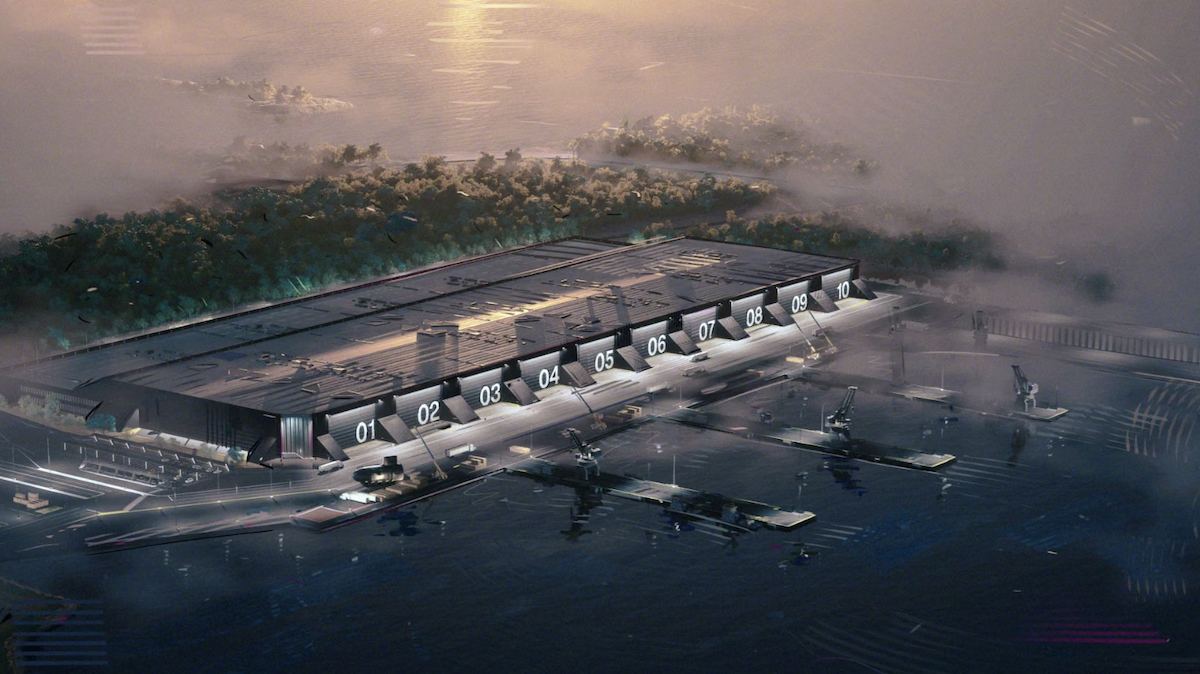
A multibillion-dollar private initiative to overhaul US submarine manufacturing marks an urgent push to revitalize naval industrial capacity at a pivotal moment in the Indo-Pacific balance of power. This month, multiple media outlets reported that defense technology firm Anduril Industries will invest US$3.7 billion of its own capital to build a 2-million-square-foot “software-defined shipyard” at Sparrows Point in Baltimore County, Maryland, to expand US Navy submarine production capacity, according to company and defense officials. Under a complementary US Navy contract worth up to $2.9 billion, with disbursements tied strictly to demonstrated production outcomes, the total $6.6 billion public-private venture aims to relieve severe bottlenecks in the Virginia-class nuclear attack submarine (SSN) program. Dubbed “Arsenal-2,” the coastal facility will feature a 1,200-foot graving dock, direct rail access, and digitized workflow tracking, creating 3,100 direct manufacturing jobs and adding roughly nine million annual labor hours — a vital 15% capacity boost to the nation’s strained nuclear shipbuilding industrial base. The intervention comes as legacy shipbuilders General Dynamics Electric Boat and Huntington Ingalls Newport News Shipbuilding continue to struggle to meet the US Navy’s minimum goal of two hulls annually. To bridge near-term operational needs, Anduril will begin delivering critical gating components, such as torpedo tubes, from a certified Costa Mesa site by 2028, before Maryland operations begin around 2030, with long-term plans to supply full hull modules and help meet domestic fleet goals alongside AUKUS defense pact delivery commitments to Australia. This private-sector expansion raises the question of whether the US can overcome domestic shipbuilding bottlenecks to maintain its undersea warfighting edge as China rapidly expands and modernizes its submarine fleet. The facility could boost US submarine production at a time when conventional shipyards repeatedly miss scheduled delivery milestones. The scale of that industrial deficit is severe. A January 2026 US Congressional Research Service (CRS) report notes that while the US Navy aims to achieve a fleet goal of 66 SSNs, actual construction has never reached that threshold and has averaged just 1.1 to 1.2 boats per year since 2022 because of persistent workforce shortages, supplier bottlenecks, and component delays. The CRS report notes that the US Navy is now pushing to raise production to 2.0 boats annually and eventually 2.33 per year to reduce backlogs, sustain domestic fleet requirements, and build replacements for three to five Virginia-class SSNs slated for sale to Australia under the AUKUS security pact. These ongoing industrial delays affect Western Pacific operations, where attack submarines are vital to the US in a possible conflict with China over Taiwan, and forward deployments reaffirm their strategic importance. Demonstrating that operational footprint, a June 2026 report by the South China Sea Probing Initiative (SCSPI), a Chinese think tank, found that in 2025 the US operated at least 11 nuclear-powered submarines in three Western Pacific operational corridors—the South China Sea, East China Sea, and Java Sea—to demonstrate forward presence and signal a clear undersea deterrence posture against China. In a high-intensity Taiwan conflict, that forward undersea posture forms the tip of the US spear. In a May 2026 article for the Center for Strategic and International Studies (CSIS), Seth Jones says US SSNs provide an asymmetric operational advantage over China by exploiting the latter’s persistent anti-submarine warfare (ASW) deficiencies. Jones notes that in simulated Taiwan Strait conflict scenarios, SSNs play a critical warfighting role by inflicting heavy attrition on Chinese invasion forces and hunting high-value amphibious vessels, surface escorts, and logistics ships. Beyond direct strikes against transport fleets, he says these submarines screen against Chinese submarines attempting to break out past the First Island Chain, routinely cycling back to forward ports such as Yokosuka, Japan, to reload weapons and resume offensive hunting operations. Yet dominating the undersea battlespace will prove far more contested than in previous conflicts. Rear Admiral Mike Brookes said in March 2026, in testimony before the US Congress, that China does not approach ASW as isolated platform engagements. Instead, Brookes points out that China frames ASW as a networked “systems confrontation,” integrating air, surface, and seabed sensors, along with unmanned vehicles, into an anti-submarine warfare system-of-systems designed to control critical waters, compel adversary submarines to withdraw, and reduce port-departure detection risks for Chinese vessels. Broadly, Brookes says China views undersea warfare as a crucial strategic enabler for naval operations under its “Near Seas Defense, Far Seas Protection” doctrine, central to US-China competition, supporting near-seas defense, ballistic missile submarine protection, sea-lane interdiction, and strikes against high-value targets such as allied aircraft carriers. China is backing this doctrinal focus with unprecedented quantitative expansion. Outlining the growth of China’s submarine fleet, Brookes says that it now has about 60 units and could reach 70 by 2027 by adding up to six nuclear guided-missile submarines (SSGN), two nuclear ballistic missile submarines (SSBN), and retiring older Chinese and Russian-built units. He adds that China could field over 80 submarines by 2035, with nuclear-powered boats making up half the fleet. China’s large submarine industrial base supports that growth. In a September 2023 China Maritime Studies Institute (CMSI) report, Sarah Kirchberger notes that China’s submarine industrial base drives rapid fleet expansion through massive state funding, state-owned bank credits, and infrastructure modernization across Bohai, Wuchang, and Jiangnan shipyards, which employ modular assembly, covered construction halls and commercial-military integration. However, Kirchberger points out that persistent production bottlenecks curb qualitative parity with Western designs. She says China still grapples with acoustic-quieting deficiencies, vibration-suppression gaps, and reactor design issues, leaving boats vulnerable to detection by allied sonar arrays. She adds that China’s shipbuilders still struggle to master indigenous marine diesels—as shown by stalled export deliveries to Thailand—and to overcome manufacturing challenges in advanced fuel-cell air-independent propulsion (AIP). Despite those constraints, China has been innovating in submarine design at a very rapid pace. In February 2026, China may have launched the first Type 09V (or 095) SSN at Bohai Shipbuilding in Huludao, featuring an estimated 9,000-to-10,000-ton displacement, a 12-to-13-meter beam, large X-form stern rudders for littoral maneuvering, a pump-jet propulsor, and likely vertical launch missile cells. In June 2026, satellite imagery uncovered an unexpected, sleek “sailless” submarine launched in Shanghai measuring roughly 120 meters long and 10 to 11 meters wide. With a streamlined bow and an unusually reduced sail designed to cut acoustic and hydrodynamic drag, the vessel is likely nuclear-powered. In March 2026 testimony before the US Congress, Vice Admiral Richard Seif emphasizes that China’s rapid submarine growth reflects advances in platforms, sensors, weapons, endurance, and operational capabilities. Seif notes that even small improvements matter in undersea competition, where slight changes in quieting, endurance, or detection can decisively shift tactical advantages. Ultimately, whether private-sector intervention can scale fast enough before the 2030s will determine whether the US maintains its decisive undersea margin, or whether China’s dense sensor networks and compressed qualitative innovations turn the Western Pacific into an anti-access sanctuary that neutralizes American naval deterrence.
Anduril’s plan to save US sub edge from China’s undersea surge
Full Article
Original Source
Read the full article at Asiatimes →KhanList aggregates and links to publicly available news content. We do not host full articles from third-party sources. Always verify important information with original sources.