
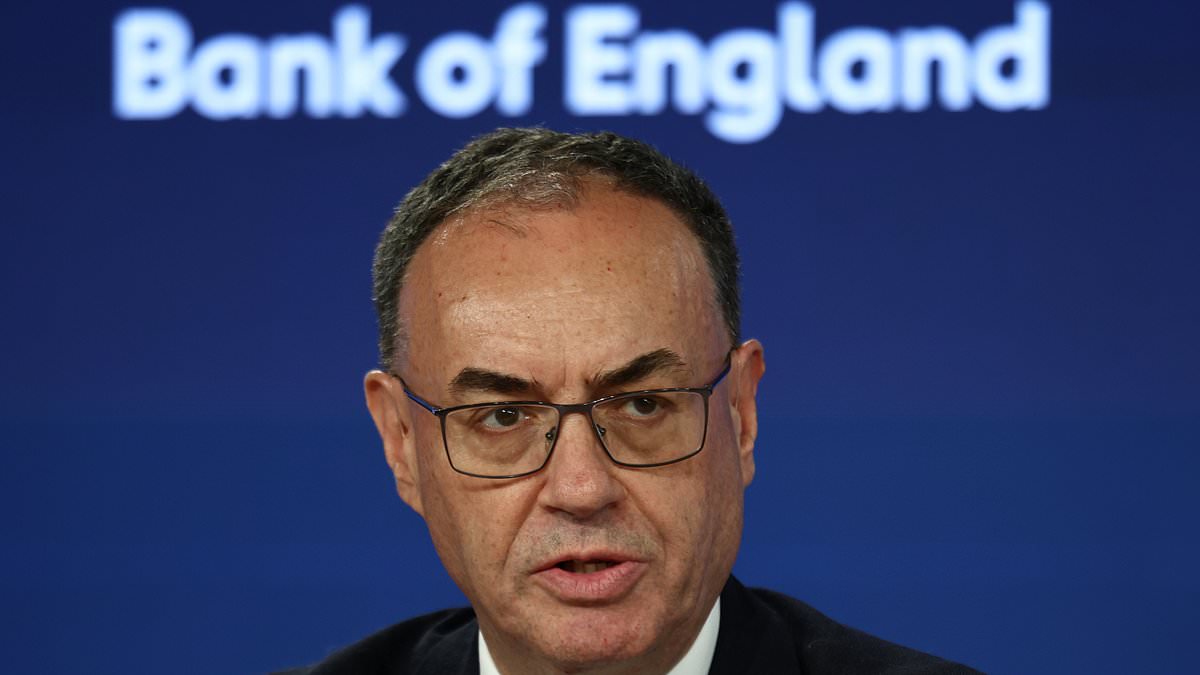
Bank of England Governor Andrew Bailey doesn’t do panic, as only befits a sober central banker whose words have the power to move financial markets.So when, in his other capacity as chairman of the Financial Stability Board, the world’s top financial watchdog, he warns the G20 club of major economies (gathered this week in North Carolina) that the global financial system is increasingly vulnerable to a variety of shocks, sensible folk sit up and take notice.His warning has reignited fears that the bubble is about to burst for soaring stock markets propelled ever upwards on a massive wave of borrowed money. Yet it’s no more than what the Bank of England’s own Financial Policy Committee has been saying with increasing force since last December.Last month it made clear that any crash – or even a major correction – in US equity and/or debt markets would quickly dispatch shock waves to this side of the Atlantic too.The stakes couldn’t be higher. A financial crash would wipe out what economic growth there is, destroy wealth and jobs, raise interest rates as credit became scarce and throw the economy into recession, perhaps deep, probably long. People are right to be concerned.The core problem is debt. It always is. Governments across the globe are addicted to it as never before in peacetime – they just can’t stop borrowing. The US is the worst offender. Democrats and Republicans have thrown fiscal discipline out the window. Fiscal incontinence is the new, potentially fatal, national consensus.As a result, the US national debt passed $40trillion this summer, an unprecedented, unimaginable amount. Andrew Bailey doesn’t do panic, so when he warns that the global financial system is increasingly vulnerable to a variety of shocks, sensible folk sit up and take notice There’s a big new kid on the block in the credit markets: America’s artificial intelligence (AI) hyperscalers are investing several trillion dollars to roll out their transformative technology Far from any thoughts of belt-tightening, the Trump administration is ramping it up further, to the tune of almost $2trillion a year as it projects budget deficits for as far as official forecasts go.This insatiable appetite for debt explains why US interest rates remain elevated and are heading even higher. With just about every major government in the globe borrowing beyond its means, the bond markets (where governments go to borrow) are demanding ever higher interest rates – a risk premium, if you like – to lend more.The US Treasury is now having to pay over 5.2 per cent interest to borrow long-term. This matters as much on Main Street as Wall Street for it is these long-term bond rates that set the interest rates on a lot of other debt, from mortgages to loans for small businesses.US mortgage rates were nudging close to 7 per cent earlier this summer before falling back. But the average long-term US mortgage is still almost 6.7 per cent. It’s a major reason Donald Trump’s approval rating for running the economy has tanked.The same process is under way in the UK, where our national debt will pass the £3trillion mark before the clocks go back. The bond markets naturally regard us as a bigger risk than America. Our Government is already having to pay almost as much interest – around 5.1 per cent – to borrow over ten years as the US does to borrow over 20 or 30 years.The interest we pay on our debt is now the highest in the G7 and among the highest in the G20. To borrow over 30 years we now have to stump up almost 5.78 per cent, the highest for almost three decades. As in America, these rates also determine mortgage and commercial loan rates.People wonder why their mortgage rate is 5.5 per cent or more when the Bank of England’s base rate is only 3.75 per cent. But the base rate doesn’t determine your mortgage. You’re paying over the odds for that home loan because the Government is borrowing too much. Even those of you lucky enough to have a loan linked to the base rate are in for a shock. At the turn of the year the markets expected the Bank to cut that rate further in 2026 (it’s already come down from a peak of 5.25 per cent).No longer. The expectation is now for a rise – several rises, in fact. Trump’s War on Iran has given inflation a new lease of life. So interest rates will have to increase.But, I hear you ask, why does any of this herald a stock market crash, with all the misery that would follow in its wake? Let me explain.Suddenly there’s a big new kid on the block in the credit markets: America’s artificial intelligence (AI) hyperscalers. They’re in the process of investing several trillion dollars to roll out their transformative technology – and increasingly they’re doing it on borrowed money. Even more worrying, they’re borrowing from what’s called the private credit markets, an expensive, unregulated, opaque source of debt – so shadowy, in fact, that nobody even knows its scale (estimates vary from $1.5trillion to $3trillion). In the UK, our national debt will pass the £3trillion mark before the clocks go back. Our Government is already having to pay around 5.1 per cent interest to borrow over ten years So voracious governments are now having to compete with the AI giants for credit, pushing up the cost of borrowing not just for themselves but for everybody else. At some stage, something will have to give. The big fear is that it will be AI share prices.Already widely regarded as overvalued (hence the idea it’s a bubble), if their share prices came tumbling down they’d bring the whole stock-market caboodle with them. Why? Because the continuing surge in share prices is overwhelmingly AI-driven.The S&P500 is a leading US stock market index covering some of America’s biggest companies. AI-linked stocks account for over 40 per cent of its total value – the highest concentration on one sector ever – and account for over 80 per cent of its rise in value so far this year. If they fall the whole stock market will be dragged down with them.It’s not hard to see what could puncture the AI boom. The current inflated value of the hyperscalers is based on the prospect of massive revenues as AI rolls into every aspect of our lives. That’s what will service the debt and eventually pay it back. But it’s not guaranteed.Americans have turned against AI data centres more virulently than the British turned against onshore wind farms years ago. Over 75 projects were blocked or delayed in the first three months of this year alone.Locals are rebelling against the massive amounts of power and water they need and the noise they make.Then there’s China (there’s always China).Its AI models might not be quite as cutting edge as America’s most advanced. But they are between 60 and 90 per cent cheaper and for many purposes will be more than adequate.Put these two factors together – a data centre backlash and Chinese competition – and suddenly these forthcoming AI revenues no longer look quite as certain.And what Governor Bailey means by his banker-speak ‘multiple vulnerabilities’ – far too much public and private sector debt, rising interest rates, inflation, dodgy credit, an overvalued tech boom, failing revenues – becomes enough of a witches’ brew to scare the hardiest among us.Nobody can predict when it will all go pear-shaped. But it will. It always does. Not every correction – even a major one – automatically leads to a great crash. But the ingredients for such a dismal prospect are certainly being assembled. And we can be pretty sure the first (and maybe last?) Burnham-Healey Budget in just under two months’ time will have nothing useful to say about any of this. It’s much more likely to make matters worse.I began by saying that Bailey doesn’t do panic. But perhaps, just this once, a dash of panic would not be entirely inappropriate.
ANDREW NEIL: With the AI bubble, soaring debts and rising interest rates, even the hardiest souls are spooked. We should ALL be fearful of the financial crisis that's coming
Full Article
Original Source
Read the full article at Dailymail →KhanList aggregates and links to publicly available news content. We do not host full articles from third-party sources. Always verify important information with original sources.