
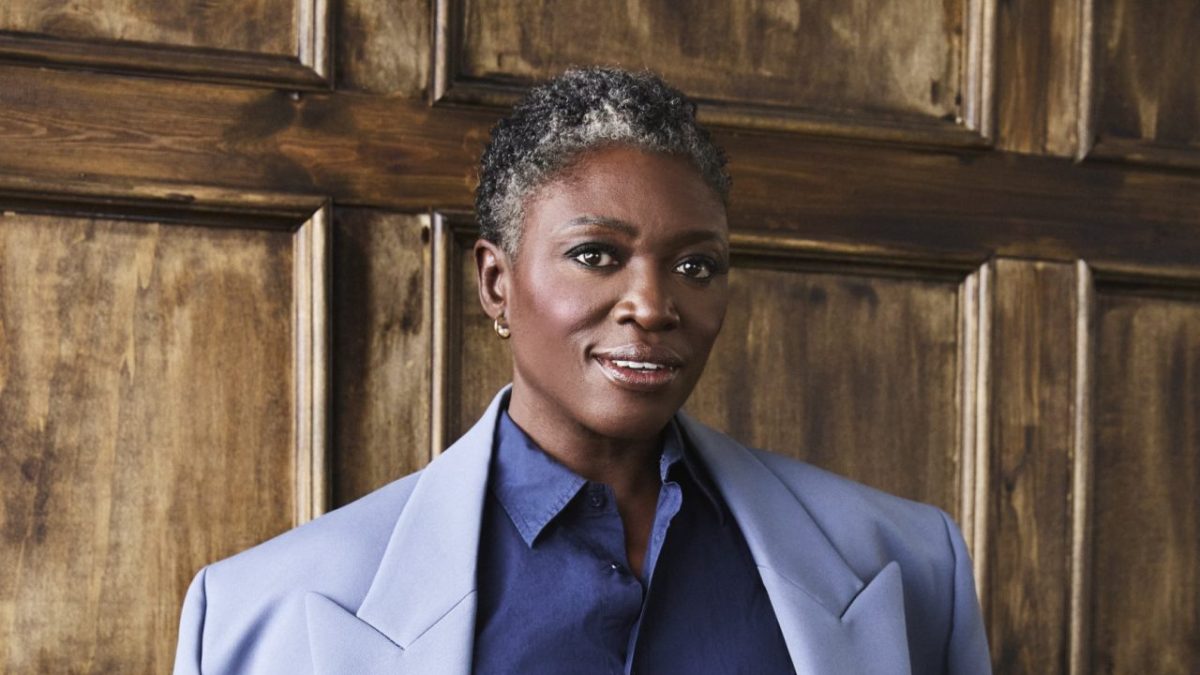
Andi Osho knows full well that “playing a police officer on screen can make you feel you’ve learned more than you actually have”. After filming series four of Blue Lights, in which she plays prudent, principled Sergeant Sandra Cliff, Osho was walking her dog in London when she witnessed a car accident and found herself rushing to the scene. “I thought, ‘I know what to do!’ And I absolutely didn’t.” She shakes her head. “But that didn’t stop me from inserting myself into the situation, and as I did I realised I was completely dysregulated. I was of absolutely no use to the poor guy with blood dripping from his nose where he had hit the steering wheel.” She sinks her head into her hands in a flush of shame. “One of the most underestimated skills of blue light workers is their ability to keep their heads in heightened situations much worse than that,” she says. “The crash I saw was a minor incident – the guy’s wife called their son and I didn’t do any harm. But blue light workers have all their adrenaline going – just like I did – and are still able to think logically and do what needs to be done. That’s much harder than it looks on TV.” Talking warmly via video link from her home office in London, the 53-year-old comic-turned-actor tells me she’s proud to be part of the Belfast-based drama that’s been praised by real members of the Police Service of Northern Ireland for its realistic depiction of frontline policing in the region. Blue Lights’ creators, Declan Lawn and Adam Patterson, have been commended for reflecting the reality of the job – from showing the real weight of side arms to the complex challenge of policing divided communities and paramilitary-run estates. Osho plays prudent, principled Sergeant Sandra Cliff on the hit BBC cop drama (Photo: Two Cities Television/BBC) This series, they gave us something else new: a surprisingly sweet midlife romance. This came in the form of a flashback “bottle episode” in which viewers learned how east Londoner Sandra Cliff (Osho) had met and fallen for her husband Gerry (Richard Dormer), who was shot and killed in the first series. “When the producers called me in for a chat, I honestly thought they were going to get rid of Sandra,” says Osho. “I thought that was quite polite, quite noble of them to tell me to my face. Then they said, ‘We’re thinking of bringing Gerry back to explore their backstory…’ Obviously I was thrilled to work with Richard Dormer again and their romance was just a joy to explore.” Incredibly, Osho says this the first time she’s ever been asked to play a woman falling in love. “I’d never really played people that are in love or falling in love. I’ve always been cast as a mum or a wife. Or the roles are predicated by the character’s job.” She’s right. She was a journalist in Line of Duty, a therapist in I May Destroy You, and a doctor in Footballers’ Wives: Extra Time. Why does Osho think she’s never been offered romantic roles before? “When I started acting, over 20 years ago, I don’t think dark-skinned black women were considered love interests,” she says, matter-of-factly. “We were ‘the goofy friend’ or we could be ‘the best friend’. We were offered roles in a mumsy space. Or medical roles.” A shrug. “But I don’t think I’m saying anything out of turn by pointing out we didn’t see a lot of black women falling in love on TV 20 or even 10 years ago.” Osho doesn’t want to be seen to be complaining “because it’s not like I’ve had a terrible career”, but she thinks it’s important that we acknowledge the “many biases in how casting is done, how people are seen”. ‘I’m quite bright,’ says Osho. ‘I think bright people usually have a sense of humour’ (Photo: David Reiss) Even in adverts, she observes, “it’s quite rare that you’ll see just an entirely black family or an entire Asian family. It’s like, ‘Take a punt, guys!’ They’ll have one white partner, one black partner and they have to find mixed kids.” She exhales. “The aperture through which black storytelling is allowed is so limited that it becomes stereotypical. It has to be set in prisons, or on a council estate. Or you have to be migrant workers, you know what I mean?” Looking back, Osho “never felt a gate was kept against me” when she started out in comedy in 2006. But when she studies the TV landscape today, she feels black female comics are still “encountering barriers”. “Commissioning teams are comfortable putting diverse voices into a pre-existing, established format,” she says. “But they’re less comfortable creating new formats for them or giving them a vehicle of their own.” She flags this is an issue that affects more women than men. She’s suffered the “constant frustration” of having scripts rejected that she suspects would have been welcomed if they’d come from “a white, male millennial”. This means she’s turned to novels to scratch her storytelling itch. After a couple of rom-coms, this year she published the deliciously dark Most Wanted, a satire on the housing crisis about a couple who take desperate criminal measures to crash property prices so they can afford a home. Osho has broken off from writing a fourth novel – “equally dark,” she grins – to talk to me today. Born Yewande “Andi” Morenike Osho in east London in 1973, and raised by a single mother after her dad walked out leaving a “father-shaped hole” in her heart, she was a “weird” but funny kid with a little extra energy explained by a recent ADHD diagnosis. Although acting was a dream, she told herself “a story about how much it cost to go to Rada” and settled for a more sensible television production course at Ravensbourne University instead before seeking acting work. Struggling to get parts – slogging though a day time job as a receptionist – Osho cannily decided to build stage confidence and attract attention via stand-up in 2006. In 2007, she won the Funny Women Award and her comedy career took flight. Were her friends surprised that she was doing stand-up? “No!” She shakes her head. She’s always been quick-witted and “not to blow my own horn or anything, but I’m also quite bright and I think bright people usually have a sense of humour”. And those who amplify that humour with a mic? “Well, Jimmy Carr says you should always ask comedians which one of their parents was depressed.” She shrugs. “I don’t know how true that is, but I certainly think if you come from an environment that has got difficult emotional energies, you’re probably gonna choose to be funny.” Osho began her career in stand up comedy (Photo: Open Mic/BBC) Much of Osho’s comedy – notably her 2011-12 tour All the Single Ladies – revolved around dating disasters. In that show she would pick a single man from the audience each night to date later that night. As she later told Graham Norton: “I ended up in some quite interesting situations… There were no second dates.” She has never married and doesn’t discuss her romantic life, although she does tell me today she once broke up with a “lovely guy” because of his “juvenile sense of humour – finding the same things funny is so important”. A bantering wit and bravery in the face of real physical danger is what draws Sandra and Gerry Cliff together in Blue Lights. He’s teaching riot control and Sandra volunteers to chuck a molotov cocktail. “Although we only saw a little of their relationship in the first series, her grieving for him has been her main storyline. It was beautiful to make sense of that.” Series four of Blue Lights also focuses on rising tensions around Northern Ireland’s immigrant community. “The plot really shows how social media is escalating those tensions,” says Osho. She thinks we might all need to make fewer assumptions about people we perceive to be from different groups. “When you see a flag on display, you might think it’s a symbol pointing towards a mood change. One person can put a flag up on a street and it could make you feel like the whole street feels like that. But it’s just one person, and you don’t know what their sentiments really are. That person might just be a patriot and they’re not thinking about how that flag will be construed by others…” She shrugs. She needs to get back to her writing. As no-nonsense as Sandra Cliff, she says her response to the current social divisions is simply to “deal with people as I find them. When you have one-to-one interactions with people then tonally, they often turn out to be very different from whatever you might think about the group that that person came from”. I get the sense that the deeply reasonable and open-hearted Osho might be more useful in a crisis than she thinks. The ‘Blue Lights’ series finale is on BBC One tonight at 9pm
Andi Osho: ‘My scripts would be accepted if they were by a white millennial man’
Full Article
Original Source
Read the full article at Inews →KhanList aggregates and links to publicly available news content. We do not host full articles from third-party sources. Always verify important information with original sources.