
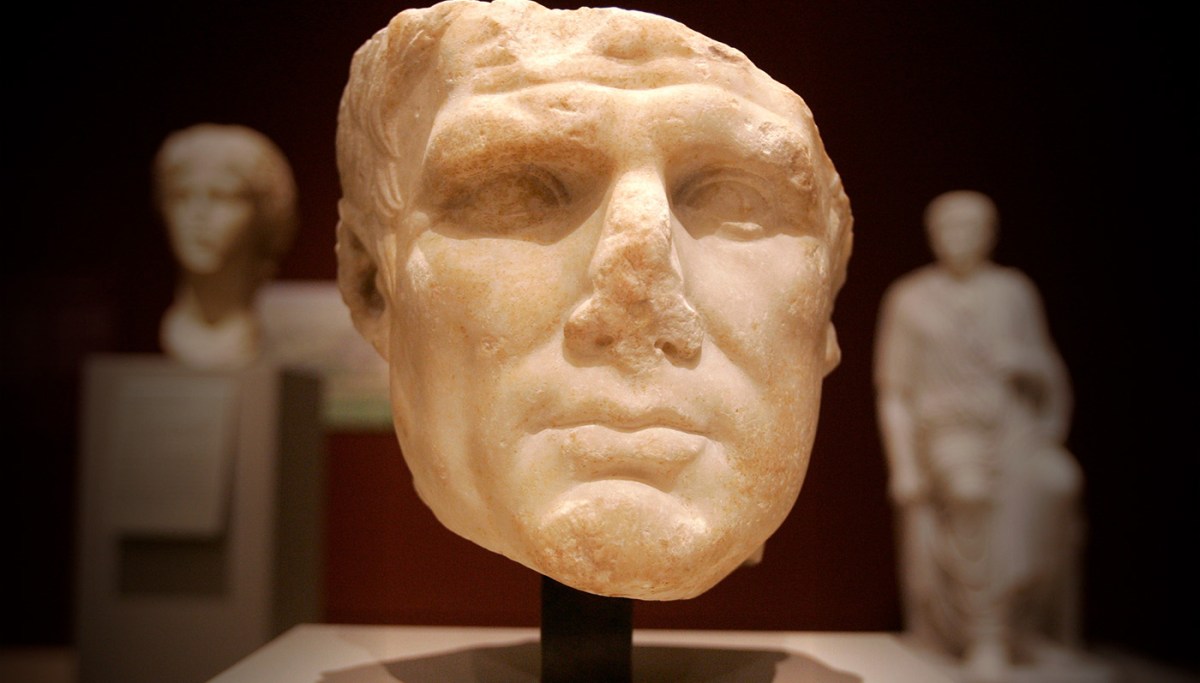
It’s hard to wring anything new out of headline acts such as Julius Caesar, Mark Antony, Augustus, Cato, and Cicero. The literary crowd has Robert Graves’s I, Claudius and Marguerite Yourcenar’s Memoirs of Hadrian. For beach reads, Colleen McCullough’s Masters of Rome series stretches all the way from the Late Republic to the early Empire. One gets the sense there aren’t many usable characters left. The first Gladiator movie featured the great philosopher-emperor Marcus Aurelius and his villainous son Commodus. The sequel had foppishly forgettable twins and CGI baboons.Instead of revisiting one of the staples of high school history class, the prolific thriller writer Robert Harris has turned to a consequential but obscure Roman for his latest novel. The eponymous protagonist of Agrippa was not one of the larger-than-life figures whose name was fated to echo down the centuries. As Augustus’s top general and right-hand man, Agrippa was undeniably important, but few clues survive as to his actual personality. Agrippa; By Robert Harris; Doubleday; 384 pp.; $32 Maybe there’s something to be gleaned from a surviving bust of the great man, now on display at the Louvre, which makes him look to be as sturdy and dependable as the aqueducts and bridges he bequeathed to Imperial Rome. While Augustus built an empire, Agrippa worked behind the scenes as a general, city planner, and all-around utility player. His marble visage has the appearance of a military engineer, a director of a municipal sewer system, or maybe a bagman for the mob.Writers tend to avoid Agrippa because he seems colorless and uninteresting, especially when compared to his contemporaries. In John Williams’s Augustus, an epistolary treatment of the same period Harris covers, Agrippa’s memoirs are a politically reliable account of major battles and landmark events. The spicy stuff is reserved for private letters from the poet Horace, the candid memoirs of the propagandist Maecenas, and other, more colorful figures from the imperial inner circle.Harris seems drawn to Agrippa because his career signaled epochal changes in Roman politics. Agrippa came from an obscure family and had no connections to the old aristocracy. Though a competent politician, he never achieved renown as an orator or statesman. His military conquests were brutal, thorough, and efficient, but they lacked the flair of more famous generals’ campaigns. His extensive public works program is often credited to Augustus, who boasted that he found Rome a city of bricks and left it a city of marble. Working away from the limelight, Agrippa embodied Rome’s transformation from a city of famous families and free (if not always fair) elections to an empire ruled by one man and his tight-knit clique of advisers.Perhaps influenced by what we know of his subject’s career, Harris’s prose is stripped-down and workmanlike. The novel is supposed to be a deathbed memoir, so this fictional version of Agrippa is quite candid about his marriages, his behind-the-scenes maneuvers, and his complicated feelings about Augustus. The two men have an almost codependent relationship dating back to their schoolboy days. Although Augustus comes to rely on Agrippa for his quiet competence, especially in military matters, there is never any doubt about who is destined to rule. Agrippa is always second fiddle to his more celebrated and powerful friend.Some authors may be tempted by the lack of ancient sources to invent florid details or secret political machinations. Harris mostly declines to add any zest to Agrippa’s story. The one exception is his decision to resurrect an obscure theory about his subject’s parentage: In Harris’s telling, Agrippa is the illegitimate son of Julius Caesar.This revelation, which comes pretty early in the book, elicits various Oedipal and fraternal resentments. Agrippa makes sure to mention that his bridge across the Rhine is bigger than Caesar’s. The secret of his parentage also complicates his relationship with Augustus, whose meteoric rise is greatly aided by the fact that he is Caesar’s adopted son. Augustus exploits this tenuous connection to the hilt, wooing Caesar’s veterans, rallying Caesar’s supporters and political allies, and legitimizing himself as divi filius — “son of a god.” Poor Agrippa, meanwhile, stews in the secret knowledge that he is Caesar’s true offspring.In purely biological terms, Harris’s theory is not totally crazy. Caesar was a famous womanizer who fathered at least one child out of wedlock. But the idea seems far-fetched because the supposed father and son were such polar opposites. Caesar was a gambler and a showman. He accumulated massive debts, wrote a contemporaneous account of his Gallic Wars for the voters back home, and declared “The die is cast” when he crossed the Rubicon. Agrippa, meanwhile, always operated in the shadows of his more famous contemporaries.A sculpture of Agrippa is displayed in the “Roman Art from the Louvre” exhibit at the Indianapolis Museum of Art in Indianapolis, 2007. (Michael Conroy/AP) Even in his own novel, Agrippa can’t escape the pull of his powerful patron. Augustus is a fascinating figure because his guile and ruthlessness seem to anticipate 20th-century politics. As Harris remarks in his afterword, “To the modern eye, there is something totalitarian in the way the Great Leader all but effaced his closest comrade from the official record.”One interpretation of Agrippa is that he was Augustus’s ruthless enabler, a man whose talents were exploited by an ambitious tyrant to destroy the Roman Republic for good. This idea is certainly plausible. Maybe Agrippa was a morally compromised figure who died, as Harris imagines, with misgivings about his chief and his place in history. But what little we know of Agrippa from ancient sources paints a different picture. Seneca described him as a model of Roman virtue. So what gives?THE NEXT GREAT EUROPEAN NOVELIST, OR NOT Maybe Harris has rose-colored glasses when it comes to Republican Rome. It is a matter of historical fact that Augustus and Agrippa gutted the innards of the Republic and replaced it with an autocracy, keeping only the trimmings of representative government for appearance’s sake. In Harris’s book, Agrippa regrets the passing of the old system: “I felt a stab of nostalgia for the old Republic of my youth, which for all its faults was designed to prevent exactly this — the emergence of a royal family, with its inevitable intrigues.”The trouble with this idea is that while we can only speculate about Agrippa’s personality, we know that the Republic he grew up with was plagued by civil war, factionalism, and endemic street violence. The most unsettling interpretation of Agrippa’s career is not that he was an efficient but morally compromised adviser to an evil autocrat. It’s that he judged autocracy to be preferable to the old ways and acted accordingly.Will Collins is a lecturer at Eotvos Lorand University in Budapest, Hungary.
Ancient Rome’s forgotten heavy comes out of the shadows
Full Article
Original Source
Read the full article at Washingtonexaminer →KhanList aggregates and links to publicly available news content. We do not host full articles from third-party sources. Always verify important information with original sources.