
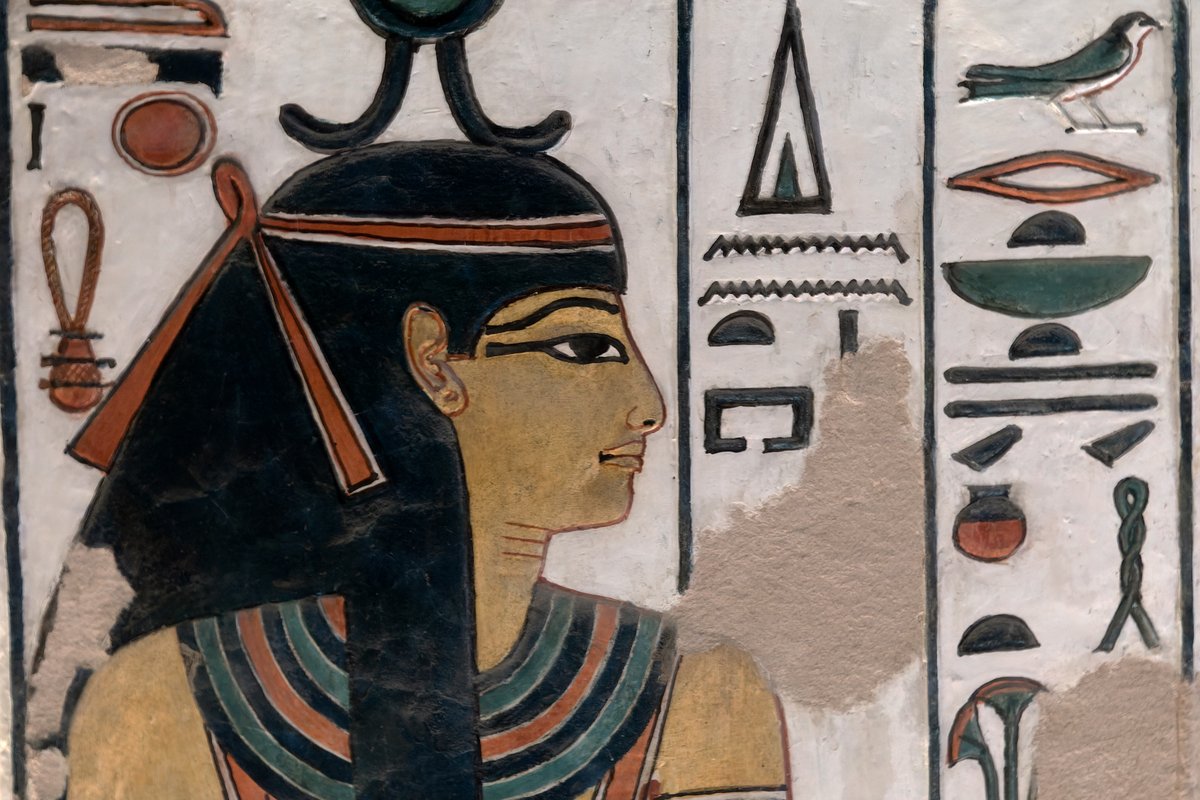
October 22, 20262 min read Add Us On GoogleAdd SciAmAncient Egypt’s first female ruler lived centuries before Nefertiti or CleopatraThe Egyptian goddess Neith in tomb of Nefertari in the Valley of the Queens. hemro/ShutterstockAround 5,000 years ago a mysterious ancient Egyptian woman was given a burial worthy of kings. Her tomb was decorated with splendid furniture and would have contained lavishly designed artifacts of stone, ivory, and copper. Her name was Meretneith.Despite these signs of her royal power, researchers have long questioned whether Meretneith actually ruled Egypt in her own right. Now new evidence suggests she wasn’t merely revered: she was ancient Egypt’s first female king. (The term “pharaoh” was not used to describe rulers until some 1,000 years later.)“Assumptions about titles and grave goods usually lead to conclusions that men had the highest titles and women did not,” says Suzanne Onstine, an Egyptologist at the University of Memphis, who was not involved with the research. The new work should help free scholars of the “mental gymnastics” they sometimes undergo to explain away powerful female figures like Meretneith, she says. The research was recently published in Prague Egyptological Studies.On supporting science journalismIf you're enjoying this article, consider supporting our award-winning journalism by subscribing. By purchasing a subscription you are helping to ensure the future of impactful stories about the discoveries and ideas shaping our world today.Meretneith was likely the daughter of Djer, the third king of the first dynasty in Egypt, which occurred centuries before the construction of the pyramids at Giza. Clues including the grave’s goods and the location of her burial inside a royal necropolis in what was the sacred city of Abydos had led scholars in the past to believe she co-ruled or acted as an interim regent.Meretneith’s grave had a stela, a tall structure etched with written inscriptions about the interred. But unlike those of the kings buried around her, it did not contain a key hieroglyph that denotes whether a person ruled at the time of their death. Called a serekh, this symbol contains a small rectangular depiction of a palace adorned by a patron animal deity—typically Horus, the falcon god.The digitally enhanced photo of one of Meretneith's serekh's.Kelly and Miller, 2026, CC by 4.0In the new work, lead author Sue Kelly, an Egyptologist at Charles University in Czechia, and her colleague Crystal Miller of the University of Bucharest in Romania focused on a set of 13 clay seals discovered in another tomb in 1946 by renowned British Egyptologist Walter Emery. One seal in particular bore serekhs naming Djer and possibly Meretneith—a detail Emery highlighted when he made the discovery. But the clay seals were lost long ago, leaving only a grainy black-and-white photograph that later scholars found unconvincing.Using digital tools to sharpen the contrast and contours of the photograph, Kelly and Miller were able to more clearly reveal the hieroglyphs on the stoppers. The enhanced photos show that the second serekh features the female goddess Neith—"a symbol no male ruler ever used,” Kelly says, suggesting Meretneith held true royal authority. “I am rarely lost for words,” Kelly adds—“it was a total eureka moment.”Onstine says that while the new work is solid, she suspects the debate over Meretneith will rage on. Still, “the research shows that in the early stages of kingship in Egypt..., there was room for female leadership,” she says.Subscribe to Support Independent JournalismGreat science journalism requires human expertise, time, effort and creativity. And it costs money. That’s why I and the journalists here at Scientific American hope you’ll join our community.When you subscribe, you are supporting staff and freelance journalists who are passionate about telling science stories that are true, important and compelling. Our editors and reporters are often experts in their fields, which means they understand the nuances of big discoveries and can untangle the breakthroughs from the hype. With a subscription, you are also supporting rigorous fact-checking to ensure the words we publish are precise and accurate. And you’re supporting original illustrations, graphics and photos that bring you closer to an advanced laboratory, an ice sheet in Antarctica or a space mission in orbit. You’re helping us craft other types of high-quality journalism as well: Our newsletters are carefully written, edited and curated by staffers you have or will come to know and love. Our Science Quickly podcast is based on original reporting, collaboration with editors and scientists and exacting production.Subscriptions keep this engine running so we can continue to deliver thoughtful, rigorous and independent science journalism to you. In an era of viral misinformation, this work is crucial. If you value what we do, I hope you’ll consider joining us as a subscriber
Ancient Egypt’s first female king revealed by long-lost royal seals
Full Article
Original Source
Read the full article at Scientificamerican →KhanList aggregates and links to publicly available news content. We do not host full articles from third-party sources. Always verify important information with original sources.