
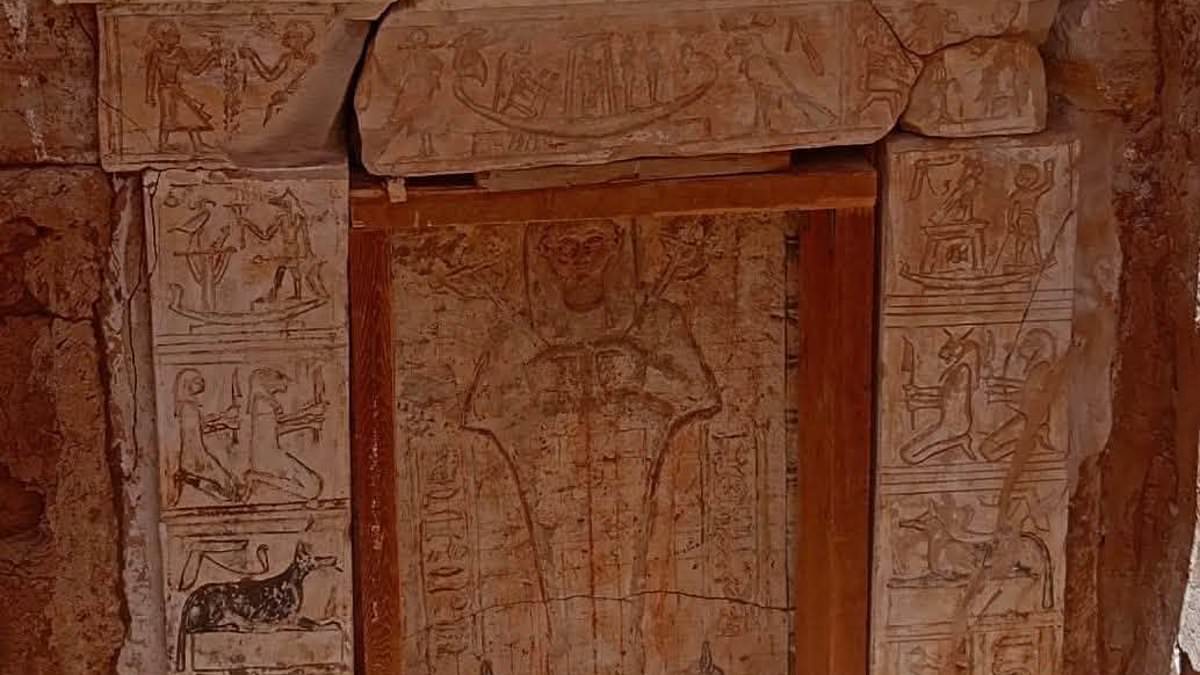
Published: 04:37 EDT, 3 October 2026 | Updated: 04:37 EDT, 3 October 2026 An extraordinary Roman-era pyramid tomb containing an ancient Egyptian 'gateway to the underworld' has been uncovered in a remote desert oasis.Archaeologists found the limestone tomb in the Bir al-Shughala necropolis in Egypt's New Valley, where it was built as a burial place for a man and his wife some 1,700 years ago.A staircase of 14 steps leads to a stone entrance decorated with hieroglyphic inscriptions, protective spells and religious imagery.Most striking is a rare depiction of the 'Hour of Death' from the Amduat, an ancient Egyptian text detailing the journey through the afterlife.The text acted as a guide, charting the sun god Ra's perilous 12-hour journey through the realm of the dead before his triumphant rebirth at sunrise.Egyptians believed the same journey awaited the deceased, making such imagery a powerful symbol of resurrection and eternal life.'An Egyptian archaeological mission has uncovered a pyramid-shaped tomb made of limestone, dating back to the Roman era, dedicated to the burial of a man and his wife,' Egypt's Ministry of Tourism and Antiquities said.'[It is] characterised by its unique architectural design and the rare inscriptions and funeral texts it contains.' Archaeologists were shocked to find a rare depiction of the 'Hour of Death' from the Amduat, an ancient Egyptian text detailing the journey through the afterlife Archaeologists found the limestone tomb in the Bir al-Shughala necropolis in Egypt's New ValleyExperts from Egypt's Ministry of Tourism and Antiquities said the entrance to the tomb was sealed with a stone block bearing magical symbols and the image of an official figure.It is adorned with a finely carved stone slab featuring hieroglyphic inscriptions, protective spells and religious texts.The decorative engravings also include a traditional Egyptian cornice, a winged sun disc and ornamental motifs designed to resemble bundles of reeds.Inside, researchers discovered a pyramid-shaped funerary monument carrying a 19-line mourning poem written in ancient Greek.The inscription commemorates a man named Bisichthes, who may have served as a judge during the Roman period.Other finds included pottery, a purification basin, a funerary offering table and a bronze coin bearing the name of Roman emperor Constantine.Experts say the discovery highlights the blending of Egyptian, Greek and Roman traditions that flourished in the oasis.The tomb is thought to have been reserved for members of the local elite and offers a rare glimpse into their beliefs about death, burial and the afterlife.A staircase of 14 steps (left) leads to a stone entrance decorated with hieroglyphic inscriptions, protective spells and religious imagery. Other finds (right) included pottery, a purification basin and a funerary offering tableThe discovery highlights how ancient Egyptian beliefs endured for centuries under Greek and Roman rule.Instead of disappearing, traditional funerary practices became intertwined with foreign cultural influences, producing a unique mix of Egyptian, Greek and Roman customs that can be seen throughout the tomb.Bir al-Shughala forms part of the ancient cemetery of Mothis, the principal settlement of Egypt's Dakhla Oasis during the Roman and Byzantine periods.Now known as Mut, the town was a thriving regional centre and an important hub for communities living deep within the Western Desert.Excavations led by the Egyptian authorities began there in 2002 and have since uncovered an impressive collection of tombs, revealing a rich variety of burial styles, architectural designs and decorative traditions spanning several centuries.
Ancient Egyptian 'gateway to the underworld' discovered inside remarkable Roman pyramid tomb
Full Article
Original Source
Read the full article at Dailymail →KhanList aggregates and links to publicly available news content. We do not host full articles from third-party sources. Always verify important information with original sources.