
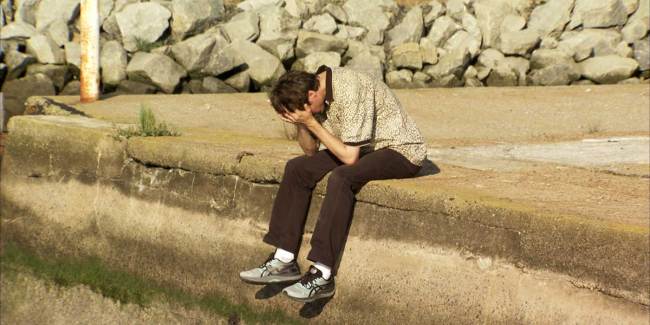
What if Ross McElwee were a cretin? A hyper-specific millennial meltdown gloss on “Sherman’s March,” “Anchors Aweigh” stars writer-director Matt Barats as an unnamed, nebulously-employed NYC creative. After breaking up with his much wealthier girlfriend, he moves into the cheapest accommodation he can find, alternating between watching vérité DV tapes of his college years and 20s and filming new monologues around the city, trying to string together what he repeatedly and unconvincingly describes as “a loose series of vignettes.” Tim Heidecker and Eric Wareheim’s Abso Lutely Productions are among the companies behind the alt-comic stalwart’s palpably micro-budget second feature (following 2023’s “Cash Cow”), which fits right in with other signature works from the company like “Nathan For You” and “Tim and Eric Awesome Show, Great Job!,” hoarding cringe encounters and archaic media formats like precious resources. Even a slender 71 minutes is a long time to stay in such a narrow comic lane, but the laughs arrive continuously until the end and the larger conceptual framework is airtight. “Sherman’s March” was McElwee’s 1986 breakthrough feature, in which the then-single filmmaker went on a series of dates throughout the South while musing on broader familial and national histories. His carefully constructed, gentle-reverie-prone voiceover alternated with direct-to-camera monologues more emotionally close to the bone; in both, he performs the illusion of emotional openness with structurally novelistic precision. The voiceover element proved massively influential to documentarians like Michael Moore — who took on a variant of McElwee’s finely crafted haplessness for the very different purpose of pretending to be naive while facing off against corporations — and, more recently, John Wilson, whose halting delivery and openness to chance encounters is firmly in the pocket. All of McElwee’s descendants operate in a fashion similar to the basic guideline David Foster Wallace described regarding the persona constructed for his comic nonfiction essays, in which he performed the effect of being someone “that’s a little stupider and schmuckier than I am.” Barats’s version of this director-persona is overtly stupider and schmuckier from the get-go, musing in voiceover about how lucky he is, as a late 30something, to have a hot “dimepiece” 25-year-old girlfriend, Megan (Serena Profaci). Leaning fully into glee at their age gap until his marriage proposal is rejected, Barats finds himself literally adrift on a new rental sailboat home, allowing the script to aggressively lean into hackneyed sailing metaphors. Determined to find something of worth in his personal archives that can be repurposed as a feature that will set his course straight — or at least footage that will snap him out of his torpor— Barats starts watching his old DV tapes, but the more he sees the unhappier he becomes. “Damn, I’ve been an idiot for so long!” is his accurate, unsparing takeaway. I realized I was the same age as the filmmaker immediately thanks to the opening epigraph; “Are those Radiohead lyrics?” I thought to myself while dimly recognizing lines from “Pyramid Song”. (“Yup, that’s Radiohead,” the on-screen text answered me.) Other self-dating touchstones include reaction videos of the first time Barats saw the 2007 “Two Girls, One Cup” video and George W. Bush’s unforgivable presidency, revisited in archival footage of Barats driving in a pickup while inchoately rambling about not wanting to support the government. “I — I just don’t want to do anything to promote the kind of government system that’s kinda…running the show right now.” “Yup, those were the Bush years all right,” the present-day Barats deadpans, summing up precisely my memories of eight years of increasing frustration. It’s one of the rare moments where the mask of haplessness is discarded for dead-on observation. Present-day direct-to-camera segments unfailingly begin with him holding a large shotgun microphone just like McElwee, thumping it loudly with his hand before speaking directly into it. The schmuck facade of his anachronistic homage to a film way above the character’s pay-grade falls away as Barats shares acidic observations about dimwitted tourists and the physical unimpressiveness of comedy writers playing basketball; throughout, there’s a sliding scale between the intelligence of the person making the film and the dumber version he’s externalizing. The on-camera Barats comes to perceive that his is a wasted life: While he hoped that watching DV documentation would let him say that he’s grown and changed, in all honesty he can’t. Minus one conspicuously high-res camera, most of the present-day footage is also shot on various lo-fi digital cameras, a nostalgic format fetishism visually matching the character’s stuck-in-time malaise. On-camera, Barats may be a mess; behind it, he knows exactly what he’s doing. If the film struggles to get to the 71-minute mark that makes it marketable as a proper feature, padding itself out with repeated jokes, such self-flagellating is also part of the texture of comedies, and its formal conceit is conceptually airtight. Grade: B “Anchors Aweigh” premiered at the Oak Cliff International Film Festival 2026 and screened in the Midnight Madness section of TIFF 2026. It is currently seeking U.S. distribution.
‘Anchors Aweigh’ Review: One Man’s Alt-Comedy Millennial Meltdown Gets a Hybrid Documentary Gloss in Matt Barats’ Second Feature
Full Article
Original Source
Read the full article at Indiewire →KhanList aggregates and links to publicly available news content. We do not host full articles from third-party sources. Always verify important information with original sources.