
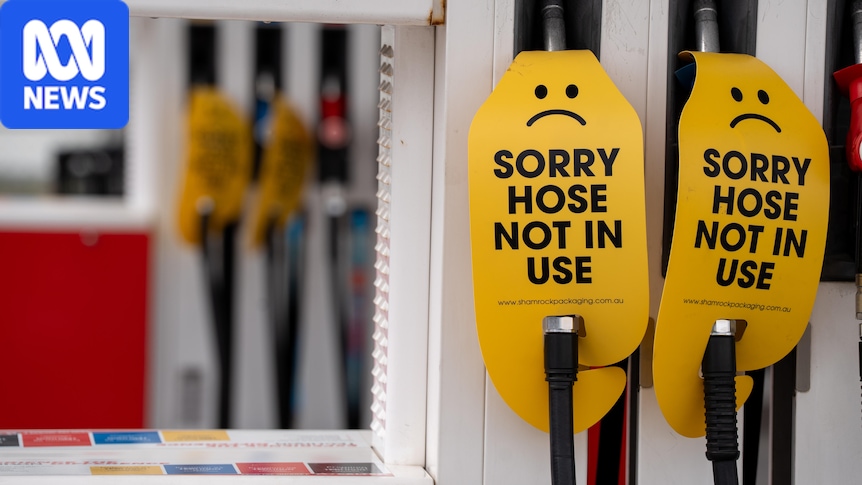
A leading energy analyst has warned that Australia could be looking at diesel rationing within weeks and prices topping $4 a litre if US President Donald Trump goes ahead with an export ban on the fuel.MST Marquee's head of energy research Saul Kavonic said the proposed export ban is "probably the most worrying development we have seen in global fuel markets since the [Middle East] war began when it comes to Australia's vulnerability".Mr Trump said on Tuesday, local time, he backed the idea of a ban on diesel exports from the US, which is being floated by some Republican politicians ahead of the midterm elections in November."I've said let's not send out the diesel. We make a lot of diesel … I've called for it. I've called for it within my people," Trump told reporters before a meeting with the Ukrainian President Volodymyr Zelenskyy.The country exports roughly 1.3 million barrels of diesel a day, which is about one-quarter of its refining output.Diesel prices have climbed to more than $US6.50 a gallon in the US, the highest average on record.Real threat of fuel rationingMr Kavonic told ABC's The Business program if the export ban went ahead, there was a very real risk of diesel fuel rationing in Australia and prices climbing 50 per cent to more than $4 a litre."If the US goes down this path, and particularly if they do it in a very severe way, I think we'll be looking at that in a matter of weeks," he said.While Australia does not directly import diesel from the US, the flow-on effect on global markets puts Australia in a uniquely vulnerable position.The economy is heavily weighted toward both agriculture and mining, both industries that rely heavily on diesel."Australia is actually the largest importer of diesel in the world; that's not per capita; that's an absolute sense," Mr Kavonic said."We account for 1 per cent of the world's fuel demand, but 10 per cent of the world's seaborne diesel imports."The crunch happened because, globally, both the conflict in the Middle East and Ukraine-Russia war have seen a number of major refineries taken offline.Russia and China have also stopped exporting refined fuels as the fuel crisis evolved.That means the US has been picking up the slack in the diesel export market.US considering partial or full diesel banUS Treasury Secretary Scott Bessent said the US government was examining whether it was feasible to have a full or partial ban.Mr Kavonic said any bans could force the Australian government's hand."This is the kind of thing which could have to see Australia reconsider our demand management and rationing program potentially go to stage 3 and stage 4," Mr Kavonic said.Under Australia's National Fuel Security Plan, stage 3 includes "practical measures to reduce fuel demand" and level 4 includes plans to "direct fuel supply to ensure national supply is allocated fairly" and "prioritisation of fuel supplies at the local level", generally considered to be rationing."Well, it was probably only a month ago that Australia and the Australian government thought we'd managed through the worst of this crisis and we could actually disband the fuel task force," Mr Kavonic said.Since then, two critical developments have occurred: disruption to fuel coming through the Red Sea, and now a possible US export ban.With attacks by Houthis on both the Saudi oil pipelines and the Red Sea, oil companies were turning to clandestine ship-to-ship transfers."So if the US does go down this [export ban] path, particularly if they do it in a very severe way, I think we'll be looking at [rationing] in a matter of weeks, particularly if we don't see a de-escalation in the Middle East occurring at the same time," Mr Kavonic said."And if that continues to escalate, plus a US export ban, that's the one situation which we were really fearing and hoping would not happen. And unfortunately, it could be on our doorstep."Stockpiles won't last foreverHe said while Australia had solid fuel stockpiles, the nation could run out quickly."And particularly we're heading into a season now where we need that diesel for our agricultural part of our economy. So we can't afford many delays."Australia is a huge importer of diesel because our agriculture and resources industries are heavily reliant on it. (ABC News: Laurissa Smith)Mr Kavonic said it was critical the federal government continued its attempts to shore up supply from international partners like Saudi Arabia."I think government, and minister Bowen, but all the way up to the prime minister, really stepped up at the beginning of this conflict. We paid more, but it kept coming, and that's commendable," he said."We thought we were past the worst of this, but now these developments suggest there's actually no light at the end of the tunnel here."Given our global supplies of oil and diesel have been drawn down significantly this year, and clearly there'll be increasing competition from other countries as well for the supplies that remain, we're still far from being out of this conflict."We have to keep up with this diplomatic engagement, and we might even have to look to re-arm, stand up that fuel task force if things continue to get worse from here."While the US's complex supply chain means any export ban could also have internal ramifications, Mr Kavonic said it was still a possibility it could happen in the short-term to ease pressure on prices inside the country ahead of the midterm elections."The concern here is that they'll do this even if it's just temporarily, even if it's not sustainable for political reasons, and then the rest of the world's going to pay the price in that near term."Export ban could actually lead to internal fuel problemsMr Kavonic is not alone in his view.Capital Economics chief climate and commodities economist David Oxley said any ban could paradoxically force American refiners to cut supplies of oil products."While an export ban would initially boost the availability of domestic diesel supply to parts of the US, it would subsequently reduce the supply of diesel and other oil products because refining and distilling a barrel of crude oil produces a mix of products in closely fixed ratios."Accordingly, if refiners can't sell or store the diesel that they produce, they'd eventually be forced to cut their overall output, including of gasoline and jet fuel."Looking at the US Gulf Coast alone, Capital Economics estimates that "diesel storage in the Gulf could rise to pandemic-era highs" because of a sharp fall in refinery utilisation, "within a matter of weeks"."All told, the political aspect of being seen as doing something to help reduce fuel prices in the run-up to the midterms means that some form of export restriction now seems likely to be announced in the coming weeks," Mr Oxley said."This would further complicate the outlooks for energy markets and fuel price inflation."We suspect that it would be short-lived."
Analyst warns diesel could top $4 and rationing possible if US ban proceeds
Full Article
Original Source
Read the full article at Abc →KhanList aggregates and links to publicly available news content. We do not host full articles from third-party sources. Always verify important information with original sources.