
The election last week of coalitions involving the ANC, ActionSA, EFF, the MK party, and others in eThekwini, Joburg, Tshwane and Ekurhuleni shows that a large group of parties with very different beliefs will now try to work together.The make-up of these coalitions can be startling.ActionSA, led by the former chair of the Free Market Foundation, is now working with the ANC, the radical leftist EFF and the MK party, a party that believes traditional leaders should govern without a Constitution.Those who have joined these coalitions sometimes try to obscure these differences by using race. They claim this is about keeping the “racist DA” out of office.But the huge ideological differences between these parties cannot remain hidden. They represent different parts of our society and have radically different policies.This is sometimes about identity, but often about economic class. In many democracies, economic class differences drive the major political dynamics. It would be foolish to assume that race can prevent that from happening here too.This is why, before it started to fracture, the ANC used to explicitly say that it was a multi-class party. It was an attempt to show it could represent different parts of our society. Those class differences were often expressed inside the ANC, in arguments primarily about economic policy.EFF leader Julius Malema briefs the media at the election results centre in Midrand, Johannesburg on 7 November 2026. (Photo: Felix Dlangamandla) While the personality of Julius Malema was absolutely a large factor in his expulsion from the ANC, economic arguments also played a part. It was his campaign to nationalise the mines that provided the context for the process that saw him leaving the ANC and forming the EFF.In the case of the MK party, while Jacob Zuma first played the role of a multi-class leader during his time in the ANC, his party’s manifesto shows a desire for incredibly radical change. Much of this is in direct contradiction to what the ANC professes to stand for, particularly its desire to remove the Constitution, which is based on the Freedom Charter, the ANC’s historic document. Former president and MK party leader Jacob Zuma. (Photo: Gallo Images / Luba Lesolle) Yet the ANC has taken the decision to work largely with these parties rather than the DA, which shares its commitment to the Constitution.The roots of this outcome lie in the decision by the ANC’s national leadership to allow the ANC’s regions to make their own decisions on a case-by-case basis. The national leadership, at a slight distance from the day-to-day governance in councils, could have been expected to consider principle, ideology and the longer-term future of the party. This might even have come before the short-term gain of power at all costs.Contradictions in councilOnce regional leaders were free to make their own decisions, the die was cast.That meant people who stood to personally benefit from coalition decisions were now making those decisions.As a result, many have made decisions to work with those who will allow them to continue to extract from council administrations.This might explain one of the curious quirks of these negotiations.It appears that while the ANC will occupy the position of mayor in Ekurhuleni, it has been content with the position of Member of the Mayoral Committee for Finance in other metros. In some cases where it is the second-biggest party in the coalition, it has not taken the position of deputy mayor.This might suggest it considers control of the finance portfolio as more important. On this cynical view, it might also be making the political calculation that if these coalitions are not going to improve governance, then it is best to avoid high-profile positions. The finance position, while coming with immense influence, does not attract the same kind of attention as the position of mayor or deputy mayor does.This decision by the national ANC’s leadership has now led to complete contradictions, driven only by the maths of various councils.In KwaZulu-Natal, the ANC is in an array of different coalitions with different parties.This means that, as different parties make different demands, ANC councillors will be voting in completely contradictory directions.They might vote to in-source cleaners in one council while voting against it in the council next door.The very identity of the ANC will start to fray more quickly.Worse, other problems will now crop up.In 2024, the ANC refused to work with the MK party in national government for the simple reason it was obvious that Zuma had the intention of trying to remove Cyril Ramaphosa as President.Now many of its regions, in KZN and Gauteng, have decided to work with the person responsible for the “nine wasted years” of the State Capture era.In the coalition negotiations, it would have been easy to forget all of these differences. When you are talking to people you worked with for 20 years before fighting with them for five years, it’s easy to concentrate on the first period. The MK party’s Mxolisi Phakathi was elected eThekwini mayor on 27 November 2026. (Photo: Supplied / City of eThekwini) Especially with the prospect of power in easy view, and with an enemy you can claim to have in common.But once these parties are governing together, the tensions that emerged previously will resurface. If they had not been deep-seated, they would have been resolved before the MK party split from the ANC.And the spectre of a common enemy, so powerful while negotiating a coalition, will almost fall away entirely once you are in office. Extraction and patronageIn eThekwini in particular, where the ANC preferred to work with the DA and the IFP in the province, these tensions are likely to surface regularly.Now, the eThekwini region of the ANC may find the MK party demanding that the ANC in the province work with them in KZN. This would put the interests of the ANC’s eThekwini region in opposition to those of the ANC’s KZN province.The same is true of the EFF and the SACP, both parties that have had close and complicated relationships with the ANC.This is all a result of the lust for power and, presumably, money.It is also the end result of a process that has been observed since at least 2010, when ANC provinces started to resemble fronts for criminal enterprises. It is also the consequence of the fact that ideology appears to no longer be a factor in local politics.As many others have observed in other democracies, when ideology is no longer important, the only glue available is extraction and patronage.This is now the dominant factor in our local governance and could well become the vital factor in provincial and national government in 2029. DM
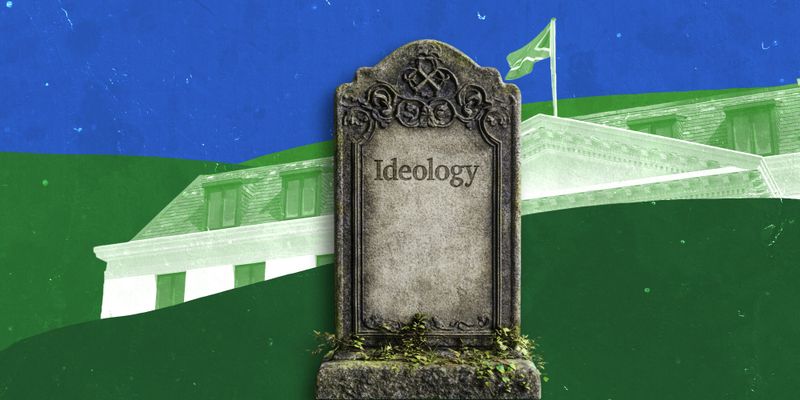
ANALYSIS: Ideology is dead, welcome to the age of extraction
Full Article
Original Source
Read the full article at Dailymaverick →KhanList aggregates and links to publicly available news content. We do not host full articles from third-party sources. Always verify important information with original sources.