
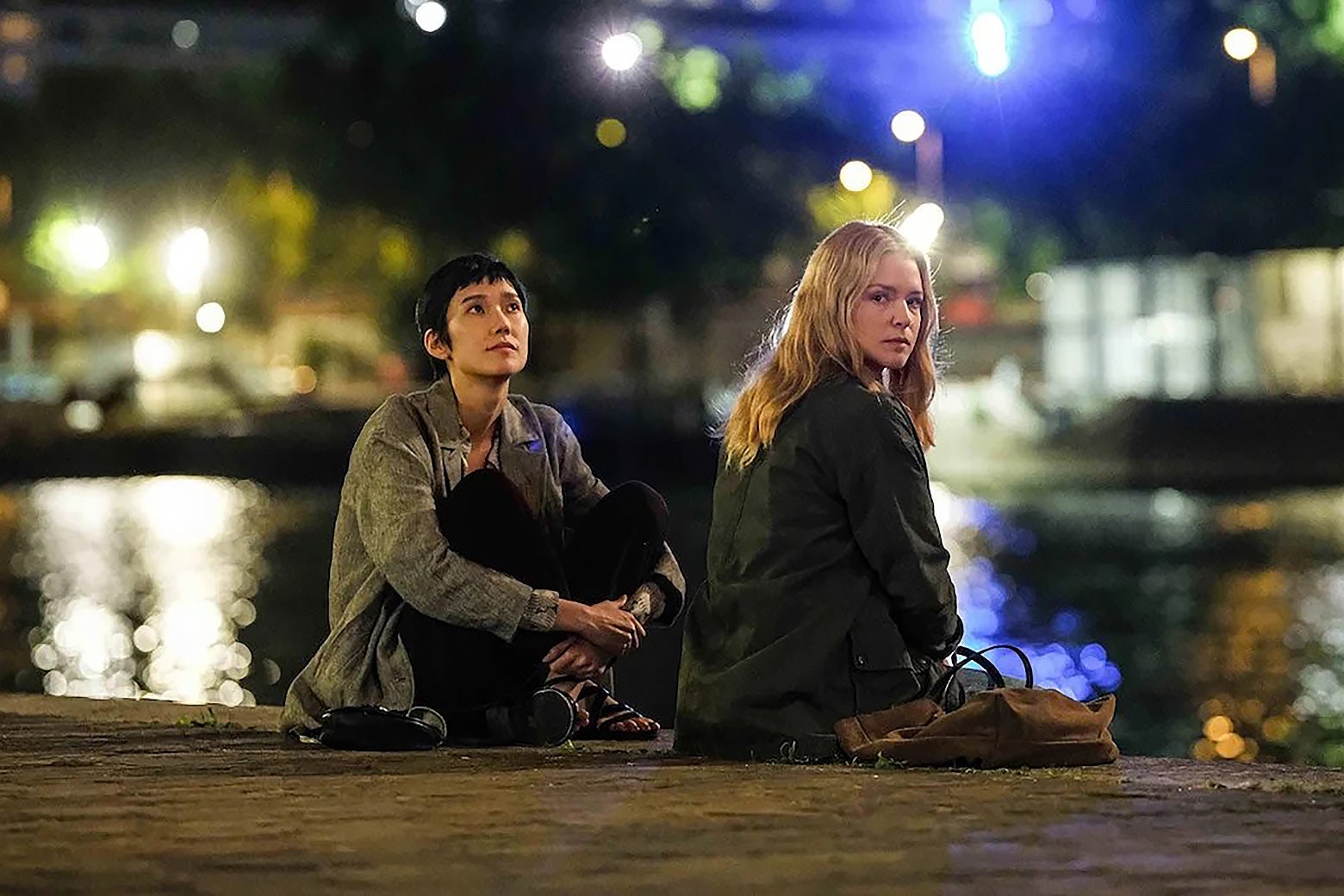
Movies All of a Sudden Is a Gossamer Miracle of a Film Ryusuke Hamaguchi’s Oscar contender feels like life itself. By Enter your email to receive alerts for this author. Sign in or create an account to better manage your email preferences. Unsubscribe from email alerts Are you sure you want to unsubscribe from email alerts for Sam Adams? Nov 25, 20263:35 PM Neon Sign up for the Slatest to get the most insightful analysis, criticism, and advice out there, delivered to your inbox daily. Some movies are so big it feels like they could contain the entire world. I don’t just mean long, although Ryusuke Hamaguchi’s All of Sudden runs a little over three and a quarter hours. And I don’t mean that it has a complicated plot or sprawling cast of characters—quite the opposite, in fact, since the movie’s spine is a series of one-on-one conversations between Marie-Lou (Virginie Efira), the director of a French long-term care facility, and Mari (Tao Okamoto), a Japanese theater director. But Marie-Lou and Mari aren’t much interested in talking about themselves. They discuss Marie-Lou’s troubles at work, where she is phasing in an approach called “Humanitude” that aims to make patient care more humane and empathetic, and meeting resistance from her profit-oriented bosses and some of the facility’s more entrenched staff. And they talk about Mari’s career in theater, how she came to be staging a one-man show about the history of Italian mental hospitals, performed by a Japanese actor, Gorō (Kyōzō Nagatsuka), in the suburbs of Paris. Both women’s careers look beyond the boundaries of self, and the movie, which has emerged as an Oscar contender—including for Best Picture—since its Cannes debut, does, too. After Marie-Lou goes to see a performance of Mari’s play, the two women spend a long evening sharing ideas about everything under the sun, strolling by the river as the sky darkens, then shifting to Marie-Lou’s nursing home, where she is on night duty. It’s hours for them, and not much less for the audience watching them in the theater. And yet the next morning, when Marie-Lou impulsively texts Mari a picture of herself and her ex-husband, Mari has no idea who she’s looking at, and neither do we. Mari texts back: “I know almost nothing about you.” We learn more about both characters in this gossamer miracle of a film: that Marie-Lou’s mother died of early-onset Alzheimer’s, which is what made her determined to change the way patients in cognitive decline are cared for; that Mari has end-stage cancer, and only a few months to live. But as immediate and profound as their personal connection is—despite the fact that the relationship is never consummated, the movie is an account of love at first sight on par with that of Before Sunrise—Hamaguchi is as interested in how his dual protagonists exist in the world as he is in how they are with one another. And they feel the same way. A good chunk of that first night is devoted to their discussions on the subject of capitalism: first Marie-Lou’s thoughts about how the pressure to manage her revenues and expenditures presents a systemic block to viewing her patients as people, then Mari’s literal lecture, complete with impromptu whiteboard illustrations, about how negative externalities ultimately doom a profit-driven system to failure. Mari’s ideas aren’t especially brilliant or revelatory, but her commitment to making sure that Marie-Lou understands them, and how they could change her ideas about how a care facility might operate, is an act of purest communion. Marie-Lou and Mari rarely speak each other’s languages, at least in literal terms: aloud and even via text, they communicate in their own respective languages, because, as Gorō explains before performing his theater piece in Japanese, there is a depth of feeling that can only be conveyed by your mother tongue. Hamaguchi wrote the script for the film, his first set outside his native Japan, with the French-Japanese dramatist and translator Léa Le Dimna, drawing loose inspiration from a collection of letters, later published as a nonfiction volume, sent between a cultural anthropologist and a philosopher who was dying of cancer. (The book’s Japanese title comes from a phrase doctors use to warn patients that their condition might rapidly decline.) As with the rural community in Hamaguchi’s Evil Does Not Exist, All of a Sudden feels both immersed in and invigorated by its surroundings, and not just because there’s a passing reference to the new scrutiny focused on institutional care for the elderly in the wake of the scandal around the French nursing-home giant Orpea. You can feel Hamaguchi taking in the way the light falls in the care home’s yard in the afternoon, or the way a reaction moves through the audience at Mari’s play. Gorō has an adult grandson, Tomoki (Kodai Kurosaki), with nonverbal autism, and part of Mari’s practice involves allowing him to roam onstage and interrupt with emphatic cries whenever the impulse strikes him. Most artists would see this as a disruption of their work, but, Mari says, that’s how she knows it’s been a good performance. Hamaguchi, who took home the Academy Award for Best International Feature for 2021’s Drive My Car, is a deeply thoughtful filmmaker, but he’s also a deeply intuitive one. All of a Sudden has the scope of a great novel and the evocativeness of great poetry, a sense of humility before the complexity of the human heart, and the knowledge that all any work can do is capture the slightest fragment of it. It feels like it lasts forever and that it’s gone in an instant, just like life itself. France Japan Movies The Oscars
An Oscar-Winning Filmmaker’s Latest Is a Miracle of a Movie
Full Article
Original Source
Read the full article at Slate →KhanList aggregates and links to publicly available news content. We do not host full articles from third-party sources. Always verify important information with original sources.