
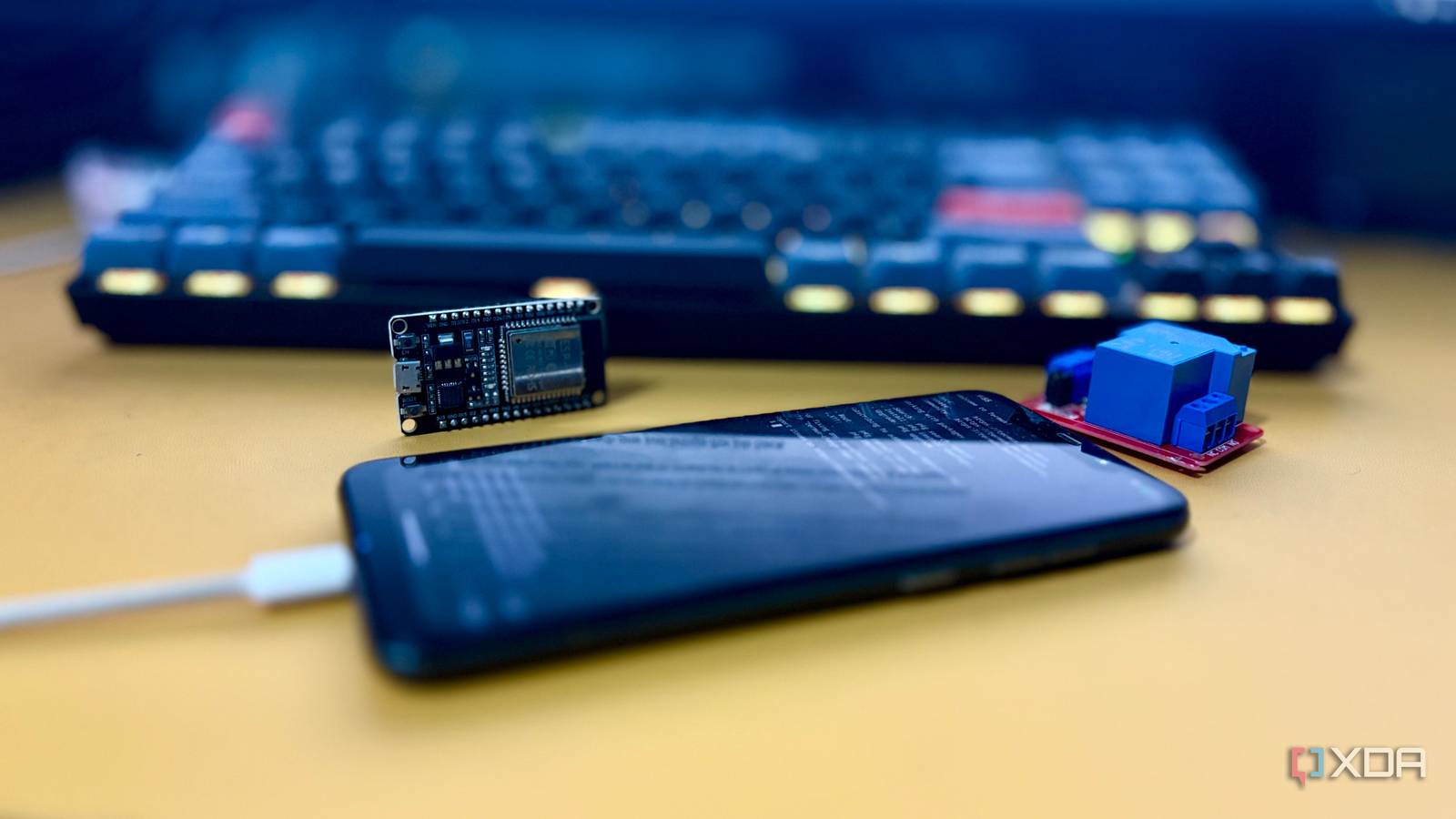
Published Aug 21, 2026, 3:30 PM EDT Shekhar Vaidya is a veteran technology journalist and computer science engineer. He is the founder of TechLatest, where he has spent years providing technical analysis on hardware and Windows ecosystems. Now a Computing Writer at XDA, Shekhar leverages his deep background in NAS, storage solutions, and PC internals to help readers master their tech. When someone mentions a tiny, cheap, always-on piece of hardware, their mind usually goes to a single-board computer (SBC) like a Raspberry Pi, Arduino Uno, or Orange Pi. Generally, it is the right choice, too. I was on the same path a few weeks ago. I was looking to buy a Raspberry Pi 5 to host my DNS server. Before getting it, I looked at the old Android phone living in my drawer and decided to use it as a DNS server. I successfully installed Pi-hole on it, and surprisingly, it handled my home network DNS filtering without breaking a sweat. After a couple more services on the phone, the Pi felt unnecessary. But all the magic was happening in software. Then I thought of an experiment that needed external hardware, and the equation flipped. The phone wins everything that lives in software It's an always-on Linux box with a battery and a screen When you are starting with a Raspberry Pi, most homelab subreddits suggest a standalone project like a DNS server. Since it is standalone, it doesn’t need additional dependencies like GPIO, sensors, or specialized hardware. Just the board, some storage, Wi-Fi connectivity, and a power source, and you are good. DNS is something you should always keep outside your main home server, and I found out why firsthand, but that’s a story for another day. Before committing to the Pi, I used my old Android phone to install a DNS server on it, which was getting dusty in my drawer. The setup was simple: Termux with root access, Debian via proot, and Termux:Boot for auto-start after reboot. I’ll admit, the initial setup did take time because Android phones aren’t designed to act as a server. But once that was done, it started feeling much better than a Pi. Hardware was one of the things that outshone what the Pi could have offered. The SDM845 SoC, 6 GB RAM, and 128 GB UFS 2.1 storage were overkill for a DNS server. And the built-in Wi-Fi, display, and, most importantly, the battery complemented the whole setup. The battery contributed the most practically. A DNS server is supposed to run 24/7, so a short or even a long power interruption doesn't immediately take the service down. A basic Raspberry Pi 5 starter kit costs more than $250 today; an old phone that you already used till its last breath is worth next to nothing. And using the same phone means effectively turning unused hardware into a server. A DNS server is one example of a broader class of software-only workloads. Once the DNS server was working fine for me, I used the phone to deploy other tasks too — replacing my laptop for remotely accessing my homelab during small routine tasks. I also ran it as a blind-spot homelab monitor. I also planned to use it for lightweight automation, bots, schedulers, and more. The point is, the workload doesn’t care that the computer running it happened to be a phone. The phone wasn’t just capable of running a DNS server, but it was arguably overqualified for the job. But in the end, it was a sealed device with limited external access. Then you reach for a single jumper wire The gap isn't performance. It's that the phone is a sealed box. The phone handled the DNS server, a remote Linux box, and the homelab monitor without even breaking a sweat. Whatever I threw at it, software-wise, it did well at everything. But that was the software end. When I thought of a project that needed something to connect with, the problem showed up. A Pi has GPIO pins, 3.3V/5V power and ground, and interfaces such as I²C, SPI, and PWM. These are exposed interfaces, typically for wiring hardware into the Pi. I can wire up almost any experiment I want. In comparison, the phone is a finished product sealed for uninterrupted consumption, not for experiments. The only exposed port is the USB-C port. I tried to use the Type-C port via OTG and adapters, but it is nowhere near as flexible as the GPIO pins. I used multi-port adapters with USB, HDMI, and Ethernet, but these are the hard ceiling. Charging the phone while connecting other hardware immediately complicates the setup. For example, I have been thinking of a DIY weather station for home. It would feed temperature, humidity, and atmospheric pressure measurements to my Home Assistant to manage my home's air conditioning. On the software side, the phone could process the readings and communicate with Home Assistant, but can it connect to the physical sensor without extra overhead? No. With a Raspberry Pi and the right hardware, this isn’t even an hour-long job. I could wire the sensors directly to the GPIO interface, and the Pi reads them straight off the hardware. The point is the Pi has the GPIO/I²C pins to connect the BME280 directly; the phone doesn't. This was just one example. The phone is overqualified for these projects; it can easily handle the compute part of the system, but when it comes to external hardware, the Pi suddenly starts looking useful again. What if we keep the compute part as-is and let another small board handle the sensors? The workarounds exist, and each one just brings the job back Every fix quietly turned into a second board A $5 ESP32 with Wi-Fi looked like a perfect solution — not a standalone project but a complement to the current phone setup. For my weather-station example, I could easily connect the BME280 over the ESP32’s I²C interface. It could read the values and send them directly to my Home Assistant wirelessly. And the phone would still handle the compute side, i.e., the software and the services running on it. Suddenly, it felt like the old phone found another life. The phone no longer needed the GPIO because a cheap ESP32 could handle the physical connectivity. But the whole premise of simplicity broke again — I added another board just to handle the hardware side. For a small weather station, it is fine since the board is cheap and the sensors are simple enough to wire up. But the moment I decide to add a small display, LED lights, and a relay, that simplicity is gone. At this point, my question changed from “Can my old phone replace a Raspberry Pi?” to “Can my old phone replace the compute part of a Raspberry Pi project?” Instead of comparing my old phone directly with a Pi, I was really only looking for the software half. That was a much narrower claim than the one I started with. I could use my phone and an ESP32 for a few projects, but that’s two devices doing one project’s job. A single Raspberry Pi would have done both on a single board. A USB-to-serial adapter, hub, and other peripherals can physically connect to the phone, but communicating with it is a whole different problem. And you need to understand the USB port isn’t a drop-in replacement for the Pi's exposed GPIO/I²C/SPI ecosystem. It barely solved the connectivity problem; thinking of it as a Pi replacement is generous. The phone was never trying to be a Pi Can the old phone handle the compute part? Absolutely, it can do it without using half of its resources — the Pi-hole and the other two experiments are the living proof. But can it fully replace a single-board computer like a Raspberry Pi? Standalone, no. Paired with a smaller board like an ESP32, it can get close, but by breaking the simplicity of the phone setup. The phone is a superb headless software appliance; the Pi is where software meets copper. In the end, the phone can be a server, not a microcontroller. The trick is knowing which one the job really needs. Brand AITRIP Connectivity Features UART, USB The ESP32 is a fantastic development board that combines solid specs with an affordable price. Despite being cheaper than Arduino and Raspberry Pi Pico, it outperforms most of its rivals. Plus, the ESP32 even has Wi-Fi and Bluetooth functionality built into every board, making it great for projects where you can't physically keep the microcontroller connected to your PC at all times.
An old phone beats a Raspberry Pi for everything except the one thing that matters
Full Article
Original Source
Read the full article at Xda-developers →KhanList aggregates and links to publicly available news content. We do not host full articles from third-party sources. Always verify important information with original sources.