
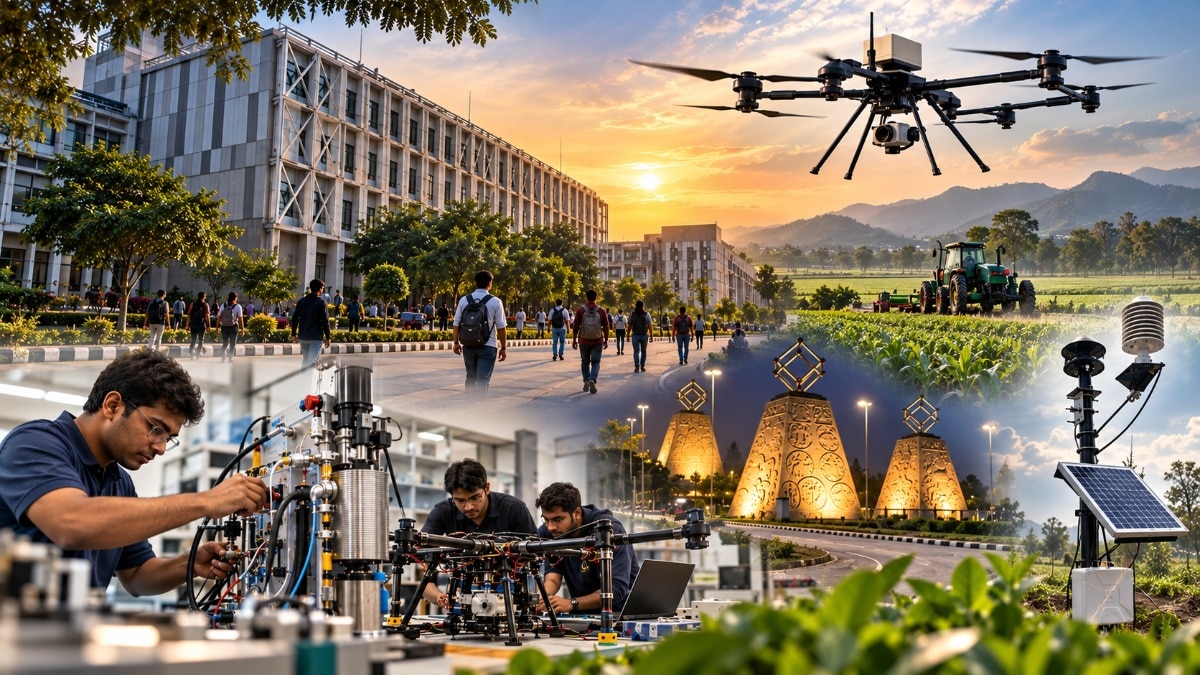
The venerable Indian Institutes of Technology (IITs) – a symbol of excellence long sustained by New Delhi – are now seeking to stand upon their own feet, and to build what India most needs at this hour. The laboratories that are named after CV Raman, Homi J Bhabha are beginning to take a form that may, in time, make them centres of manufacture and entrepreneurship.The question of self-sufficiency thus reaches beyond the walls of the institutes, opening a wider possibility: that these centres of learning may become places of industry support, employment generation, and community development.As Professor Rajeev Ahuja, Director of IIT Ropar, observes, “for everything we as IITs look towards government, it can provide resources; but exploring a possibility of becoming self sufficient is our priority.”His point is plain enough: the years ahead will require the campuses to raise more of their own means, rather than live at the mercy of changing government budgets. At present, the Ministry of Education provides tens of thousands of crores for the IITs as a whole, with a capital grant of 2,400 crore for 2025–26 alone.Yet a large share of this money naturally flows towards the older and established IITs, leaving the newer institutes - the so-called second and third generation IITs - still waiting to catch up. The robust alumni network across IITs is one big resource that in Professor Ahuja's vocabulary could be utilised more sufficiently.What will it take for the IITs to build the institution of the future - one where a laboratory experimenting with what is new can exist alongside another strengthening what already works, and where the problems of entire regions can become problem statements that students and professors together seek to solve?FROM LECTURE HALL TO WORKSHOPIIT Ropar is now seeking larger opportunities, from projects connected with the India cluster in agritech to advances in drone machinery, while also building a strong base of more than 600 startups, some of which are now reaching a later stage.At IIT Madras, IIT Bombay, IIT Kharagpur and IIT Kanpur, which announced a Rs 180-crore School for Innovation and Entrepreneurship at its Noida campus, meanwhile, plans have been laid for infrastructure running into hundreds of crores, marking a very different scale of institutional ambition.Recognising this gap, Prof Ahuja calls for a change in the old academic habit. His experience abroad, he says, was quite different. “My experience in Sweden was completely different,” he recalls, where leading universities expect professors to raise outside grants that may meet half their salaries and pay for equipment.Across Europe, professors often secure a part of their own income through research contracts, while the university retains an overhead, or IRG, which may then be used to build and maintain laboratories.India, by contrast, has long depended upon government schemes for stipends and salaries.A European arrangement, in which 50% of a faculty member’s pay is raised through outside grants, would, in Prof Ahuja’s view, lessen the burden upon the institution while bringing more money into its laboratories and infrastructure.The old command to “publish or perish”, then, may slowly give way to another: innovate, and invest. The IITs are being asked not merely to teach and research, but to become engines of enterprise in their own right.It is no accident that this movement towards greater independence comes at a time when India’s startup economy is expanding rapidly. Government reports and recent trackers show that India now has more than 133 unicorns - startups valued at over $1 billion - as of mid-2026. Many of these young companies can trace their beginnings to IIT campuses.Since the Covid years, the IITs have become busy grounds for enterprise. Undergraduates arrive with rough ideas and find mentors; PhD scholars turn research into ventures; and faculty members, too, have begun building companies around their work.Recent government figures put the number of DPIIT-recognised startups at roughly 1.57 lakh, nearly five times the number recorded in 2016, with more than 17 lakh jobs created.IITs: THE NEW STARTUP HUBIIT campuses have effectively become test-beds for innovation. Inside the laboratories and workshop bays, brilliant young minds apply rigorous research to real-world problems.At IIT Ropar, for example, Professor Sarang Gumfekar (Associate Dean of PG and Research) describes an almost assembly line of invention:“Typically, incubation works for two years. A startup enters the incubation programme and, after two years, has to graduate, meaning it has to move out,” he explained.In other words, from the moment a student or professor has an idea (say, an autonomous drone or an AI app), the institute’s incubator provides space, equipment and mentorship for two years. Then the fledgling venture must fly on its own.In practice, this means each year dozens of startups emerge, pitch to investors, and seek funding.The system works. As Prof Gumfekar notes, angel and venture support are woven into the ecosystem – quarterly investor meets connect startups to funding, so that by the end of their incubation they are often ready for seed money.This entrepreneurial ferment is bolstered by active industry–academia ties. Government R&D agencies like DRDO and Army Design Bureau (ADB) frequently issue problem statements that IIT teams tackle in-house.In effect, many IIT projects are “request driven”: a retired general or a space scientist comes to campus asking for a capability (e.g. an all-terrain drone or a satellite imaging tool), and professors and students race to develop it.The result is that the work of the IITs is more often finding its way into the fields – quite literally – than remaining confined to the pages of journals.Here lies another distinction: this wider reach is also becoming a dependable means of sustaining the institution, through certificate courses, postgraduate diploma programmes, and an expanding effort to reach the schools beyond its gates.For instance, IIT Ropar – though only established in 2008 – has become a laboratory of innovation for defense and agriculture.Through its Centre of Drones and Autonomous Systems (CoDRAS), Ropar engineers now work closely with the Indian Army to develop indigenous aerial systems.A July 2025 India Today story revealed that IIT Ropar researchers are building “next generation surveillance drones” to reduce dependence on foreign hardware.One team is teaching drones to auto-land on rugged terrain and provide real-time geolocation, while another develops AI vision for target recognition even under jungle canopy.In tandem, IIT Ropar has signed an MOU with an industry partner (AVPL) to create a fully indigenous combat drone, ensuring that “the entire supply chain, from design to deployment, remains under Indian control”.As the article notes, these efforts “fit into a larger planto make aerial surveillance and response more self-reliant”. In short, the classroom and lab now serve the battlefield – and the path from whiteboard to army base is swift and direct.Similarly, on the agricultural front, IIT Ropar is turning academic research into practical farming technology. Professor Gumfikar is currently working on multiple projects. (Image: India Today) In 2024, it launched ANNAM.AI, a new Centre of Excellence for AI in Digital Agriculture (under India’s 990crore AI-CoE program). ANNAM.AI is charged with “revolutionising agriculture by leveraging cutting-edge technologies,” focusing on sustainable practices and data-driven farm solutions.Already, the center is building tools to help small farmers use AI for better yields and resilience. And Ropar’s incubation output includes green startups: for example, NanoKriti Nanobubble Technologies (an IIT-Ropar spinout) applies nanobubble aeration to clean and oxygenate irrigation water.Observers note that NanoKriti’s devices “rejuvenate water bodies, save water, and boost farm and aquaculture productivity” – a vivid proof that sustainability-driven innovation creates real ecological and livelihood impact.In other words, the institute’s students are not only building drones for defence; they are also planting seeds of high-tech hope in India’s fields and rivers.INNOVATION – DRIVEN DEGREESThis spirit of enterprise extends even to academia itself. IIT Ropar has launched what it calls an “Innovation-driven PhD”, the first of its kind amongst IITs.In the traditional Indian system, a doctoral student must write and publish multiple papers. Under Ropar’s new model, the degree can be earned by a startup or product. As Prof. Ahuja explains, a student admitted to this program “does not need to write any PhD thesis.During the five-year term, he can do one product development or one start-up or have one patent granted; that is his PhD thesis.” In effect, the institute absolves the student of publishing demands – instead requiring proof that a viable innovation has been delivered.The advantage is twofold: graduates emerge not only with a doctorate but with a real company or technology in hand. Prof Ahuja notes that this also sidesteps perverse incentives (like data manipulation to hit paper quotas).This practical bent reflects a larger ethos at modern IITs: education is a means to serve society. Directors argue that just as European universities instill an obligation on students to directly benefit industry or community, so should India’s premier institutes.Already Ropar offers short courses to naval and CISF officers, and runs “dual” M.Tech programmes in defense technology on army bases. Professor Ahuja recounts conferring degrees to active gunners without them ever coming to campus – a literal example of “outreach education.”Likewise, the institute is preparing its drone engineers not only to fly machines, but to produce them indigenously, reducing foreign capital outflow.EUROPE'S EXAMPLE AND THE PATH AHEADThe comparison to European institutions is more than rhetoric.As Prof Ahuja often stresses, Western universities are largely autonomous revenue generators. He notes that in Scandinavia, a professor might be granted only half salary by the university, on the condition that he raises the rest via research grants or teaching. In effect, “you take part of your salary from [external] funding projects, not from the IIT,” he recalls.Crucially, those grants pay overhead back to the university, building labs and equipment (“overheads from consultancy give us IRG [internal revenue generation]”).This system creates a virtuous circle: motivated faculty bring money and then the institute reinvests it in infrastructure, benefiting all. Ahuja believes IITs in India must adopt the same rigor.Already, he points to new policy autonomy under NEP (National Education Policy) which lets campuses patent and sell technology.He foresees a time when “no government can support you 100%. So you have to be self-sustaining Why should I need funding from the government, so why cannot I generate my own funding?” With trust and teamwork (he recalls, in Europe “we never used the word I we always said we will do it”), Indian faculty can transition toward this model.Indeed, universities around the world are moving in this direction. Many top European institutions actively solicit industry partnerships or run companies. For example, the University of Cambridge’s West Cambridge site includes enterprise zones where startups form alongside labs, drawing on university IP.In Asia, some Chinese universities even offer “work-integrated” doctorates linked to private firms, where students can earn degrees by working on company projects (though specifics are scarce). The broad trend is clear: academic credentials are increasingly coupled to economic outcomes. IIT Ropar is merely catching up to this global turn, and perhaps even leap-frogging by formalising it in policy.Meanwhile, India’s Ministry of Education also supports autonomy in other ways. A recent Lok Sabha reply notes that in 2025–26 the Education Ministry allotted 11,828 crores to expand five post 2014 IITs, plus 130 new faculty posts. IIT Ropar campus Separate funds were set aside for second phase campuses.But the real “expansion” for an IIT, Ahuja argues, comes from extending this kind of entrepreneurship mindset: expanding the number of technologies sold or companies started, rather than merely classrooms built.In that light, IIT Ropar’s achievements are striking for so young an institute: it already claims a defense R&D thrust, an AI-in-Agriculture CoE, a drone center, a bioremediation startup and more – all coalescing into what one might call a miniature industrial cluster.By mid-2026, the fruits of this ecosystem approach are evident. The Tribune notes that Ropar’s drone centre “focuses on indigenous design” and has launched diploma and degree programs in Drone Technology and Autonomous Systems (embedding skills directly into curriculum).On another front, Ropar’s new AgriTech initiatives have partnered with farmers, using AI to forecast climate threats.Even campus life turns outward: in October 2025, Ropar hosted a twoday national workshop on “Digital Agriculture – Viksit Bharat @2047,” bringing together experts from across the country to chart tech adoption in farming.All of this feeds the community as well. IITs have long run rural outreach – tree planting, village schools, water projects – but now these efforts can be tied to measurable “green” outputs.For instance, by installing solar panels and rainwater harvesting on campus, an IIT can sell earned carbon credits or water credits to industry, converting sustainability into revenue.A NEW NARRATIVE FOR IITsIn sum, a larger ecosystem is taking shape. The IIT brand no longer means solely high fees for an engineering degree; it increasingly connotes entrepreneurship, selfreliance and industry creation.As Prof. Ahuja observes, the IIT of tomorrow must be “self-sustainable,” harnessing its alumni, industry ties and creative output to fund its mission.Ropar stands as a pilot: from AgriAI research labs to drone engineering suites, from startup incubators to innovation oriented PhDs, it is rewriting what an institute of technology can be.This shift has precursors in history: in 19th century America and Europe, great universities (e.g. MIT, ETH Zurich, Cambridge) themselves seeded industries and regional development.India’s IITs, in emulation of those models, now seek a similar fusion of academy and enterprise. In this reimagining, government funding becomes seed rather than sustenance.The students and faculty become active agents of change – startup founders and patent holders who feed success back into campus (via equity or royalties) rather than emptying it into coffers abroad.As one might paraphrase Prof. Ahuja’s vision: Indian brains have built rockets and supercomputers – surely they can build their own funding models as well.- Ends
An IIT building for self-reliance: What does it cost to stand without a central budget?
Full Article
Original Source
Read the full article at Indiatoday →KhanList aggregates and links to publicly available news content. We do not host full articles from third-party sources. Always verify important information with original sources.