
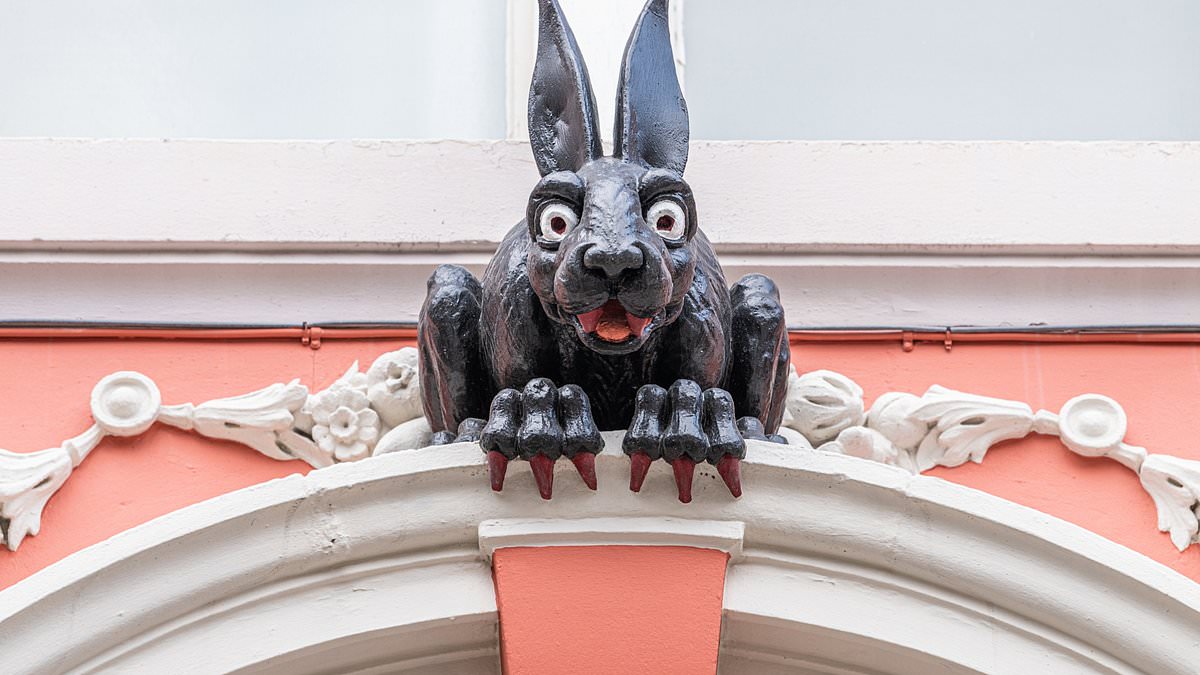
Statues are often iconic artworks designed to commemorate and remember significant places, people or events – but sometimes, the results are rather less positive.This week, an artwork in seaside town Bournemouth has come under fire – declared by residents as simply 'an eyesore'.Lashing out at the £54,000 sculpture, locals have complained that the artwork resembles 'some rusted metal with a head on top'. However, it's not the first time a public art installation has caused a fuss in the UK.From a politically charged shark statue in Oxford to a giant spoon in Northumberland and a so-called 'traffic light tree', many sculptures across the country have come under fire from the art police – and the general public.Here's our rundown of the worst offenders – do YOU agree? Lean into the Wind, Bournemouth An 'eyesore' clifftop art sculpture has been branded a giant waste of moneyThe clifftop artwork overlooking Bournemouth beach has been installed to 'reflect the town's seaside identity' and was 'inspired by the unique coastline'.According to the Liberal Democrat-run council, the sculpture was created in part by using schoolchildren's ideas.The statue appears to show the figurehead of a ship mounted on a bronze metal plinth, with three posts behind it possibly resembling Bournemouth pier.However, residents have reacted with fury over the artwork, situated on the town's West Cliff, which they branded a 'pile of scrap metal'.Pointing to the homelessness problem in the town, angry locals lashed out at Bournemouth, Christchurch and Poole Council for spending £54,000 on the 'eyesore' instead of funding people in need.One resident said: 'Are you actually joking! There's people starving, people on the streets, [...] horrendous road works, roads being made worse and you're putting up sculptures no one asked for, no one wanted, looks absolutely pathetic.'Absolute waste of money! You should be absolutely ashamed of yourselves!'Dead Tree Sculpture (The Tree of Life), Kirkby, Merseyside The sculpture of a dead 400-year-old tree was designed to breathe new life into KirkbyKnowsley Council faced major criticism back in 2015 after commissioning a divisive sculpture of a dead tree, thought to have cost up to £60,000 – but has defended the artwork as 'absolutely spectacular'. The six-metre iron sculpture, called 'The Tree of Life', was put up in Kirkby town centre in Merseyside after supermarket giant Tesco pulled out of plans for a new store in the area. Knowsley Council declared the piece 'absolutely spectacular', but many have taken to social media site Facebook to call it a 'monstrosity'. This summer, one visitor wrote on Tripadvisor: 'Silly art. A load of nonsense, isn't it.'Others are divided, though, with one commenting: 'The Dead Tree Sculpture (Tree Of Life) is a really interesting piece of street art... its got a story behind it and it's quite pleasing on the eye and adds a bit of character to Kirkby Town Centre. It's most definitely well worth a few minutes of your time if you're in the area.'The Meeting Place, St Pancras, London Up next is the Meeting Place bronze sculpture by Paul Day at St Pancras International The Meeting Place is a nine-metre-high, 20-ton bronze sculpture at London's St Pancras railway station. But over the years, since it was unveiled in 2007, it has become controversial.The sculpture, which depicts a couple embracing, has been shunned by art critics as overly sentimental and cliche.'Horrifying and terrifying. I keep having nightmares. A smaller intimate sculpture would have been perfect. Some people have phobias and seeing it there was scary. I'll never leave out of that station again,' one Tripadvisor review read.The Headington Shark, Oxford The Shark House has been controversial since it was erectedThe famous four-bedroom, four-bathroom property in Headington, Oxford, also known as The Shark House, is next on the list.It became one of the most famous and photographed homes in Oxford after the Jaws-like structure was erected to protest against warfare and bombing. The shark sculpture is an impressive 25ft of steel and fibreglass which 'crashes' through the roof.With the help of a crane, it was installed head first one morning at dawn.The Shark House was created by writer Bill Heine and sculptor John Buckley and erected on August 9, 1986. It was, according to Bill Heine, his way of expressing how someone can feel 'totally impotent and ripping a hole in their roof out of a sense of anger and desperation'.It has been controversial since its conception, having been erected overnight without planning permission, becoming the subject of a dispute spanning six years over whether it should remain or not.Oxford city council argued the inanimate shark was a danger to the public but it was later found to be safe.The council then said it needed to be taken down because it constituted a development.A retrospective planning application for the unique installation was declined in 1990 and it was only given permission to stay after Mr Heine appealed to the Secretary of State for the Environment in 1992.Having been erected on the anniversary of the second atomic bomb being dropped on Nagasaki, the Shark House was intended to be an anti-nuclear and anti-war art work.At the time, Mr Heine said: 'The shark was to express someone feeling totally impotent and ripping a hole in their roof out of a sense of impotence and anger and desperation…. It is saying something about CND, nuclear power, Chernobyl and Nagasaki.' Couple, Newbiggin-by-the-Sea, Northumberland 'Couple' by British artist Sean Henry in Newbiggin-by-the Sea has been branded 'creepy'What could be so bad about Couple, the UK's first permanent offshore sculpture by Sean Henry, which depicts partners staring out at the sea?Apparently, rather a lot. The statue, situated in Newbiggin-by-the-Sea, Northumberland, is made from bronze and steel and modelled on real people. But while some love it, others remain unconvinced.'Kitsch', 'sentimental', 'tacky' and 'creepy' are just some of the words that have been used to describe the sculpture over the years. One visitor wrote: 'A blot on the landscape. An ugly statue on an ugly plinth which you can't avoid seeing and which spoils the view from the beach.' Brick Train, Darlington Joining the list is Brick Train, located on the outskirts of DarlingtonTrain (or 'Brick Train' as it's best known), by Scottish artist David Mach, is located next to the A66, in a shopping area in Darlington. It was commissioned by the local council and unveiled in 1997. The sculpture was made of 185,000 bricks, modelled on the famous locomotive, Mallard, which broke the world speed record for steam in 1938, and is 7m high and 29m long.However, the train sculpture has been controversial, with some locals arguing it was an 'inexcusable waste of money'.One visitor wrote in 2022: 'I truly don't understand the appeal.'Another said on Google Reviews last year: 'It's a disgrace, it needs demolishing.'The Traffic Light Tree, London Joining the list is The Traffic Light Tree, LondonTraffic Light Tree is a public sculpture in between Poplar and Blackwall dating back to 1998.French sculptor Pierre Vivant designed the statue that is eight meters tall and consists of 75 groups of computer-controlled traffic lights.It aims to reflect the constant buzz and restlessness of the Canary Wharf area in the UK capital.Visitors, however, have proven to be less keen. 'By far one of the dumbest (and most hazardous) pieces of art in human history. Whoever thought it would be a good idea to put a hundred flashing traffic lights on a roundabout was bonkers,' one wrote.Another described it as a 'horrible eyesore', while others said it was a 'seriously stupid idea' and a 'total disappointment'.The Vampire Rabbit, Newcastle The Vampire Rabbit provides a creepy welcome The Vampire Rabbit or Rabbit Gargoyle is situated at the rear entrance to the historic Cathedral Buildings, adjacent to Newcastle Cathedral. It's particularly creepy and grotesque to look at, and there are many tales of its origins, with some saying it was used to scare away grave robbers at the Cathedral.It has been painted black and seems to have fangs and blood dripping from it, giving it an eerie appearance. Cramlington's Giant Spoon, Northumberland The Cramlington's Giant Spoon in Northumberland is up nextOfficially named 'Eat For England', The Giant Spoon (as it's more commonly known) is just that: a 4.5m spoon situated in a field.It was part of a public art and design initiative connecting Cramlington and the villages of Seghill and Seaton Delaval. The artist believed that a place where food is produced was the best place to locate the giant spoon. Not everyone has been convinced, though.Reviews over the last few years have said things such as 'such a waste of money', 'odd' and: 'It's a long drive and a long walk to see this giant spoon. The photo on Google is more than enough.'Sculpture for Mary Wollstonecraft, London Rounding out the list is the controversial Mary Wollstonecraft sculpture by Maggi HamblingA controversial statue of a naked woman celebrating the 'mother of feminism' Mary Wollstonecraft rounds out the list.Artist Maggi Hambling's design, which depicted a nude figure atop a 10ft 'swirling mingle of female forms', was unveiled in Newington Green, north London in 2020.But she was bombarded with criticism online as feminists asked why the figure atop the £143,000 statue had to be naked, while others complained it looked nothing like Ms Wollstonecraft. The campaign's founder, Bee Rowlatt, told Sky News at the time: 'It's been a surprise to have so much backlash, the one thing I would hope people would realise, it's not just a naked figure, and I want to be emphatic that the naked figure is not Mary Wollstonecraft, it's not a statue of her.'
An enormous shark, a giant spoon and a 'terrifying couple'... As Bournemouth residents slam new local 'eyesore', we take a look at the UK's worst statues
Full Article
Original Source
Read the full article at Dailymail →KhanList aggregates and links to publicly available news content. We do not host full articles from third-party sources. Always verify important information with original sources.