
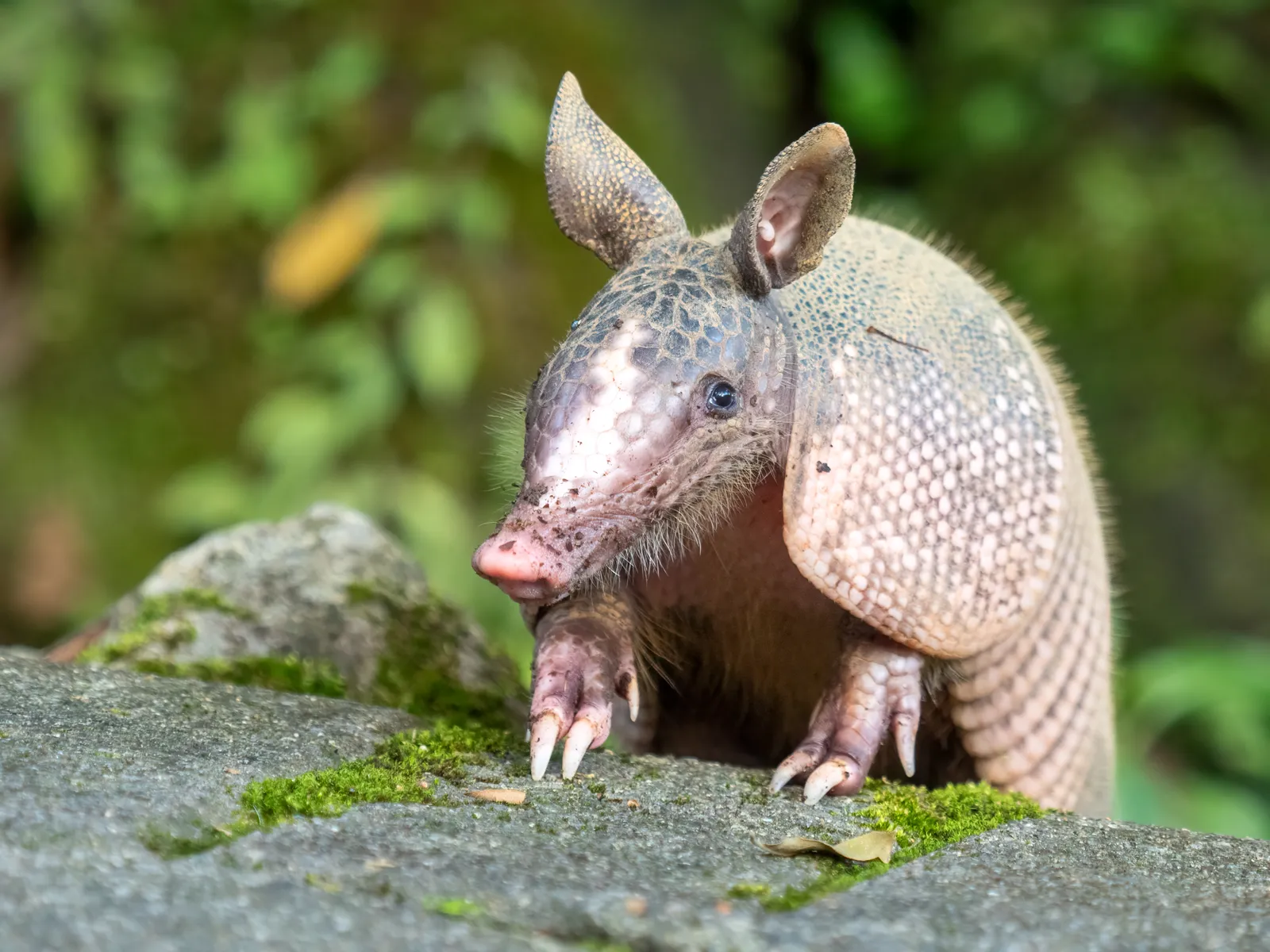
Typically spotted in the South and Southeast, the creatures have been reaching increasingly distant states like North Carolina, Virginia and Illinois as winters become milder September 21, 2026 1:56 p.m. A nine-banded armadillo in Costa Rica. The Mexican long-nosed armadillo, which is the only armadillo species found in the United States, used to be considered the same species as the nine-banded armadillo. Rhododendrites via Wikimedia Commons under CC BY-SA 4.0 When an Ohio resident spotted a roadkill armadillo earlier this month, she posted the discovery on Facebook. Researchers noticed the finding and rushed to the site. In more southern states, this would have been an unfortunate but common occurrence. In Ohio, it’s virtually unheard of. Over the past decades, scientists have tracked the armadillo’s steady northward crawl, from Texas to wider expanses of the South, Southeast and Midwest. Now, the recent discovery indicates that the mammals might soon gain a foothold in the Buckeye State. “I was hoping they were going to make it here,” Tereza Jezkova, a biologist at Miami University in Ohio, tells the New York Times’ Victor Mather. “I like armadillos.” Prior to this month’s discovery, Ohioans had documented four other armadillos, reports Newsweek’s Anna Skinner. But those were spotted far from the state’s border, so they had been written off as “hitchhikers” that might have stowed away on a vehicle, rather than making the journey on their own. This one, because it was found close to verified sightings in Kentucky and Indiana, is thought to have been the first recorded armadillo to naturally enter Ohio. Here’s what to know about the little armored creatures that may be coming soon to a state near you. The march of the armadillos Armadillos hunt for insects in the soil. Jim Mullhaupt via Flickr under CC BY-NC-ND 2.0 The Mexican long-nosed armadillo, formerly called the nine-banded armadillo, is the only one of the world’s 20 armadillo species that lives in North America. Once only found south of the United States, the animals moved across the Rio Grande in the mid-1800s, passing from Mexico into Texas. From there, they generally expanded north and east, reaching Louisiana by the 1920s and Kansas by the 1940s. They have a unique ability to cross bodies of water. Capable of holding their breath for up to six minutes, armadillos might dig their claws into the streambed and walk underwater to ford narrow creeks. Wider rivers pose a different challenge, but the animals are still equipped to face them: They’ll inflate their intestines to raise their buoyancy, then paddle across. They may also hitch rides on vehicles and cross bridges to expand to new areas. Early studies on the animal’s movements anticipated there would be limits to their survival, due to drier conditions out west and colder temperatures up north. Last year, a paper in the journal Diversity suggested the mammals had already pushed past the predicted limits. Armadillos are established or frequently occur in 17 states, per the paper, with occasional sightings in four others (including Ohio). This expansion has seemingly been driven by climate change bringing milder winters, shifts in land use and at least one human-caused release of the creatures, which happened in Florida. What’s more, armadillos in the U.S. seem to have broader diets compared to those in South America, as Anderson Feijó, assistant curator of mammals at the Field Museum and a longtime armadillo researcher, told WTTW’s Patty Wetli last year. “This might help explain why they were able to so successfully colonize areas that were not common to them,” he said. “The armadillos in the U.S., they eat not just insects but a variety of food they can find in their environment,” including roots and fruits. Did you know? The pink fairy armadillo The world’s smallest armadillo species is the pink fairy armadillo, which typically grows no more than six inches long. With a furry body, large front claws for burrowing and a rosy, scaly carapace on its back, the tiny creature looks like a nigiri with legs. The creatures are also breeding machines: They nearly always have litters of four—identical quadruplets that come from the same fertilized egg that splits in the womb. Armadillos typically breed every year. A live armadillo was first recorded in Iowa in 2017. Then, in 2021, scientists published the first verified records of alive, free-ranging armadillos in Virginia. Experts predict that armadillos will be in all 100 counties of North Carolina within 10 to 15 years, and in Chicago within a decade. “The predictions are that with the current climate conditions, they’re going to keep expanding, and they might even get up all the way into New England,” David Mizejewski, a naturalist at the National Wildlife Federation, told Axios’ Sareen Habeshian in 2023. Is there cause for concern? An armadillo in Aubrey, Texas Rich Anderson via Flickr under CC BY-NC-SA 2.0 When people hear about armadillos, one fear that tends to emerge is leprosy. It is true that the critters can carry the bacterial disease, but the risk of transmission to humans is low. “I use this advice for any wildlife: Don’t go licking it. That will save you from leprosy,” Courtney Hayes, a wildlife biologist with the Kentucky Department of Fish and Wildlife, said about armadillos to WPLN’s Giselle Rhoden in June. “And also, just don’t touch them. There’s no need.” Another aspect of armadillos that can raise red flags from residents is their propensity to dig. With their strong leg muscles and long front claws, the mammals will root through soil in search of insects and create extensive burrows that can reach several feet underground. This behavior can damage gardens, agriculture, building infrastructure or golf courses. A really persistent armadillo on a property might have to be trapped and relocated, and some homeowners have taken to shooting them. The burrows have positive effects, too. In a 2022 study in Arkansas, researchers used motion-triggered cameras to find 64 other species interacting with armadillo burrows—19 mammals, four reptiles, one amphibian and 40 birds. These underground cavities can offer opportunities for shelter, foraging, hiding or reproduction to animals across the ecosystem. Armadillos are generally not considered an invasive species. But the exact impacts of their expansion are still being parsed out. “It’s hard for me to believe that they aren’t having some substantial impact on something, but no one has done the research to show it,” Daniel Simberloff, an ecologist and evolutionary biologist at the University of Tennessee, told Popular Science’s Lauren Leffer in 2024. “There’s little doubt that many invasions do have impacts.” Jezkova of Miami University tells WLWT’s Brian Hamrick that she doesn’t believe armadillos will cause harm to other species in Ohio. As they move, however, armadillos themselves can face risks, and one of the biggest will be traffic. The creatures have very poor eyesight, instead navigating by smell. Their eyes also don’t shine like those of a deer, so they’re difficult for drivers to spot at night. Although they are small enough that a car can pass over them, armadillos jump three to four feet into the air when startled, which might lead them to hit the undercarriage or bumper of a vehicle. (The stereotypical armadillo defense, curling into a ball, is only used by three-banded armadillos.) Still, the Mexican long-nosed armadillo has a stable population and is considered a species of least concern for conservation. Armadillos, unlimited An armadillo walks in Santa Ana National Wildlife Refuge in Texas. Melissa McMasters via Flickr under CC BY 2.0 Over the years, people have suggested several barriers to armadillos that might limit their northward trek. With little fur and body fat, the animals were thought to easily succumb to cold. But by sheltering in a den, for instance, they might be able to withstand lower temperatures than thought—perhaps as low as 17 degrees Fahrenheit on average. And when snow coats the ground, people suggested that armadillos would not be able to find food, since it could prevent them from digging. But on that front, the animals are seemingly adaptable, too. “There has been a lot of expectations of how north they could go, and every time, the armadillos are able to move up and up,” Feijó told WTTW. He notes that some species of armadillo in South America can survive high in the Andes Mountains. As armadillos keep creeping up through the eastern states, and climate change continues to shift weather patterns, researchers are again asking where the limit to their movements might lie. The animals seem poised to keep expanding north, and there’s no indication yet of just how far they’ll make it. “They need to stop sometime,” Jezkova tells the New York Times. “But so far, they keep going.” You Might Also Like Get the latest stories in your inbox every weekday. More about: Animals Arkansas Climate Change Conservation Ecology Georgia Illinois Invasive Species Iowa Mammals Nature North Carolina Ohio Texas Virginia Wildlife
An Armadillo Found in Ohio Is the Latest Surprise in the Armored Animals' Expansion North. Where Are They Now, and What's Driving Their Movement?
Full Article
Original Source
Read the full article at Smithsonianmag →KhanList aggregates and links to publicly available news content. We do not host full articles from third-party sources. Always verify important information with original sources.