
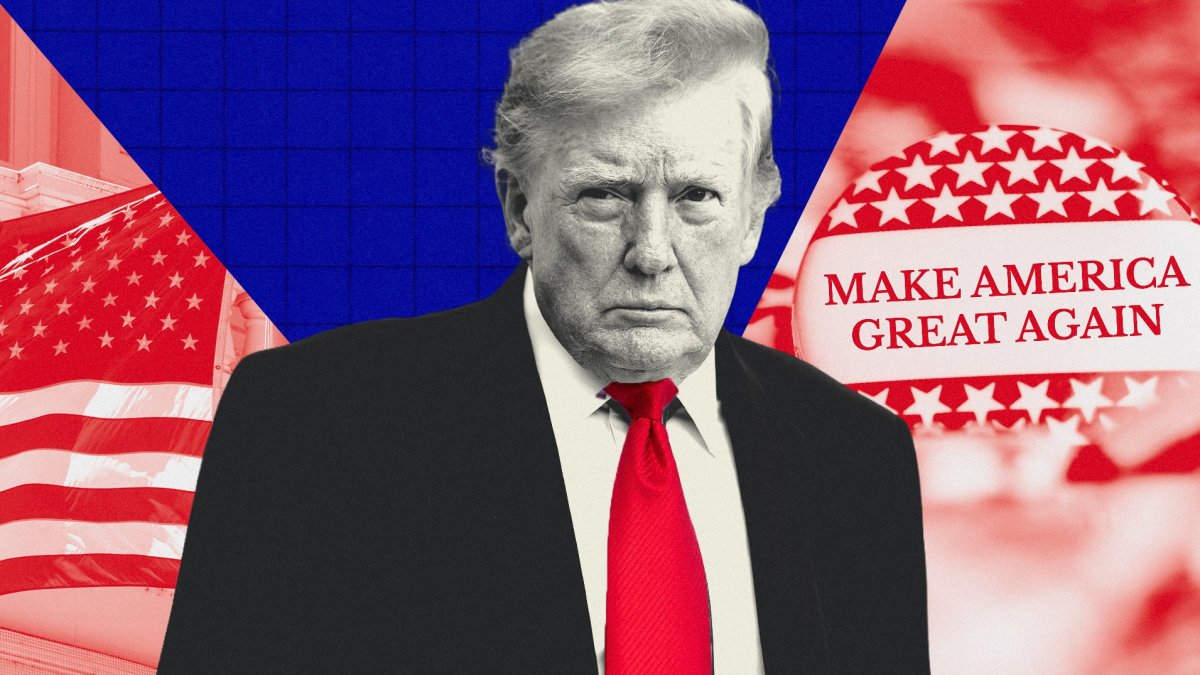
If the polls are proved right, Donald Trump faces a damaging set of midterms results. This could change the balance of power. Will Trump be a lame-duck President, or will he be emboldened to rule by executive order? For some, the last two years of Trump’s presidency have swept away the norms which for decades held presidential power in check. But others see that he is finally being restrained by the system – and that his authority is ebbing away. So, is America’s democracy about to crumble? The BBC’s former North America correspondent and ‘News Agents’ co-host, Jon Sopel, and former chief of staff of the US Department of Homeland Security during Trump’s first term, Miles Taylor, give their perspectives. The American democracy we grew up with isn’t about to crumble. It already did. And I can tell you when. On the evening of Saturday 20 September 2025, Donald Trump posted a message on Truth Social that began with a single word: “Pam”. We later found out it was meant as a private note to his attorney general, Pam Bondi. Evidently he pressed the wrong button, and the world watched a president instruct his chief law enforcement officer to prosecute James Comey, Letitia James and Adam Schiff, three people who had committed the “crime” of crossing him. Justice, he wrote, “MUST BE SERVED NOW!!!” Five days later, Comey was indicted. James followed within three weeks. Meanwhile, Schiff was already being investigated. That was the night I called time of death on the rule of law in America. I used to work for Donald Trump, and I saw plainly that he’d crossed a line that he’d been eyeing since his first term. Plenty of presidents have wanted their enemies charged with crimes. The difference was that this president had actually issued such an order in writing, and rather than resist him on constitutional grounds, the machinery of the state carried it out.John Locke said it plainly: “where law ends, tyranny begins”. That phrase happens to be engraved in the stone exterior of the headquarters of the US Department of Justice in Washington, DC. Today, on the same side of the building as the Locke quote, a massive banner now hangs of the president’s scowling face with the words: “MAKE AMERICA SAFE AGAIN.” Trump’s September social media post meant the Justice Department had become an instrument of one man’s grievances. Philosophically, it meant something even more ominous. The worst may be ahead. Trump has two years of potential lawlessness left, a legacy he’s hellbent on cementing, and, after the midterm elections, a potentially hostile Congress to contend with. A man backed into a corner with the low click of a ticking clock doesn’t submit to fate. He lashes out. This month alone, his Justice Department sued to force California to set aside 20,000 mail ballots it said had to be reviewed for evidence of “state-facilitated voter fraud”, went to court to block certification of a Senate race if his candidate loses, leaned on Washington state to sideline ballots too, and refused to rule out a “doomsday scenario” of trying to block even more states from certifying votes. Meanwhile, FBI agents reportedly fear being asked to seize ballots, something Trump says he wishes he’d ordered the National Guard to do in 2020. I fully expect Trump to contest the midterm results he dislikes. But much more than that, I believe he will wield his powers to test whether he can ignore a court order against his directives, and see how the public responds. Will he have a supportive “stop the steal” following like in 2020? If so, he’ll be emboldened. In 2028, I suspect he’ll reach for the oldest page in the autocrat’s playbook and foment a national emergency to remain in office or to dictate the terms of transition. Yes, then. The constitutional order may be heading for an even more dramatic collapse than it’s already suffered, and Americans should stop being surprised by each new blow. But only a fool would call this the end. American democracy is already displaying signs of reanimation from the rubble. Look at what happened inside the system last week. On Tuesday, a grand jury in Washington refused to indict Cassidy Hutchinson, the former White House aide the president has wanted punished since her 6 January testimony. The same day, an FBI agent under cross-examination in a controversial case against two former bureau officials (accused of lying about Hunter Biden’s laptop) conceded he regarded the investigation as “political” and a “witch hunt” (and that it had been opened on the director’s orders the day after Trump attacked those officials in a televised address). Then on Wednesday, a federal judge in Los Angeles threw out the Trump administration’s effort to sideline those California ballots, writing that no administration in American history had tried to coerce a state into abandoning its own election procedures on the eve of a vote. Judges, juries, and even agents inside Trump’s own FBI are defying the democratic backsliding in ways large and small. These are the flickering signs of resistance, and they are multiplying on the inside. Far more importantly, the people themselves appear to have made up their minds. Gallup reported in September that 89 per cent of Americans believe government corruption is widespread, the highest figure since it began asking the question, including supermajorities of Democrats and Republicans. A Brennan Center survey found more than nine in 10 voters in every party calling corruption a serious problem. And a Fox News poll this month ranked it above inflation as voters’ top concern. I released a documentary film this month called CORRUPTIONLAND and did the research: “corruption” has never been the number-one issue for Americans in an election year, at least not since polling began in the 1930s. This is seismic. There will be flashpoints and setbacks and the continuous risk of failure. In the final two years of the Trump presidency, the president will keep on placing explosive charges around the foundations of the constitutional order, and Americans will race to dismantle those bombs and respond to the successful detonations with the hope that they can salvage what’s left. I don’t think Donald Trump is trying to destroy American democracy. He’s succeeding at it. But in succeeding, he’s uniting its rebuilders across the political spectrum in ways we could have never imagined. At this perilous moment in American life, you can hear citizens uttering a single word in unison through their gritted teeth: “No.”
America’s democracy has crumbled – but Trump hasn’t counted on one thing
Full Article
Original Source
Read the full article at Inews →KhanList aggregates and links to publicly available news content. We do not host full articles from third-party sources. Always verify important information with original sources.