
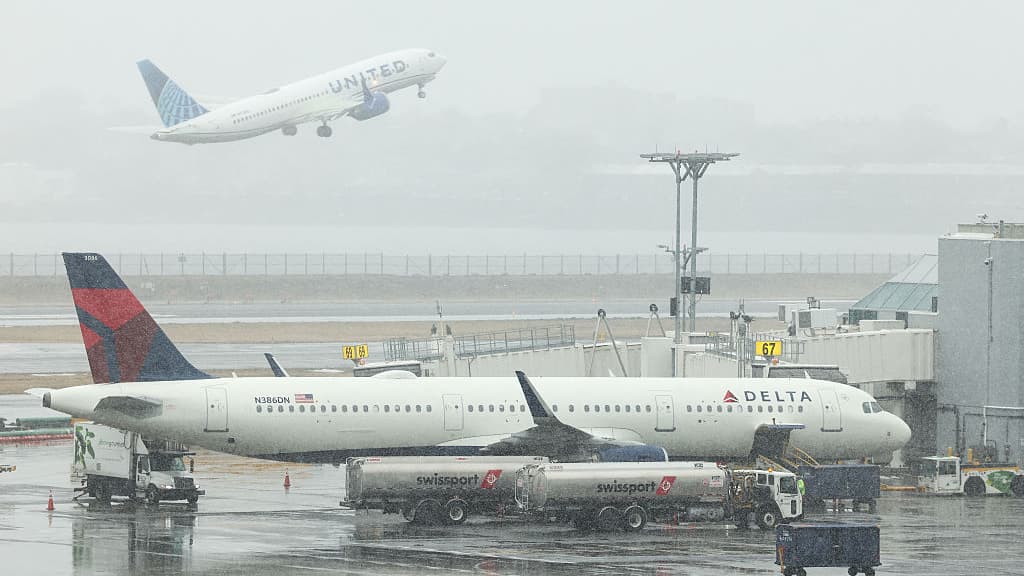
The U.S. is still reeling from a nationwide ground stop last Friday—the longest such flight stoppage in 25 years—which lasted more than four hours and resulted in more than 15,000 delayed or cancelled flights. And with Thanksgiving only a week away, the year’s busiest travel season is about to begin—bringing with it anxieties of further disruption.While nationwide ground stops like the one seen last week are rare, severe weather conditions are the most common triggers for local ground stops. As the world reckons with what is set to be the strongest El Niño in recorded history, combined with a potential cold-snap from the polar vortex expected next week, holiday travels this year could be at risk of more weather-related delays and cancellations. That’s in part because air traffic controllers in the U.S. are working with systems that are at least a decade older than those used by their counterparts in other countries. Last week’s incident, said Transportation Secretary Sean Duffy, was caused by equipment issues that destabilized air traffic control communication and radar systems during a routine network upgrade, exposing just how outdated the U.S.’s air traffic control systems are. “When I tell you that we're using old equipment, we're using old equipment," Duffy said during a press conference the day after the ground stop.For the most part, the system moves along well enough day-to-day. “I like to equate it like this—it takes a hammer to do the job, but they've given the air traffic controller a screwdriver to do it,” says Tim Kiefer, professor of air traffic management at Embry-Riddle Aeronautical University. “You can make a screwdriver work and get that nail in, and while it's not going to fit as well as it should, it works good enough that [improving the system] gets kicked down the road because the air traffic controllers are able and the pilots too are able to make this system work.” An outdated system then can become more vulnerable to disruptions, including poor weather conditions that have the potential to create cascading problems. When a ground stop is in effect, nothing is able to go into the air—including the weather balloons that help forecast weather conditions. “You get a lot of challenges with winter itself, but at the same time it all fits into this feedback loop of not being able to forecast well because you don't have the necessary information, but airplanes do need that information to take off,” says Mayra Oyola, assistant professor of atmospheric and oceanic sciences at the University of Wisconsin-Madison. Oyola also says that many of the rules pilots follow to navigate weather events might not work under our changing climate. Climate change is making storms stronger, as the atmosphere is able to absorb, and thus release, more water. One example is the rule of separation, which instructs pilots to stay 20 nautical miles from the center of a storm. “It might have been something that worked thirty or forty years ago, but it's not necessarily something that is working anymore, and we're seeing it,” she says—intensifying storms may require planes to stay even farther away. Oyola also adds that extreme turbulence cases are becoming more common. A 2023 study published by the American Geophysical Union found that severe clear-air turbulence increased by 55% between 1979 and 2020 because of warmer air temperatures, and noted that the skies are only going to get bumpier as climate change progresses.Air traffic control towers are also chronically understaffed, which means it takes even longer to recover from hiccups. “Even if the weather wasn't so severe as to stop aircrafts, but enough to cause an additional workload that the controllers aren't able to keep up with, they have to slow the system down and create the ground stops,” says Kiefer. This year’s El Niño could bring more unexpected challenges for flight crews. “We know that some of these storms are becoming a lot more dangerous. We know that this year in particular, we're dealing with one of the strongest El Niño events ever, and that basically means that you can have different weather patterns in different regions,” says Oyola. “You may have new crew that has never seen or has never experienced extremes that we may see in certain areas of the U.S.”While recent events might have many hoping it will prompt quick updates to the system, modernizing it is not something that can happen instantly, Oyola notes. “I don't think a modernization of an entire system can be done that harshly,” she says. “It’s something that needs to be taken into consideration and has to be done very carefully.” Before you travel, keep track of the weather, and turn on notifications from your airline so you’re up to date on any changes. Know that you might just have to wait. “We are seeing more of these ground stops and more of these delays because of [a number of] factors on an individual facility or airspace basis,” says Kiefer. “It might be thunderstorms today. It might be staffing tomorrow. It could be an equipment issue the next day.”
America's Aging Air Travel Infrastructure Isn't Ready for Climate-Fuelled Extreme Weather
Full Article
Original Source
Read the full article at Time →KhanList aggregates and links to publicly available news content. We do not host full articles from third-party sources. Always verify important information with original sources.